Publication: Cact. Succ. J. (Los Angeles) 36: 26, figs. 1964
Description
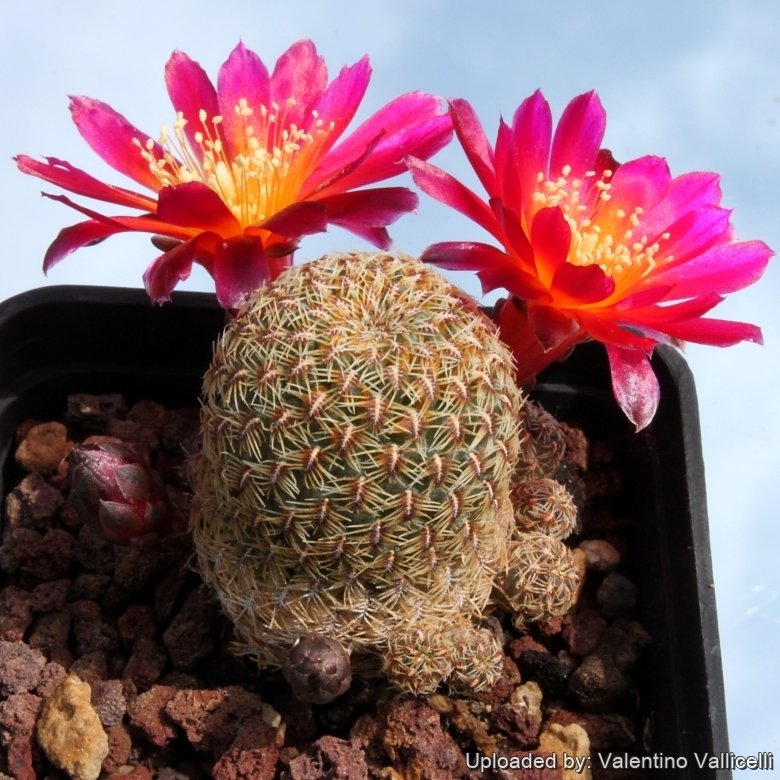
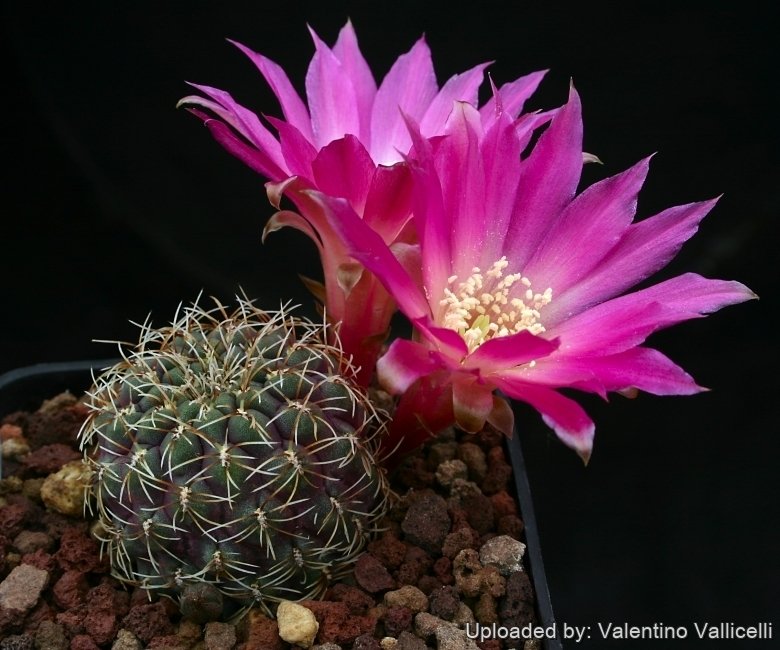
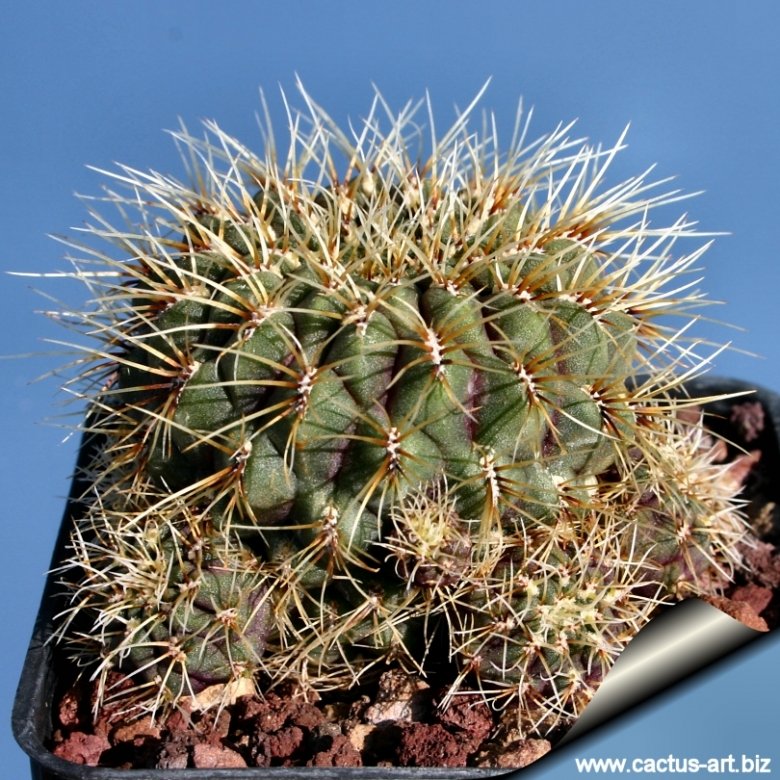
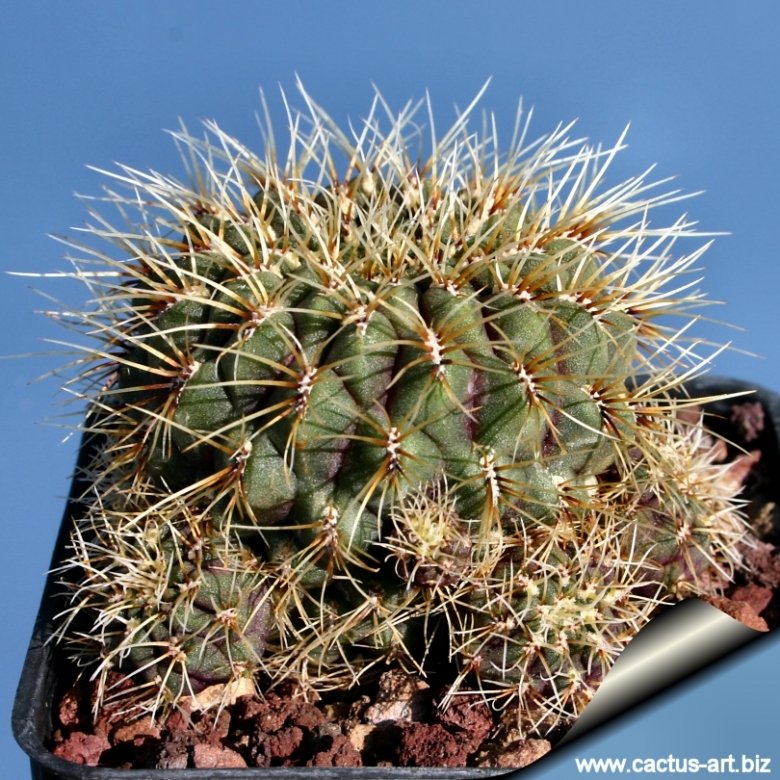
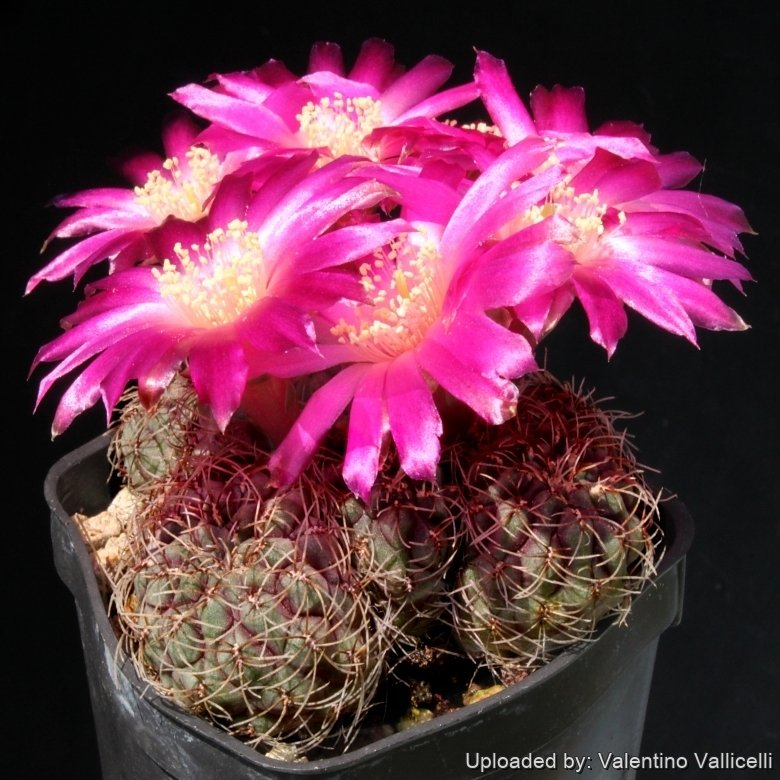
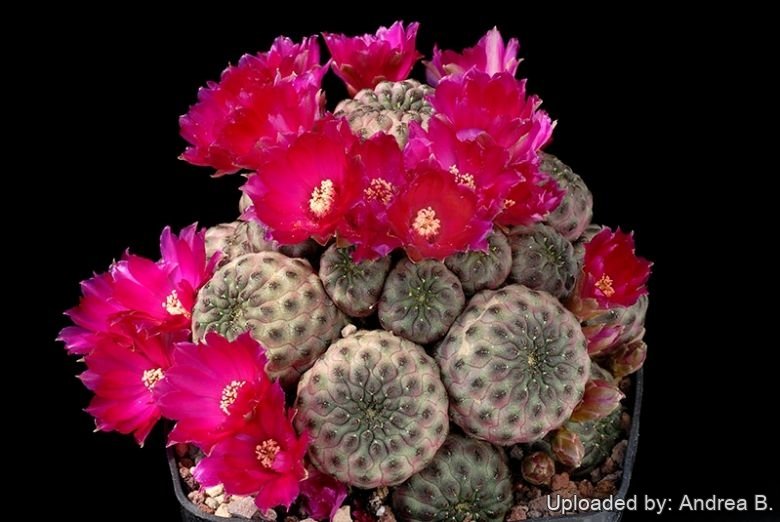
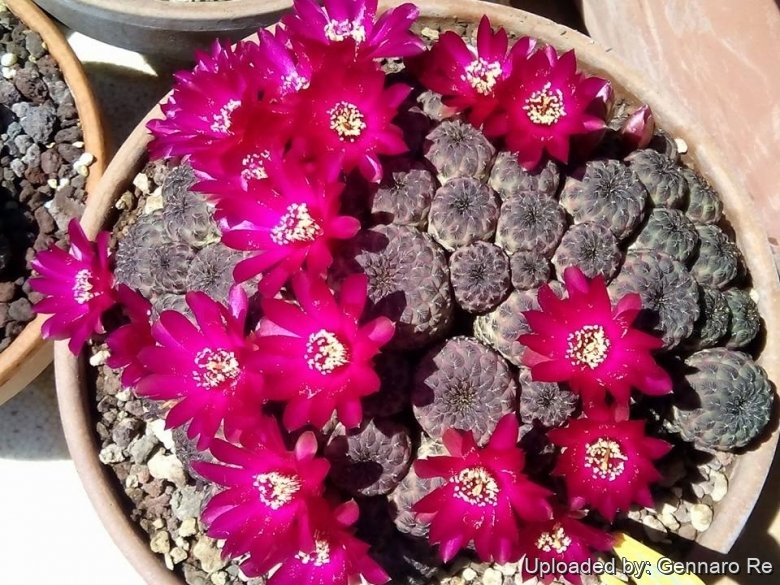
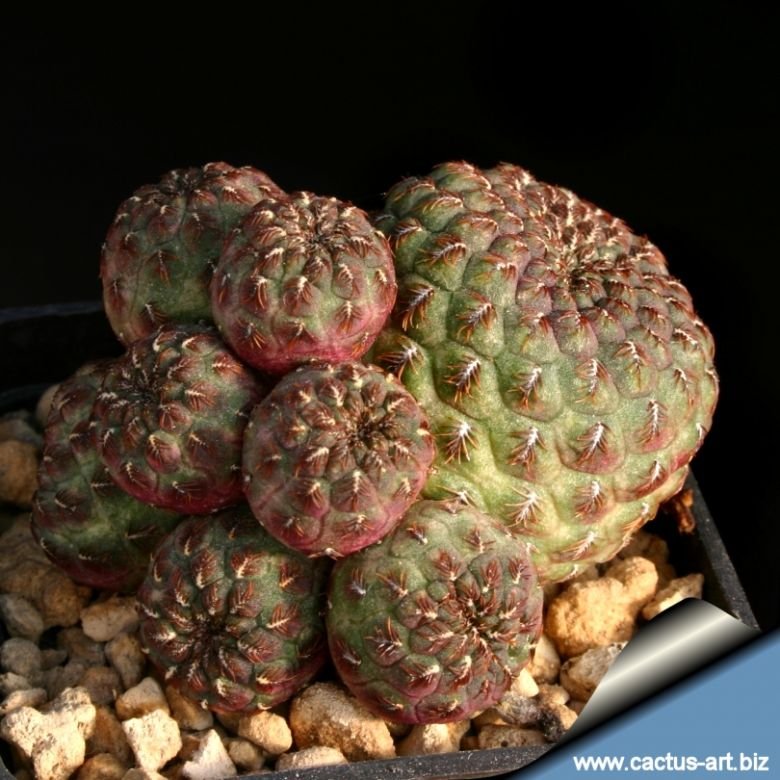
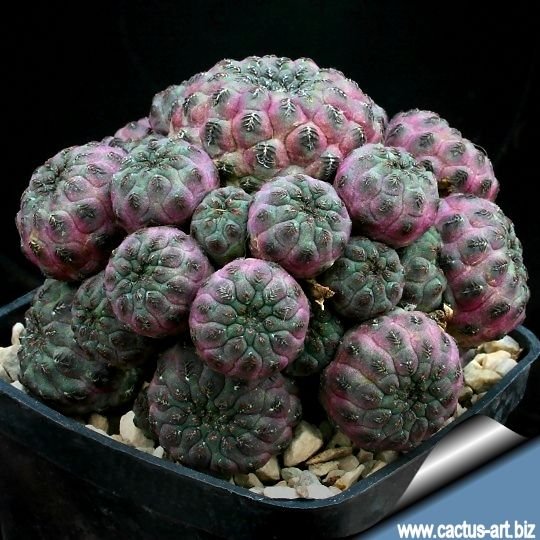
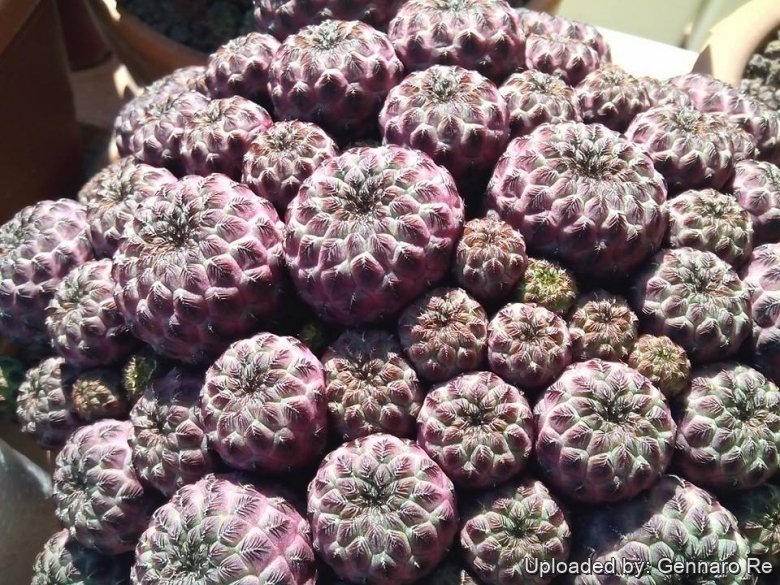
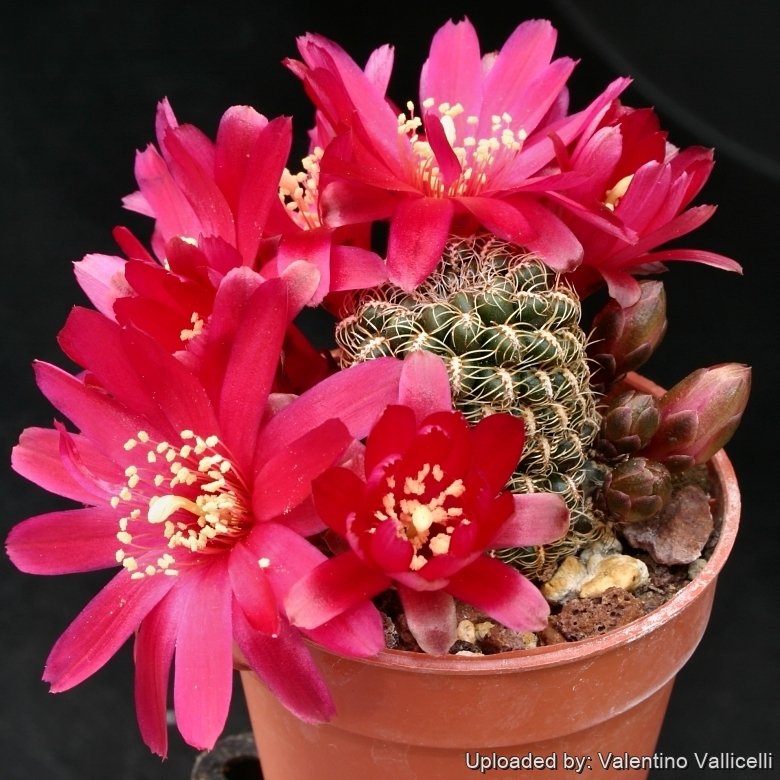
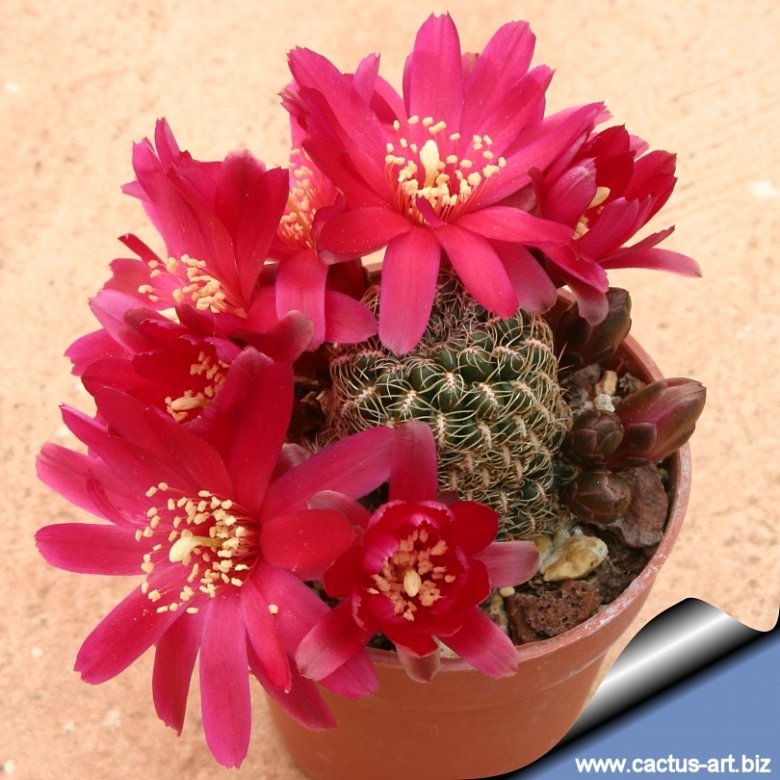
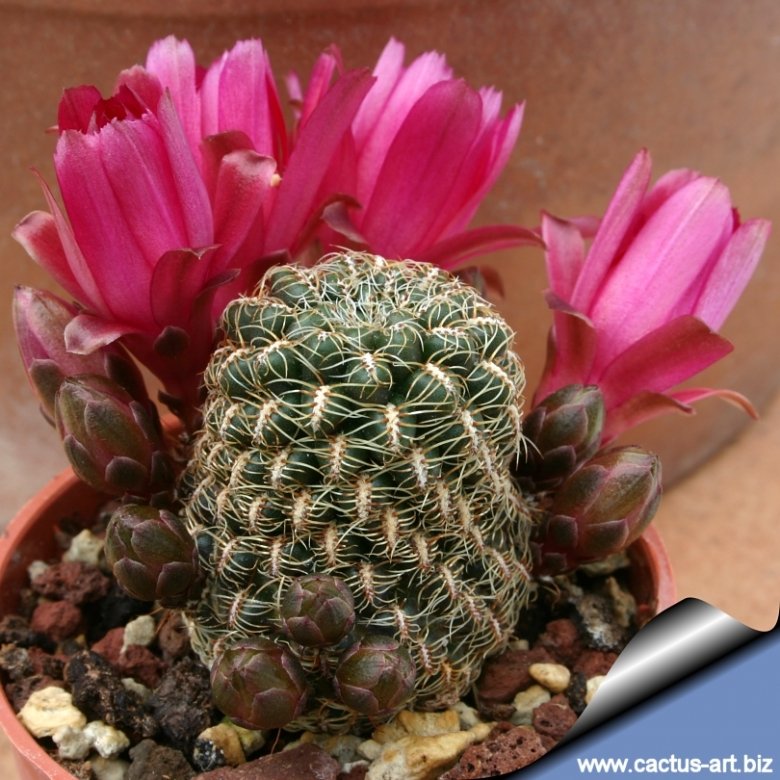
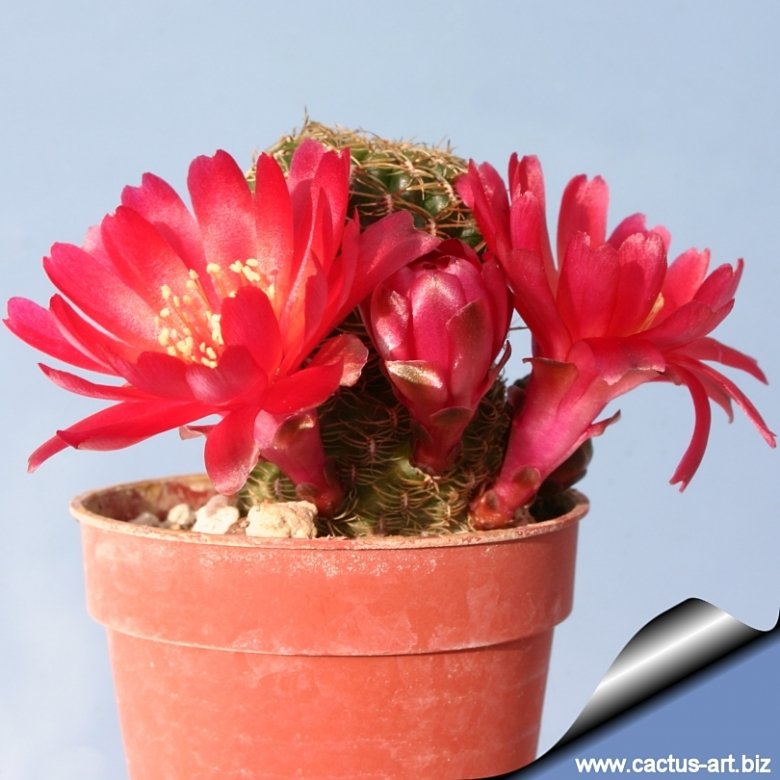
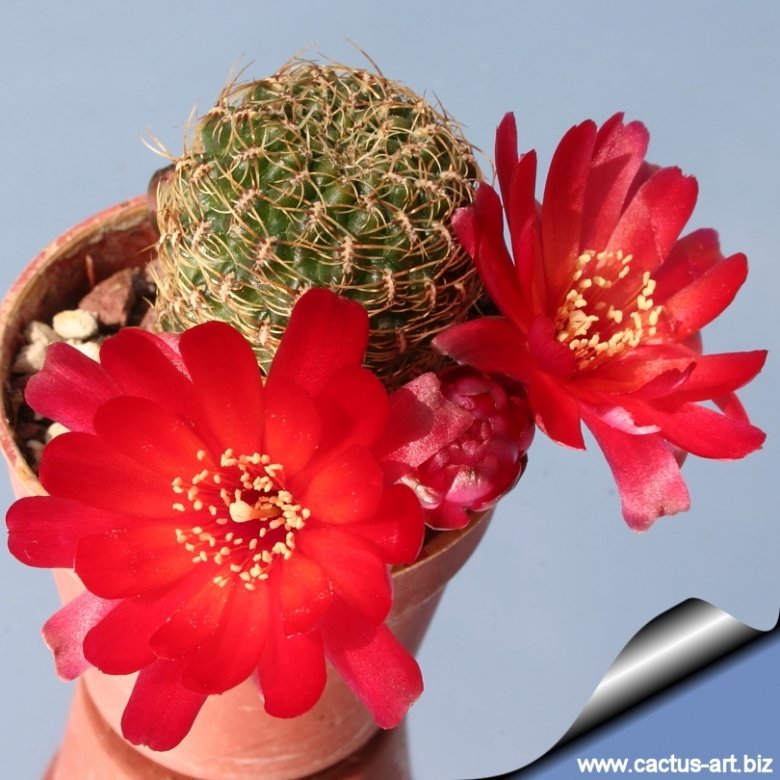
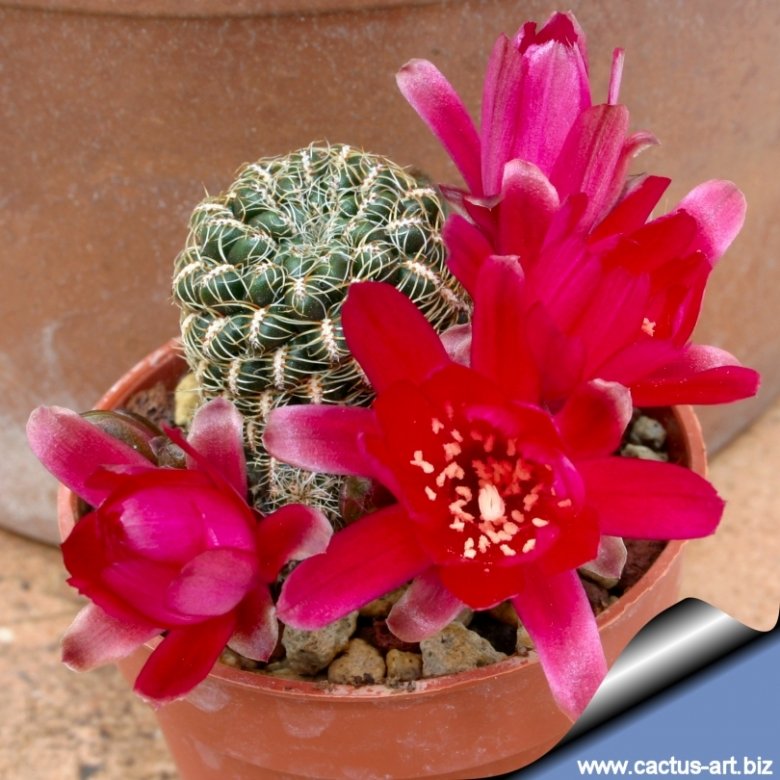
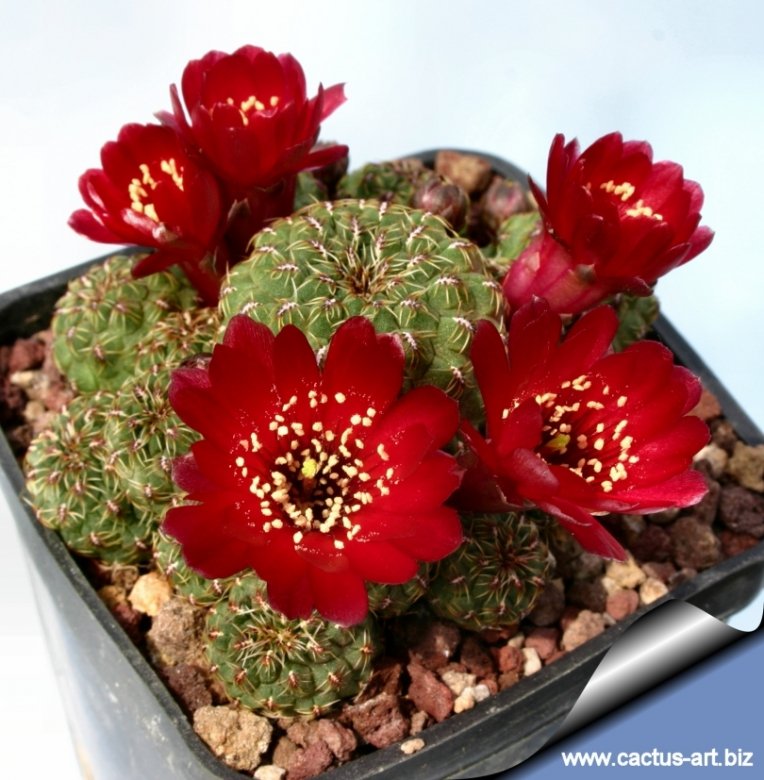
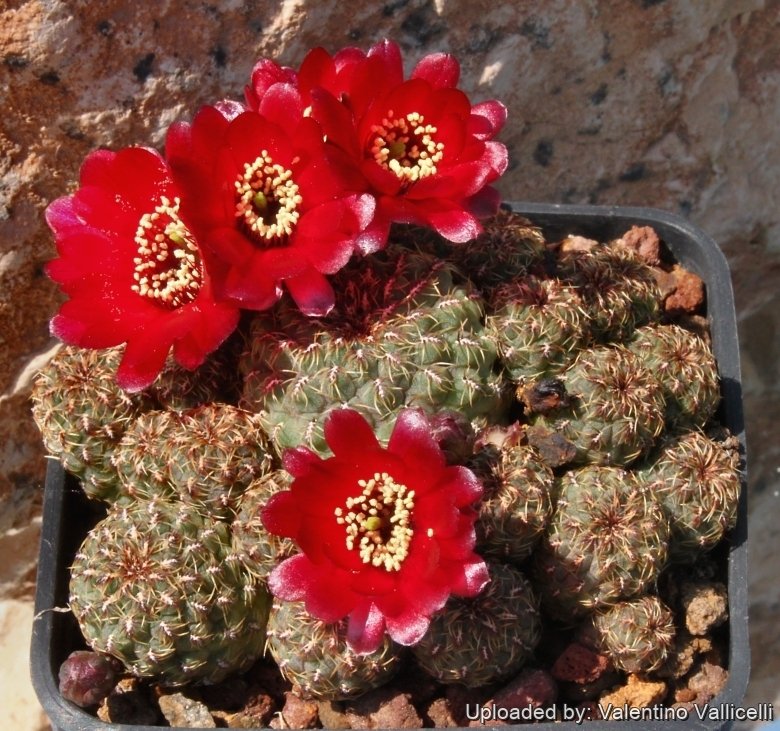
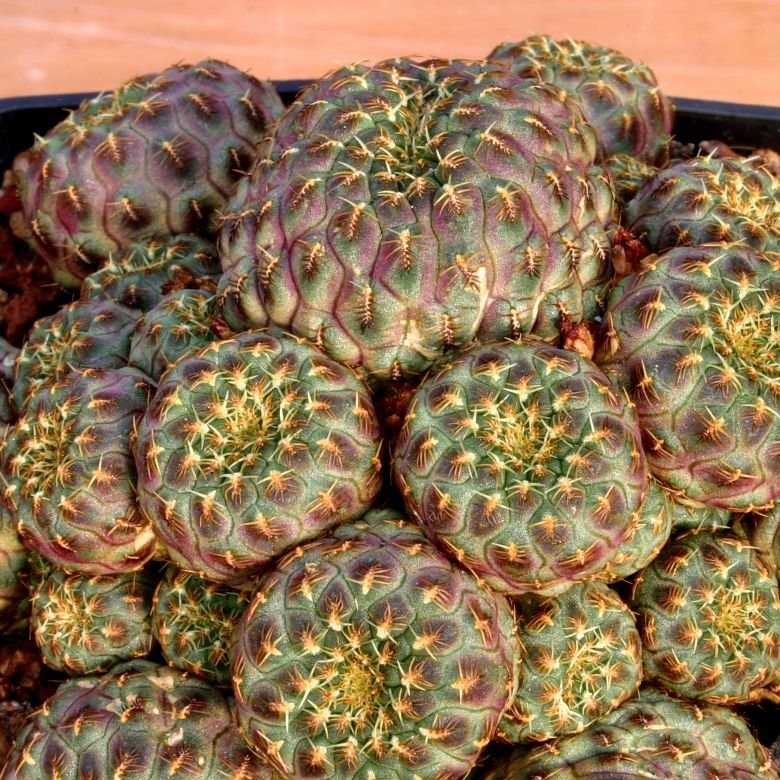
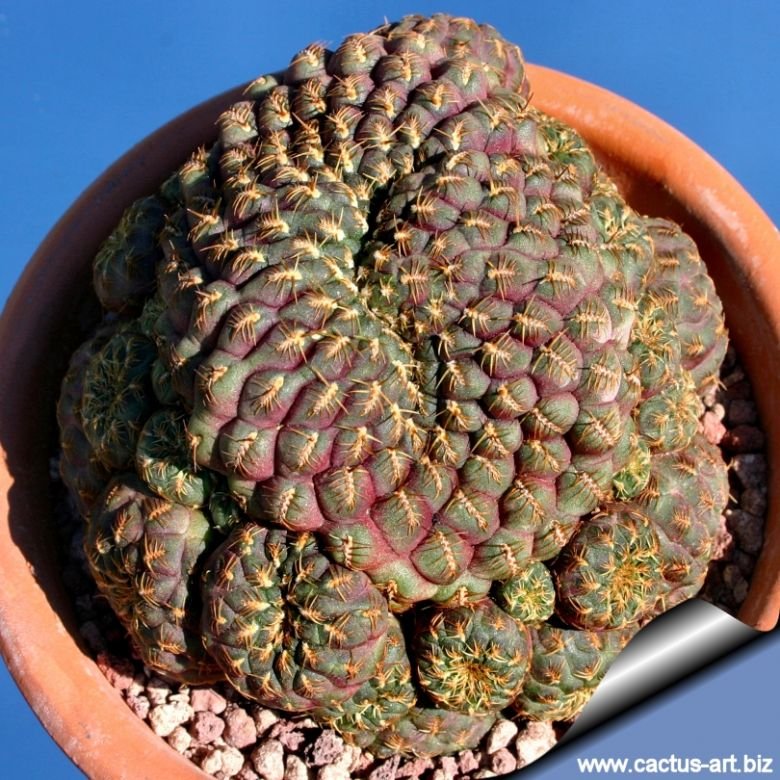
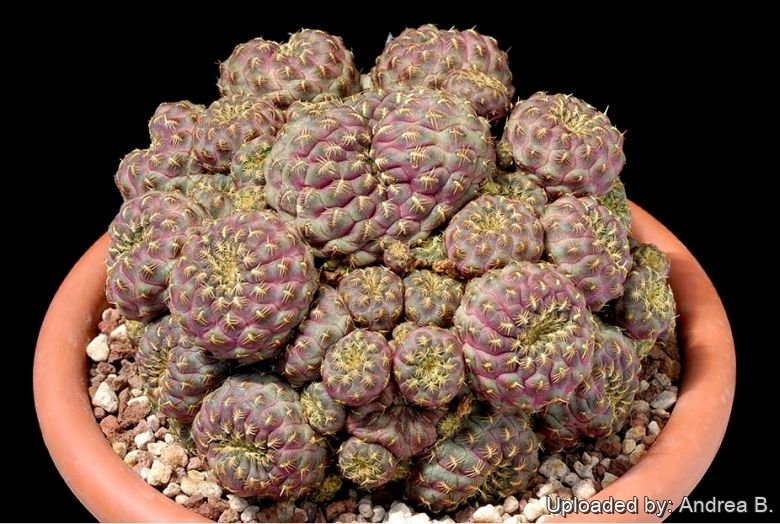
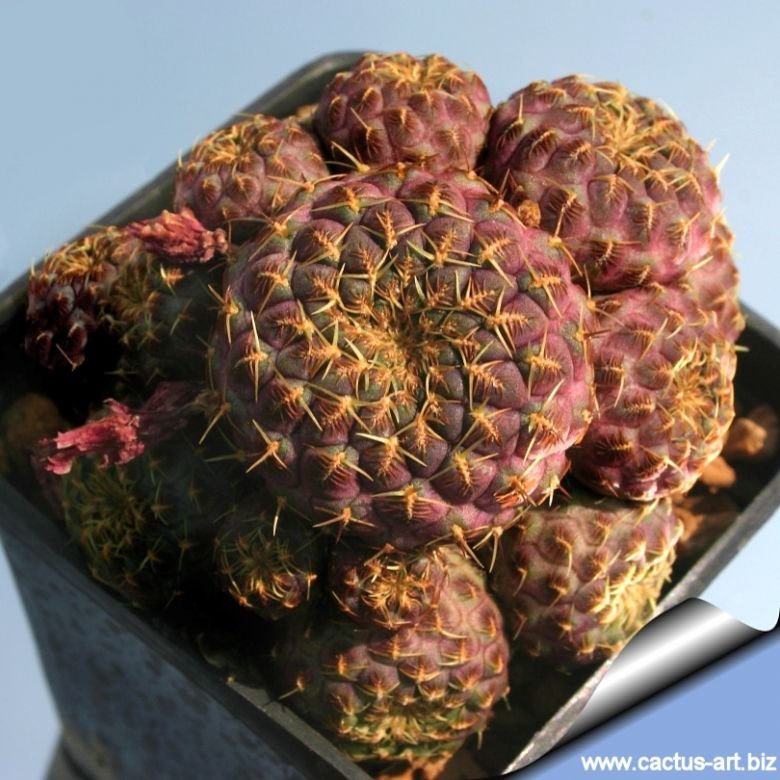
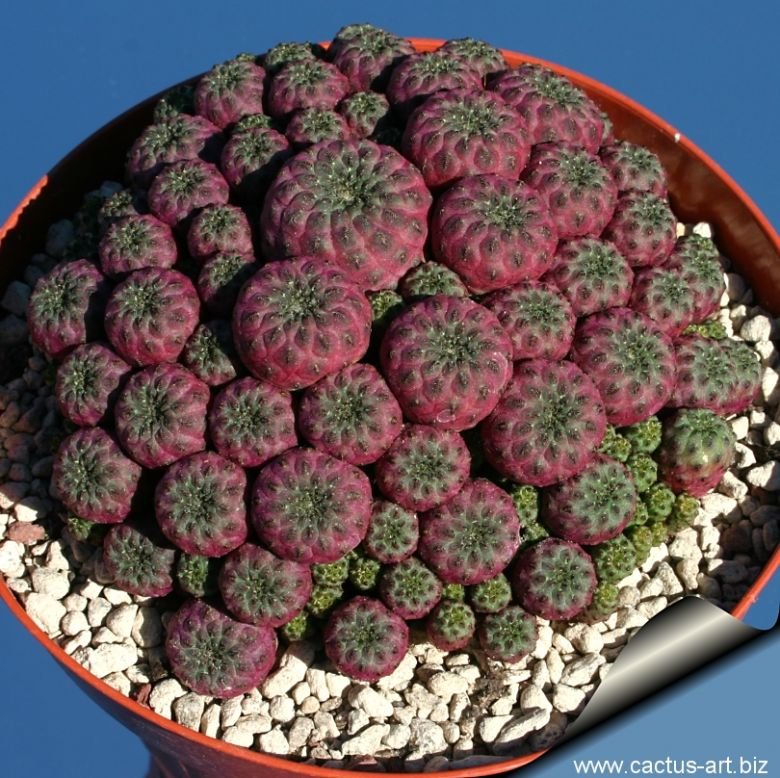
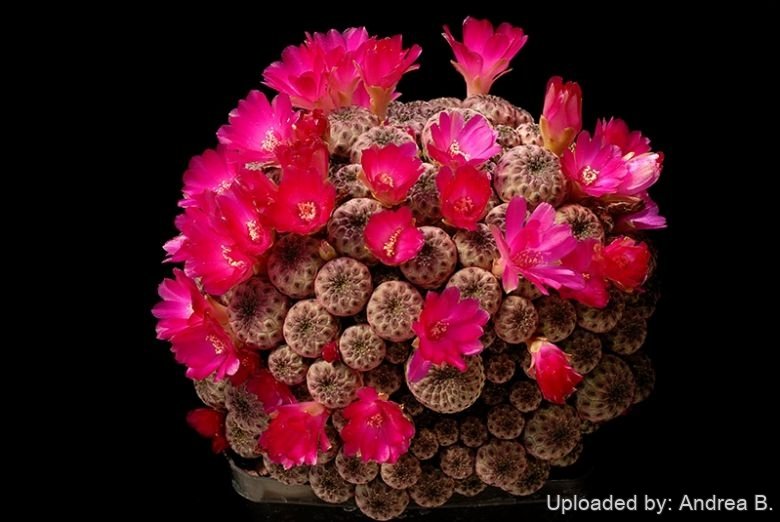
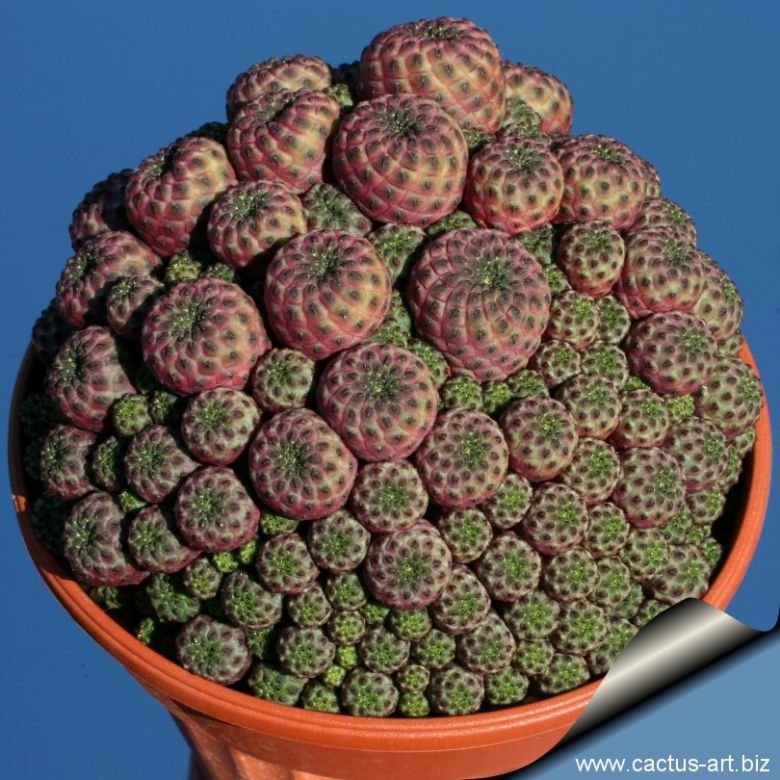
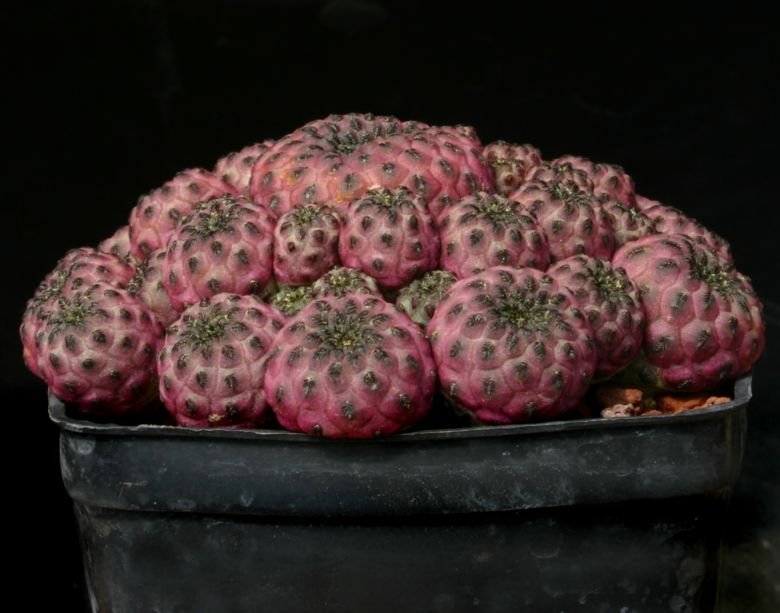
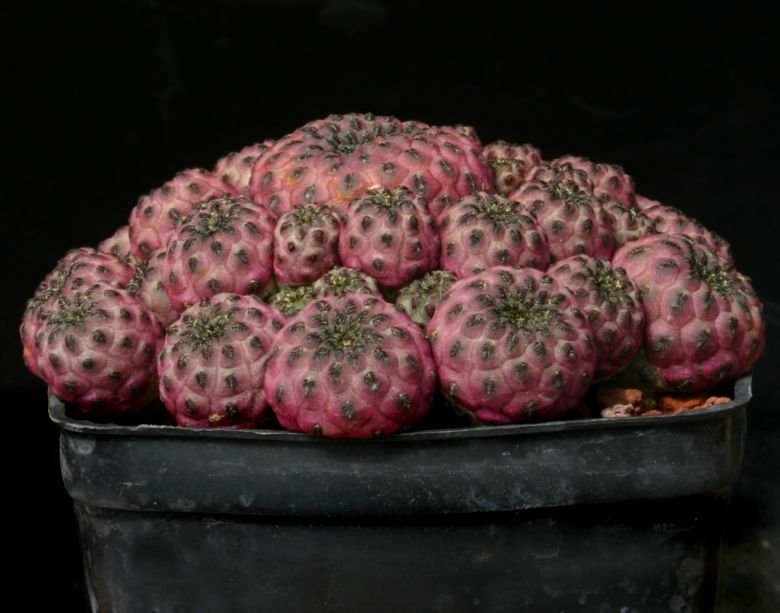
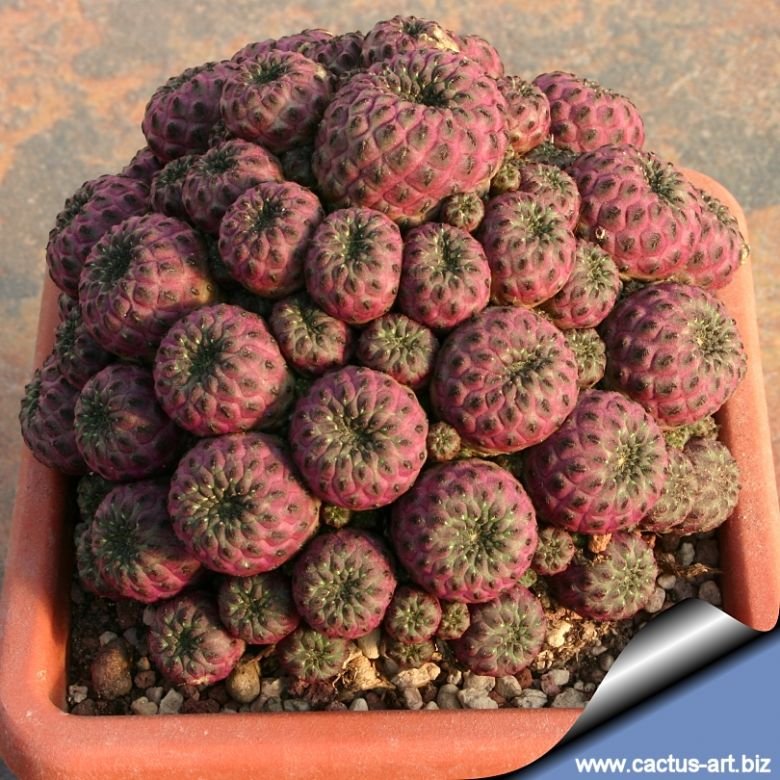
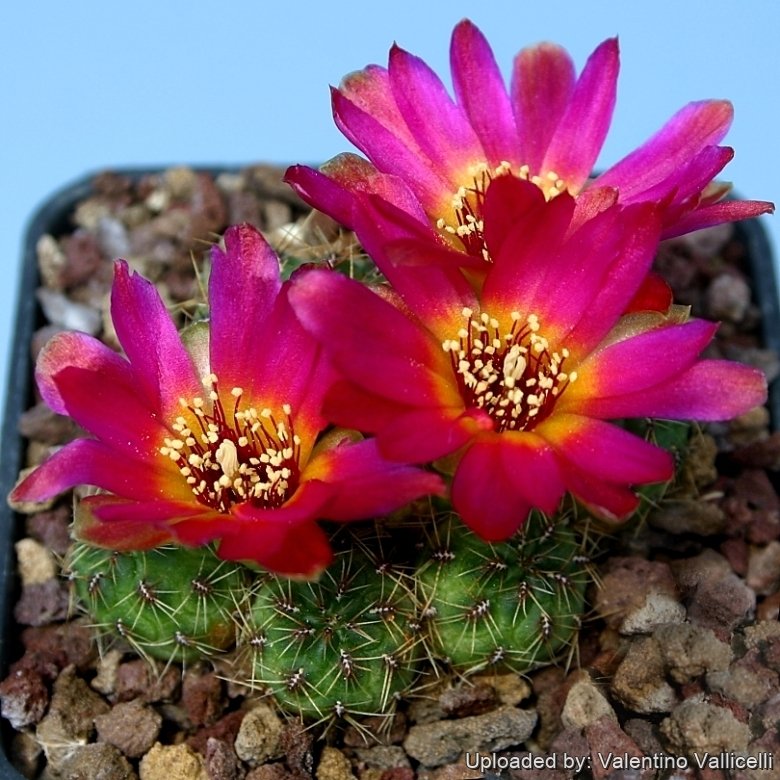
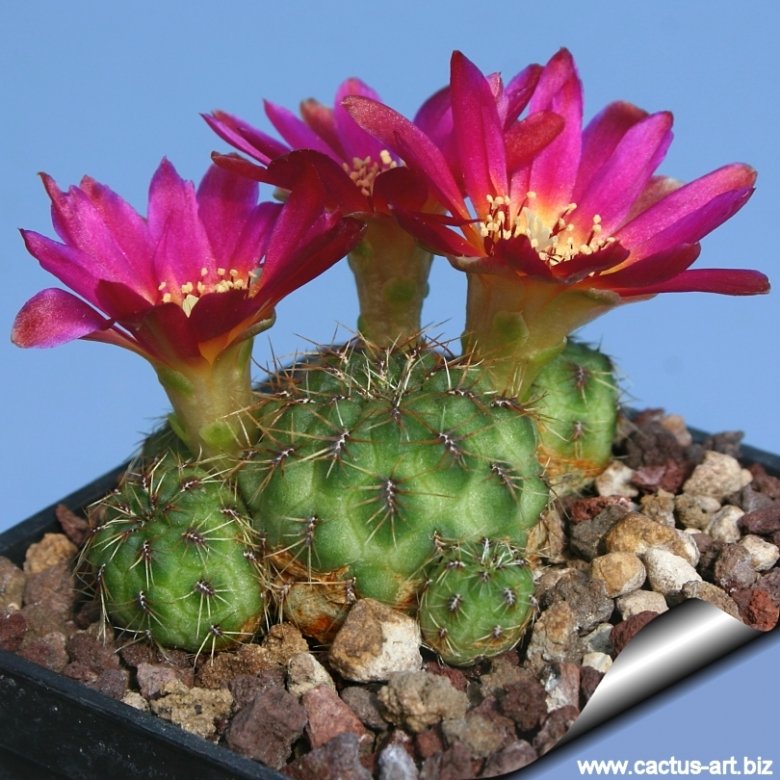
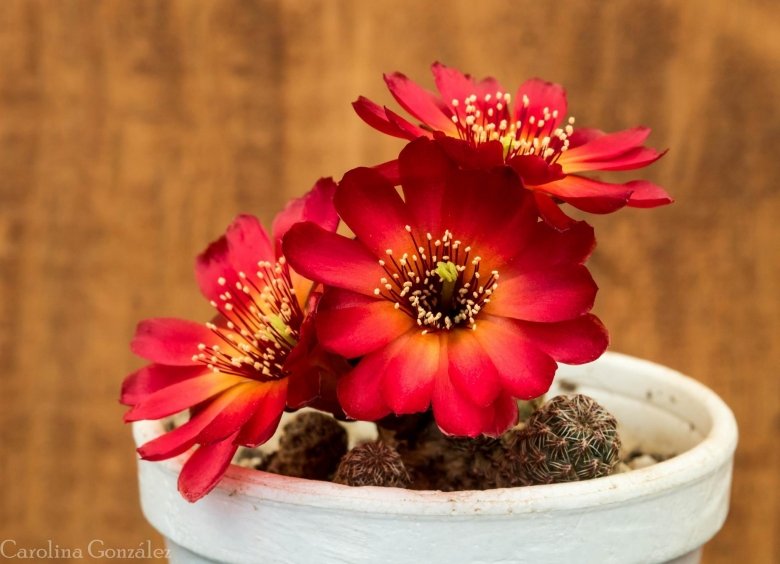
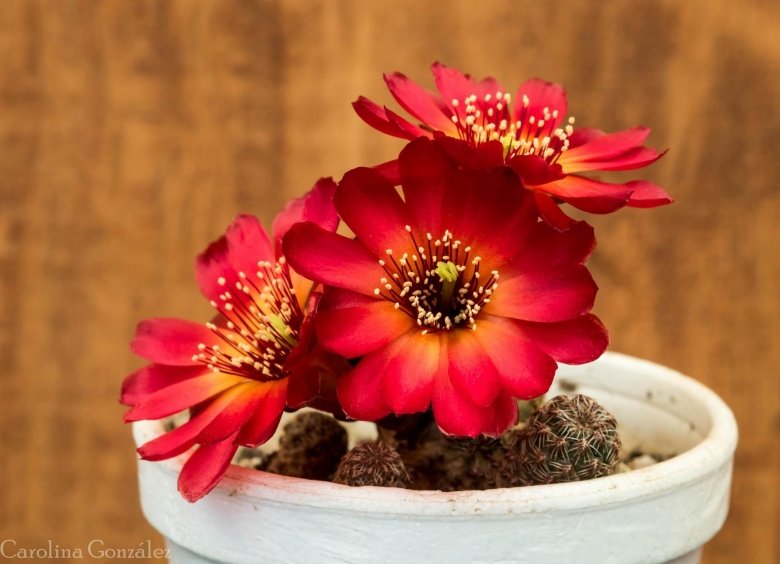
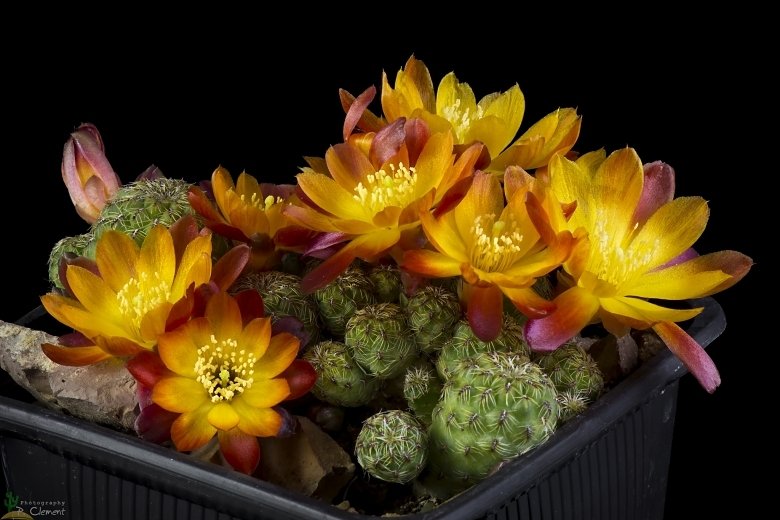
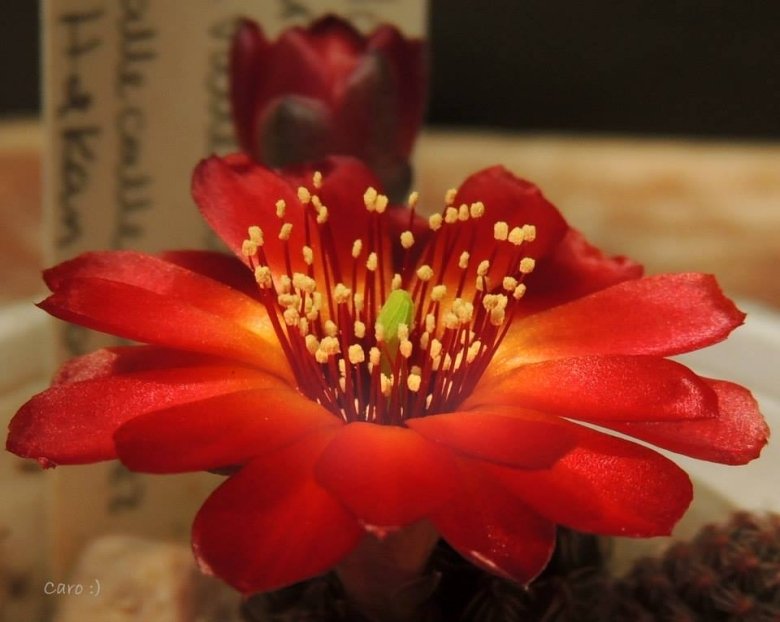
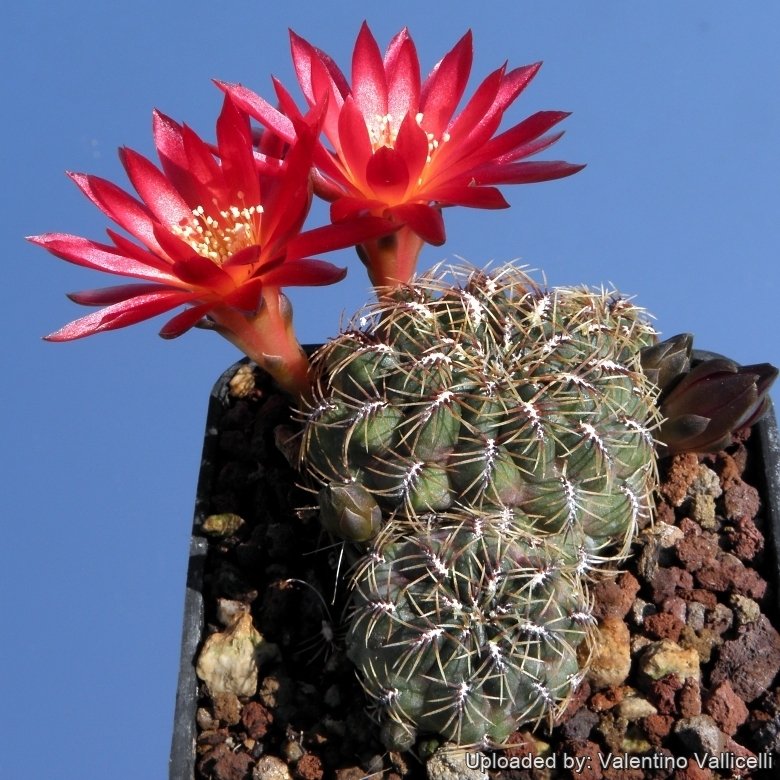
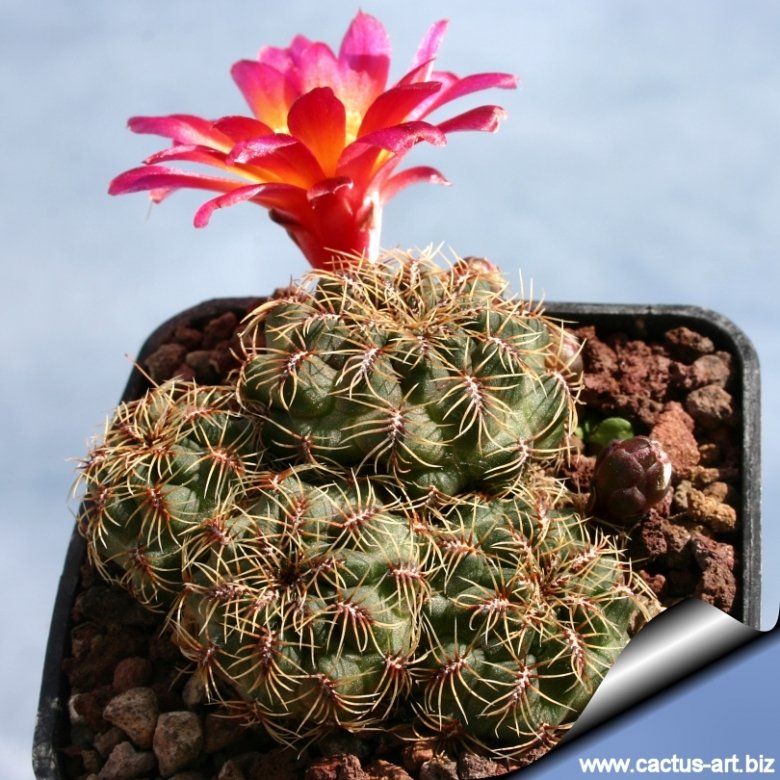
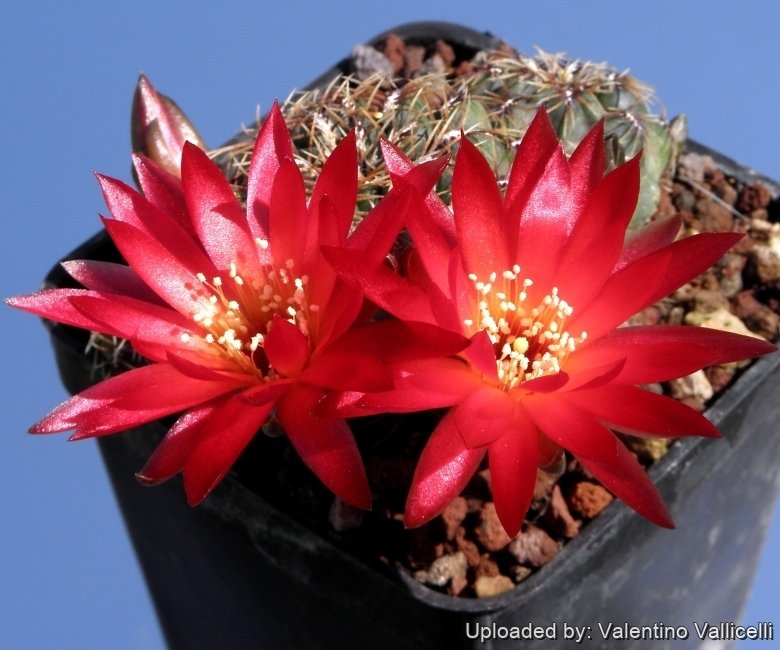
Rebutia canigueralli (more often known as Sulcorebutia canigueralli) is a slow growing clustering cactus that may forms clumps of many heads. This is a highly variable species with several variety available with light green to purple colouration and small spines.
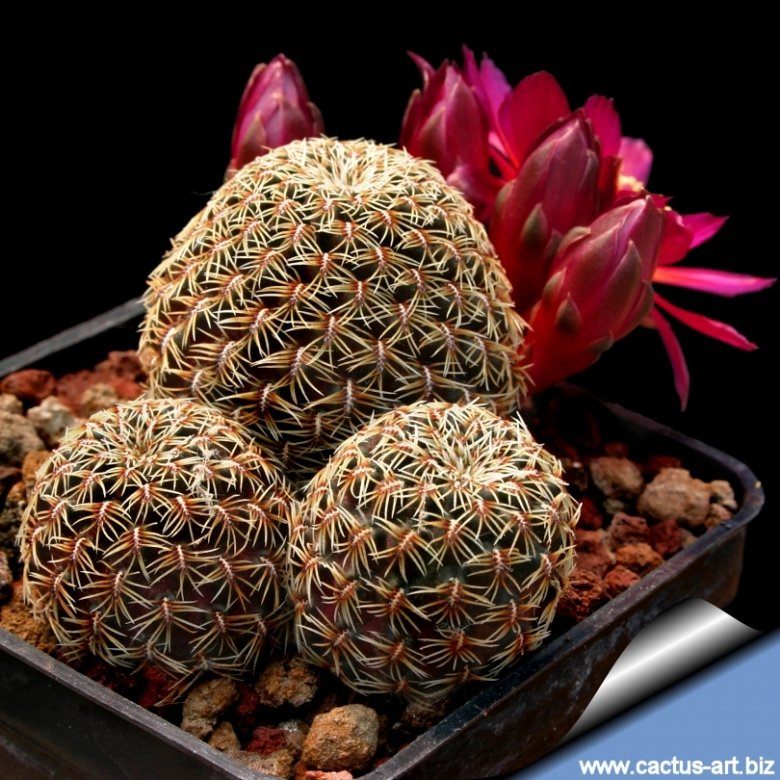
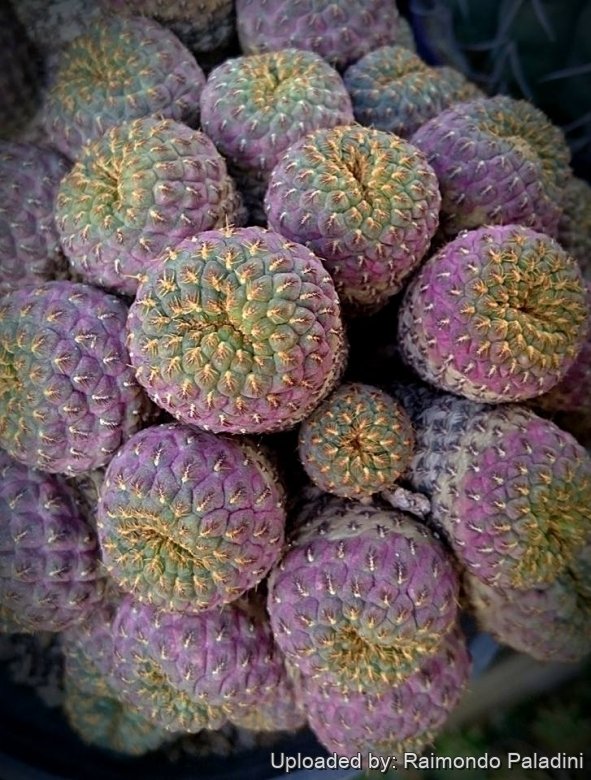
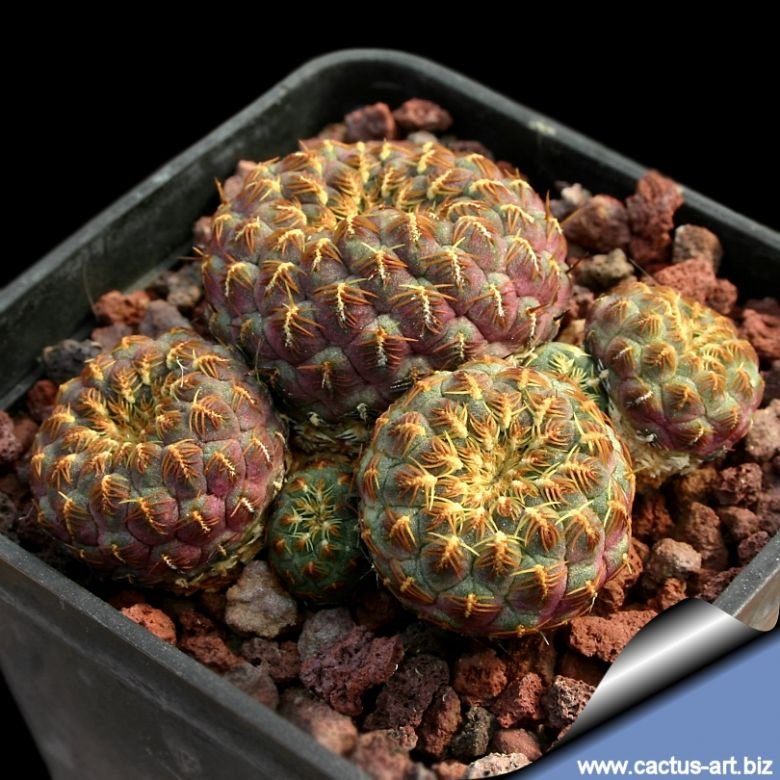
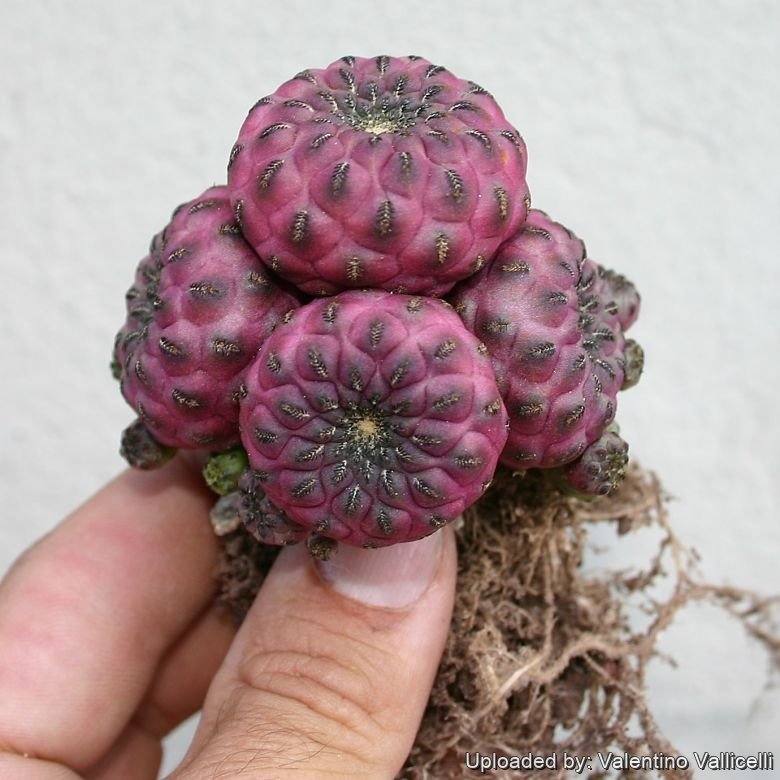
Stem: Rapidly offsetting from the base, small, grey-green, green to dark purple A characteristic of this species is that the offsets develop roots while still attached to the mother. Individual stems 2(4) cm tall, 3(5) cm in diameter.
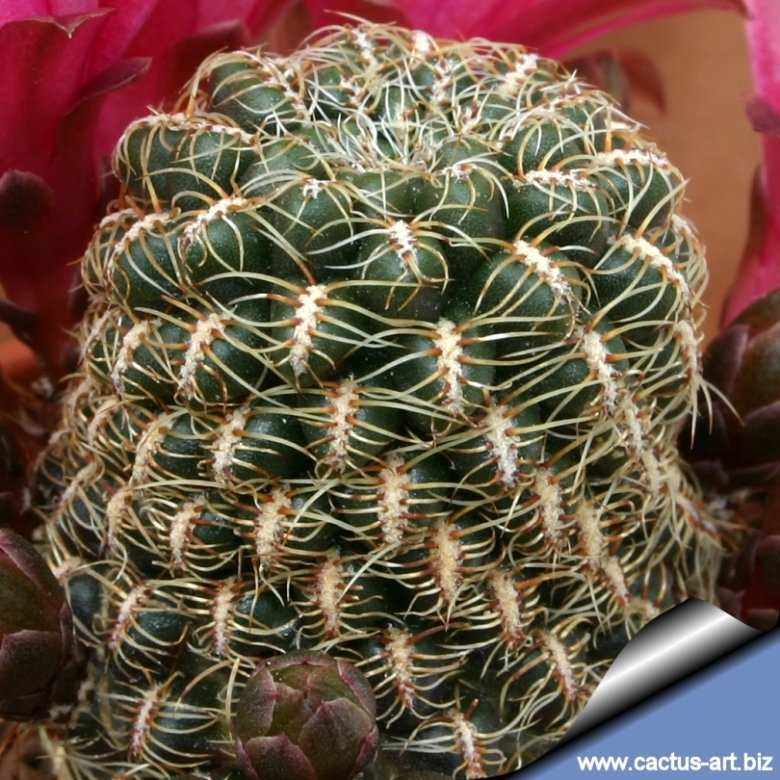
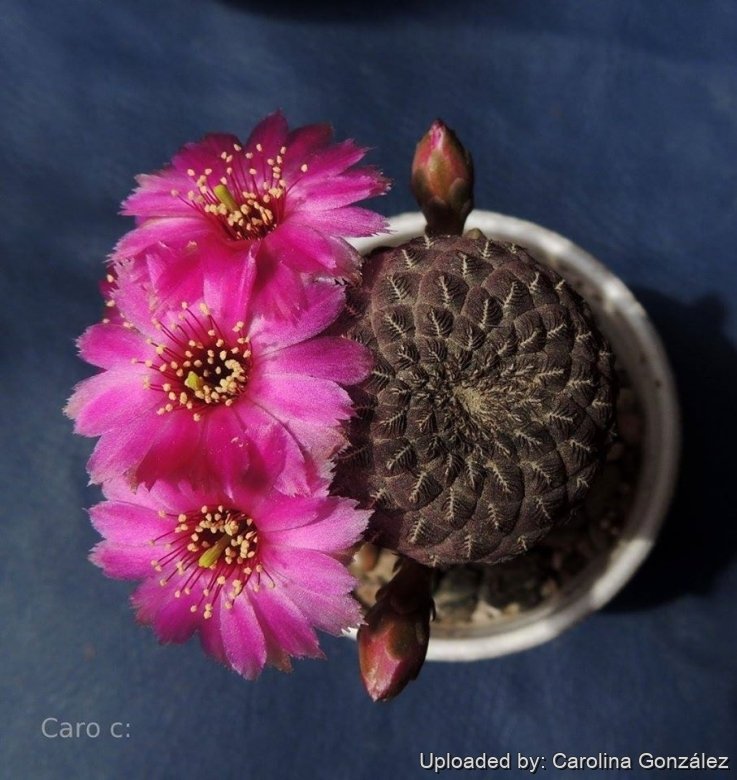
Ribs: With raised tubercles (3-5 mm wide) . In older plants tubercles are arranged in up to 13(-16) spiral line merging in the apex.
Areoles: 3 mm long, narrow with short white felt.
Roots: Conical.
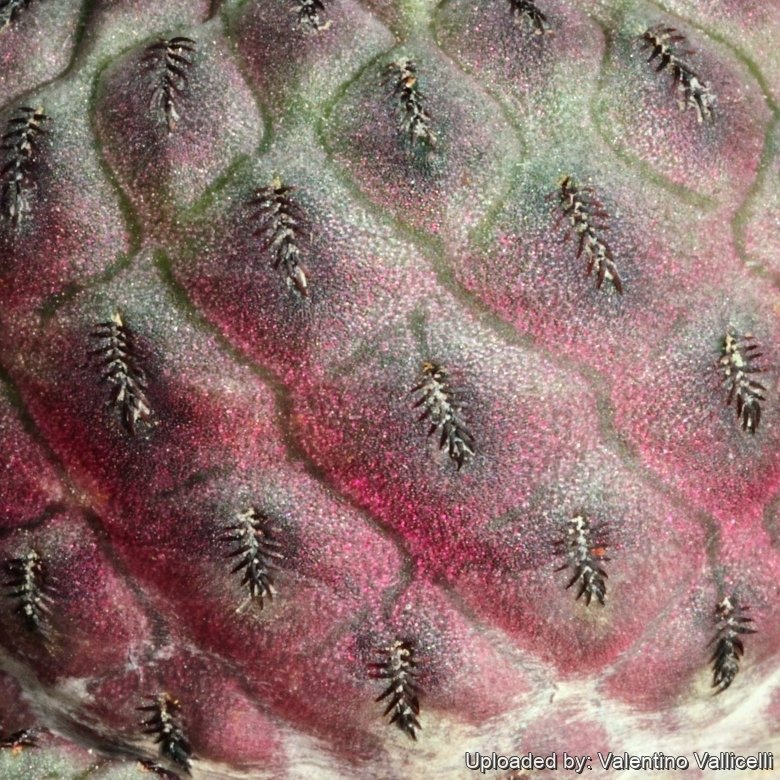
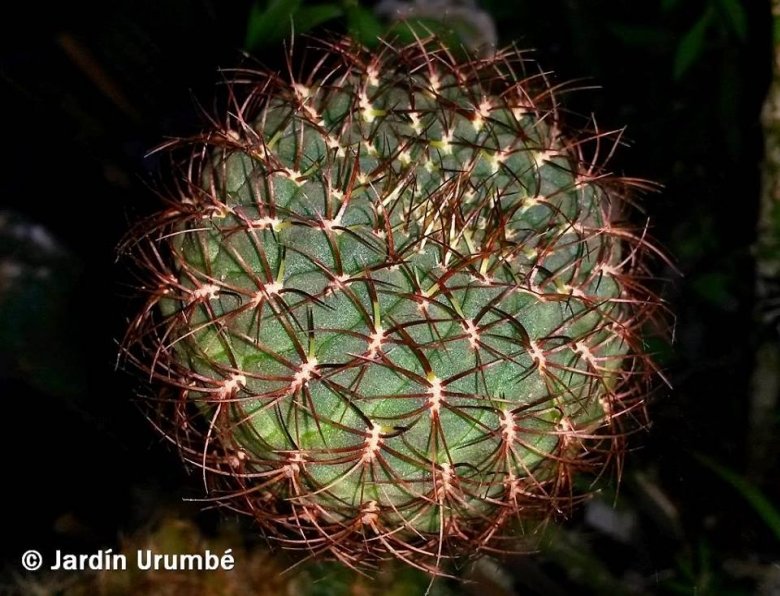
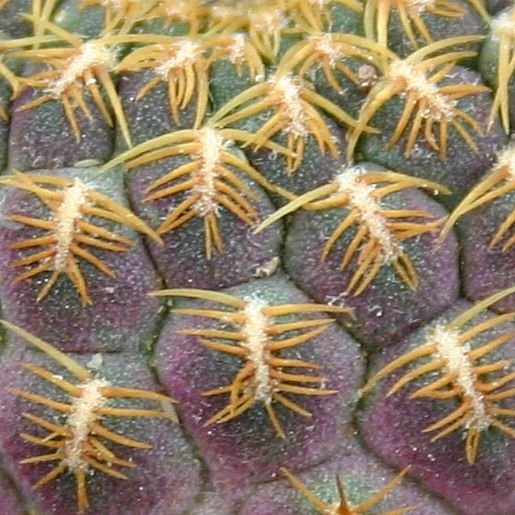
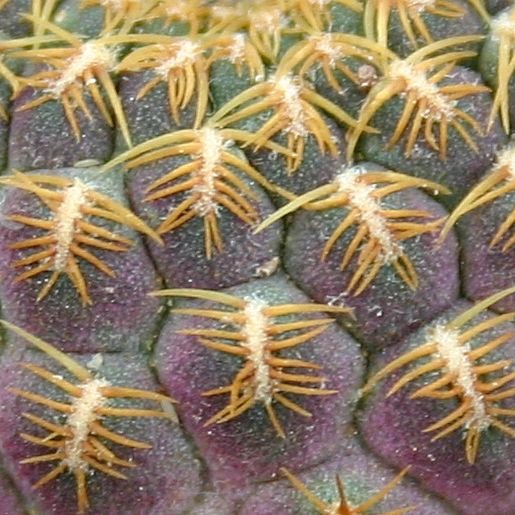
Radial spines: 11 to 14, fine, bristly, 1,5-2 (or more) mm long tight, pectinate, pointing diagonally and downward, that recurve and hug the tubercles so as not to be felt. Whitish, greyish, straw coloured, brown with darker base or almost black. Sometime interlaced.
Central spines: None or 1-2 ± erect.
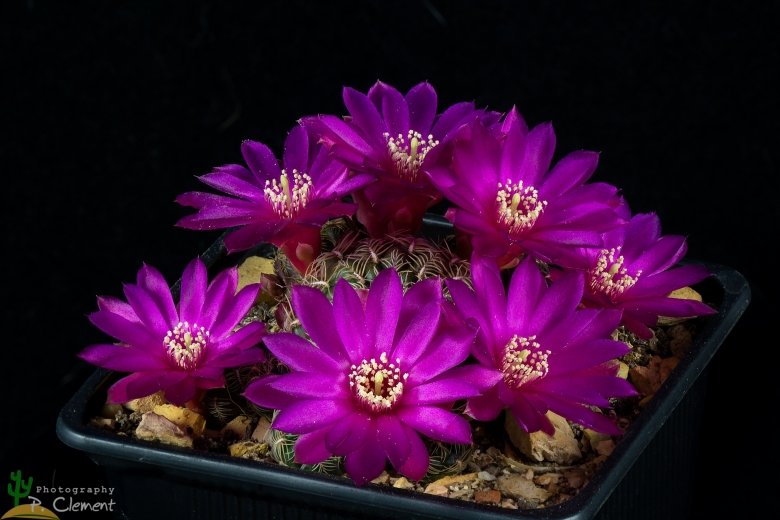
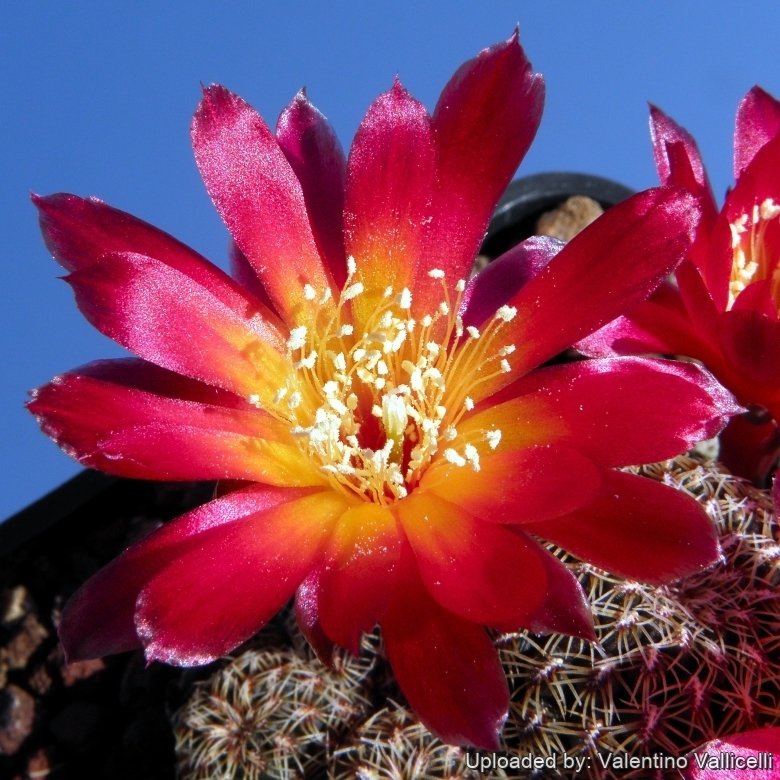
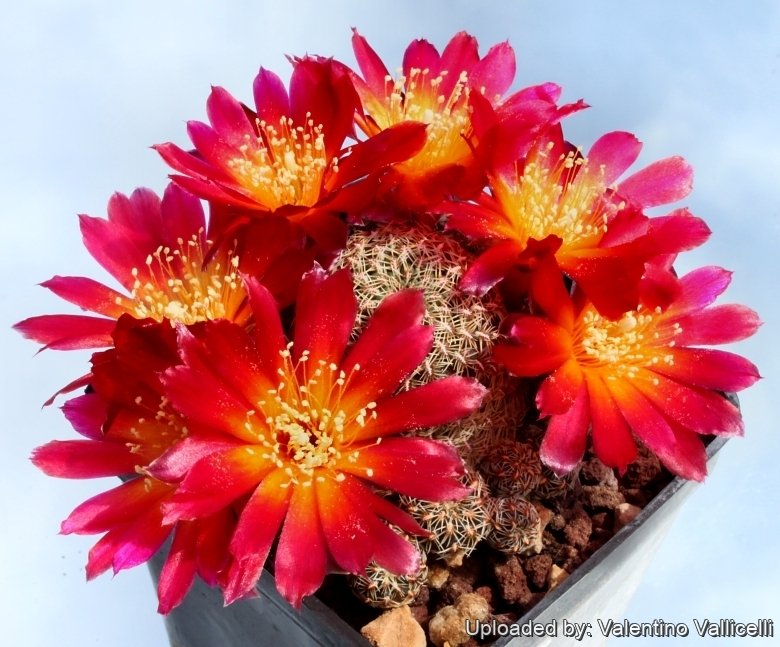
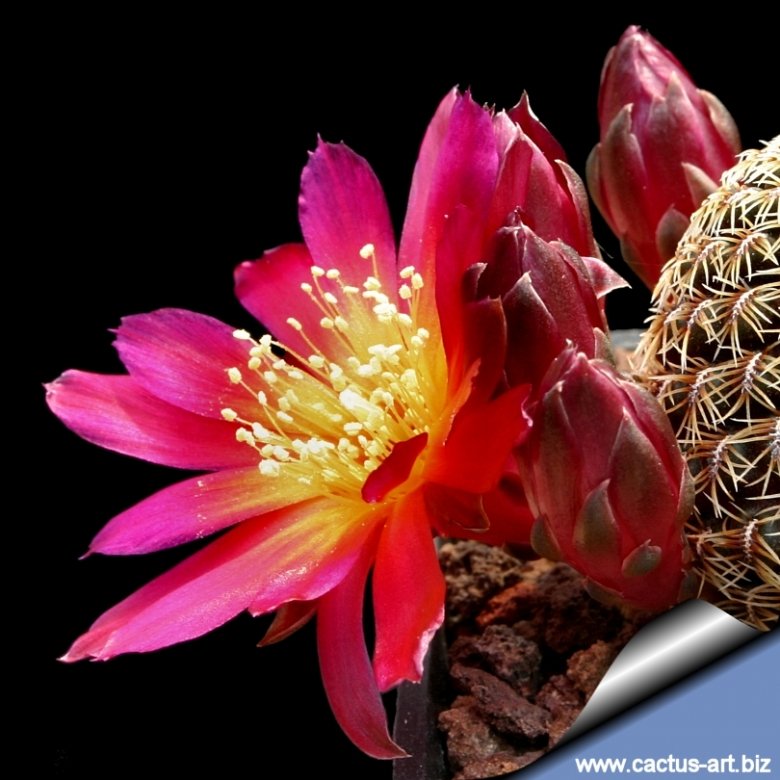
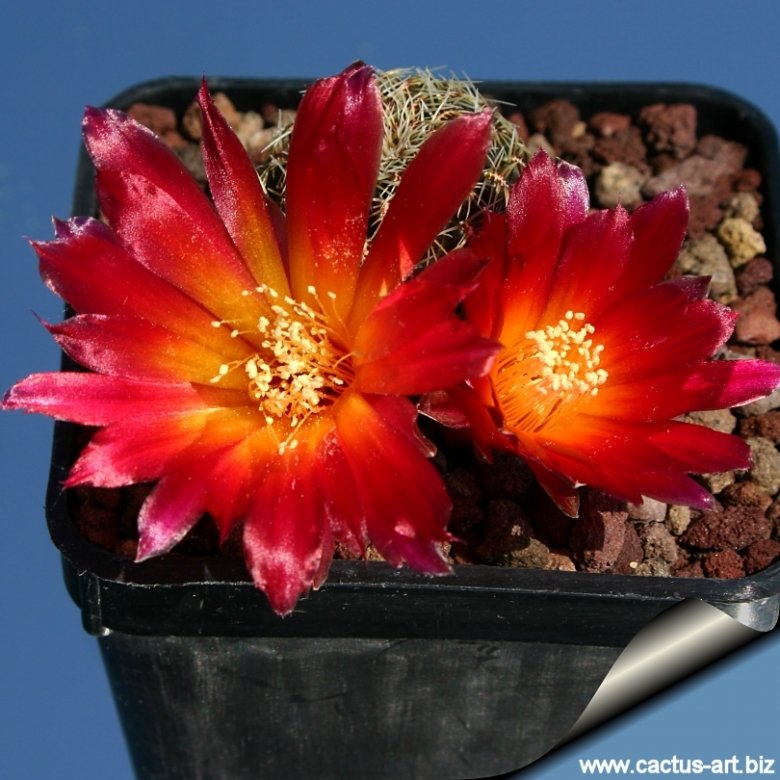
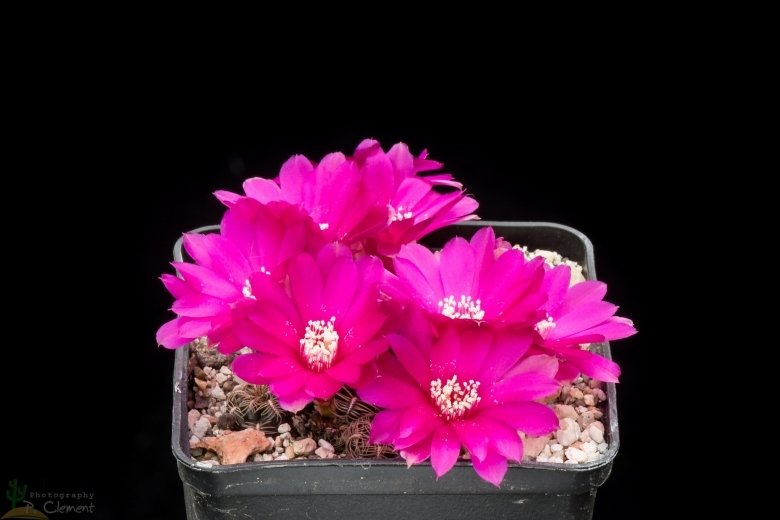
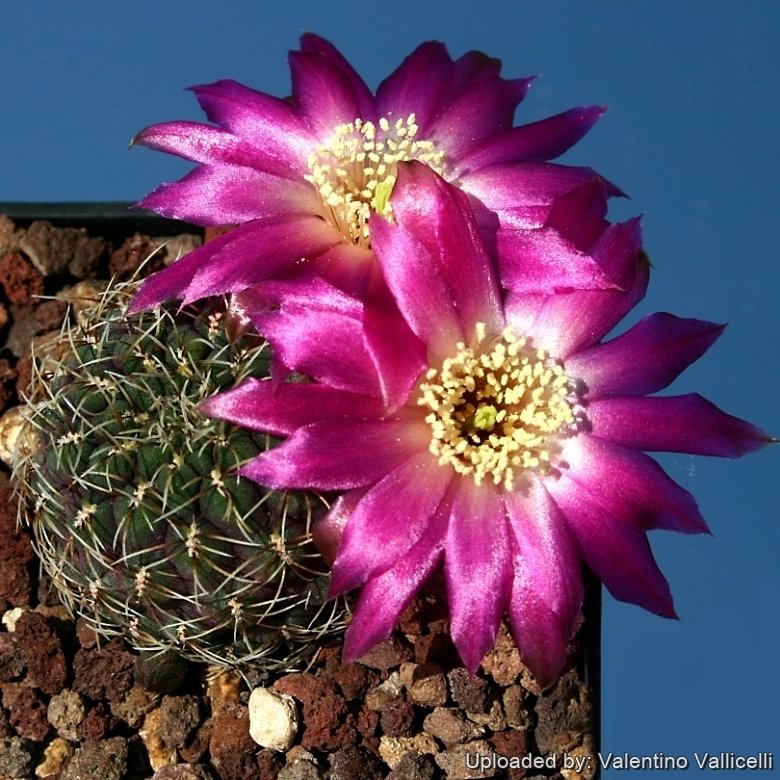
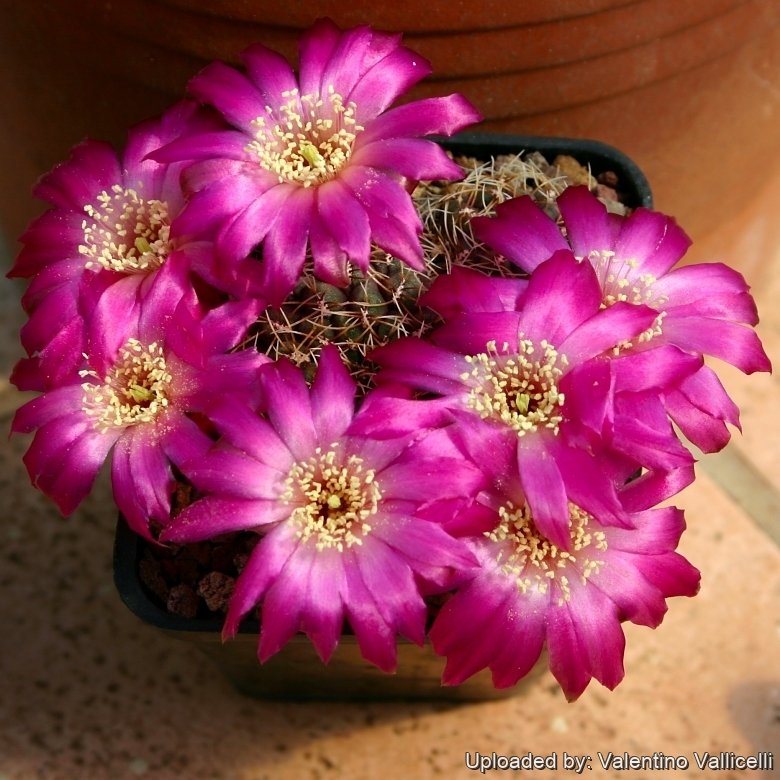
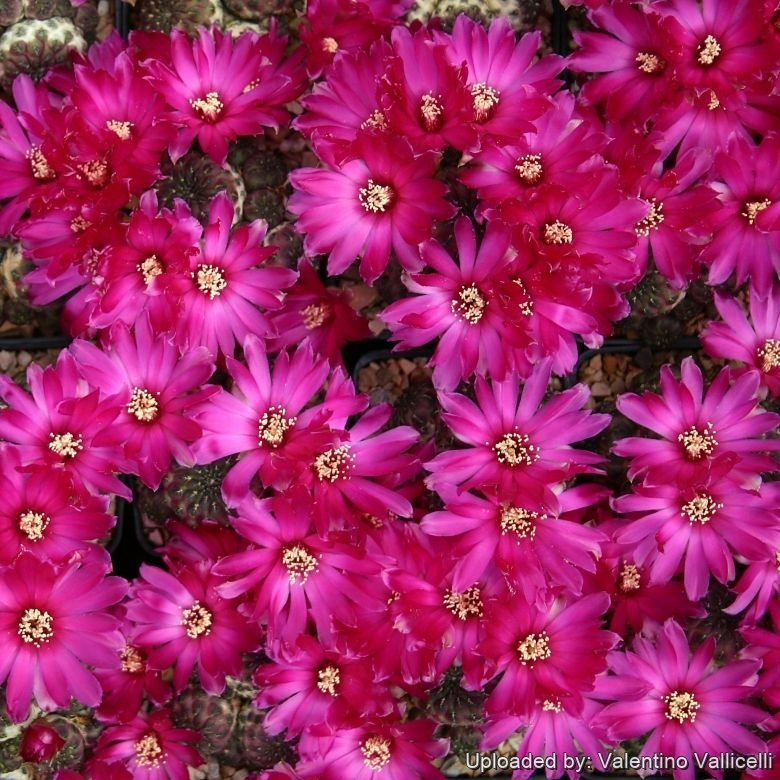
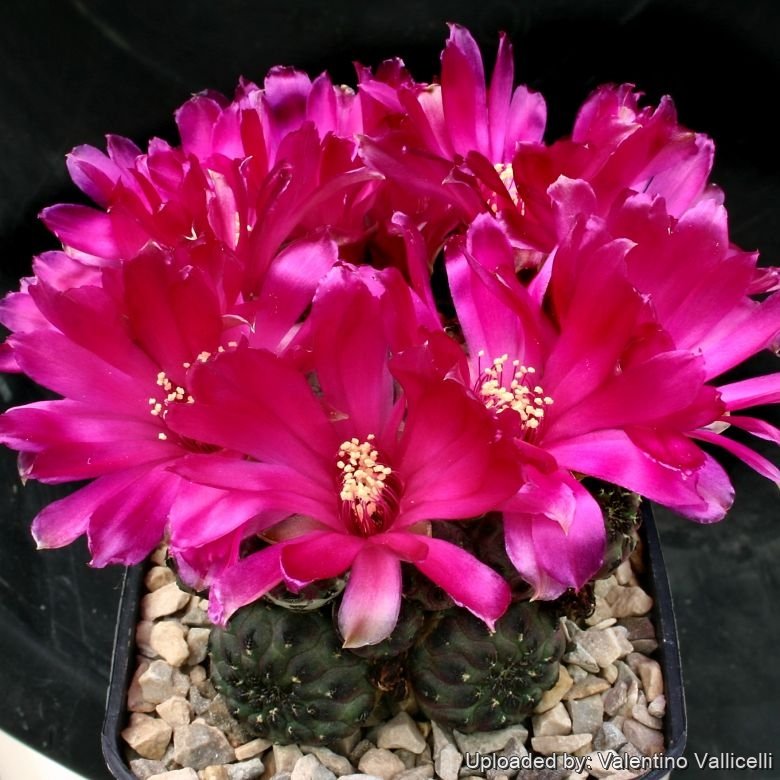
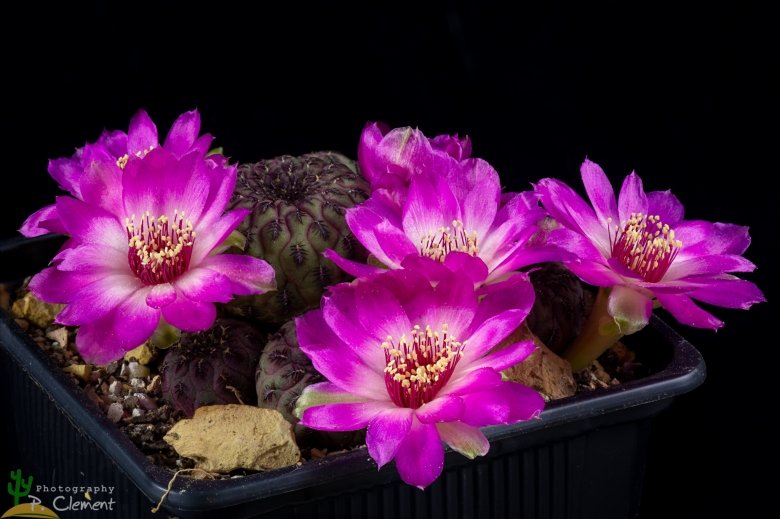
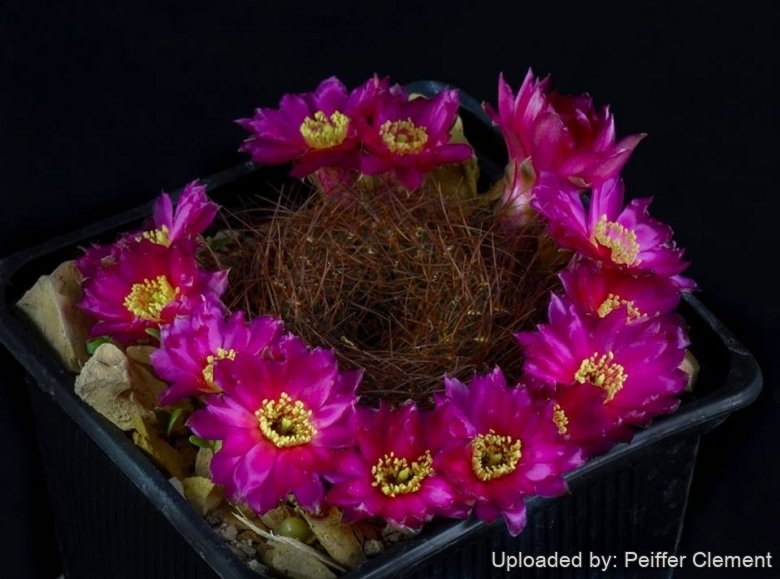
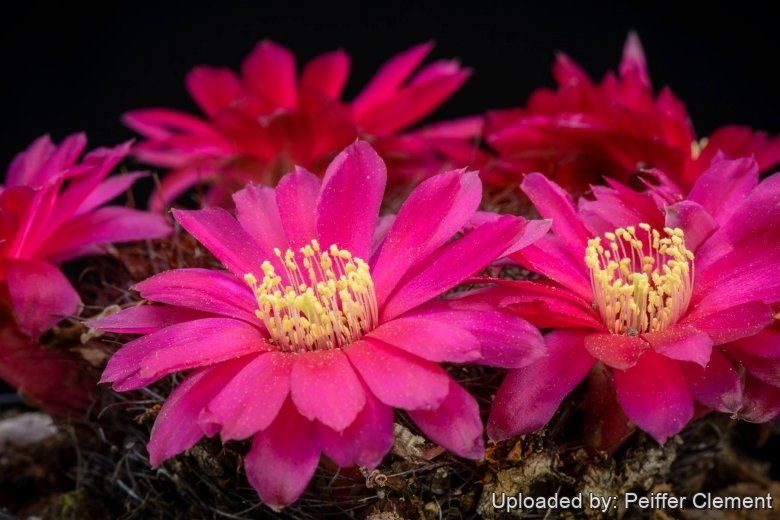
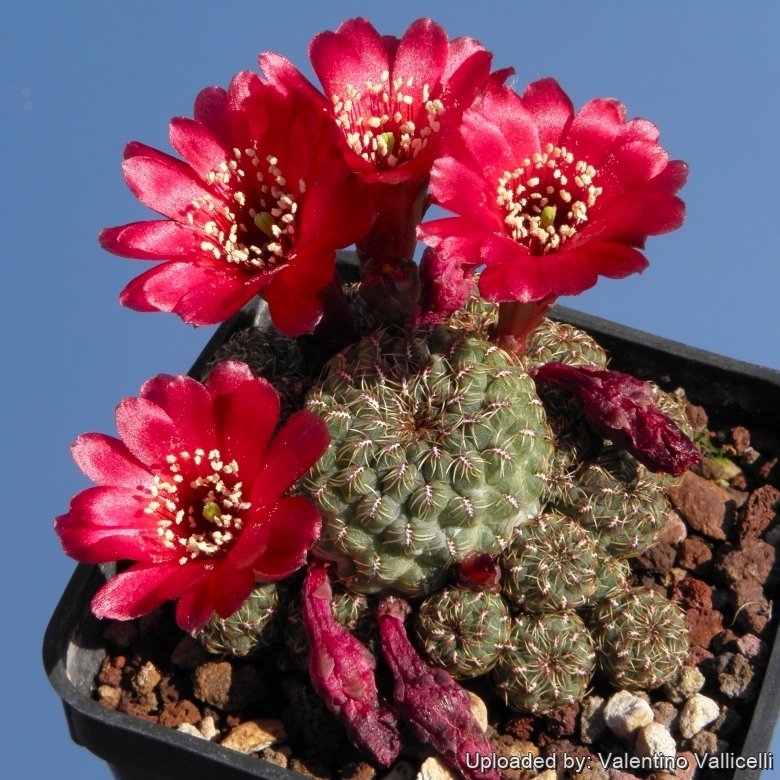
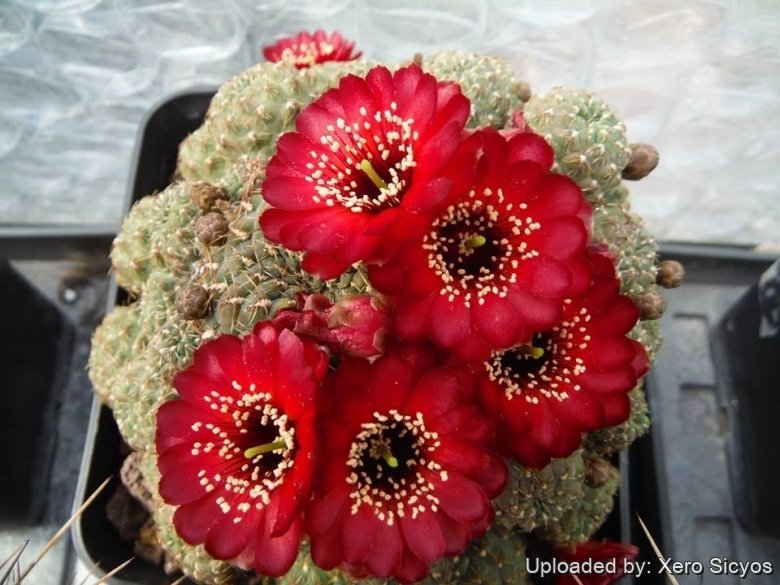
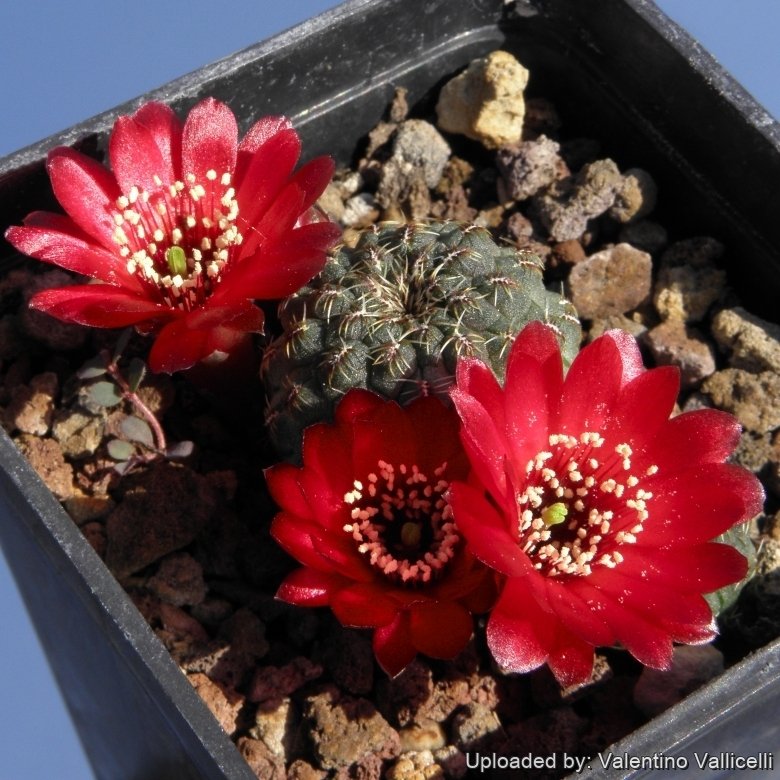
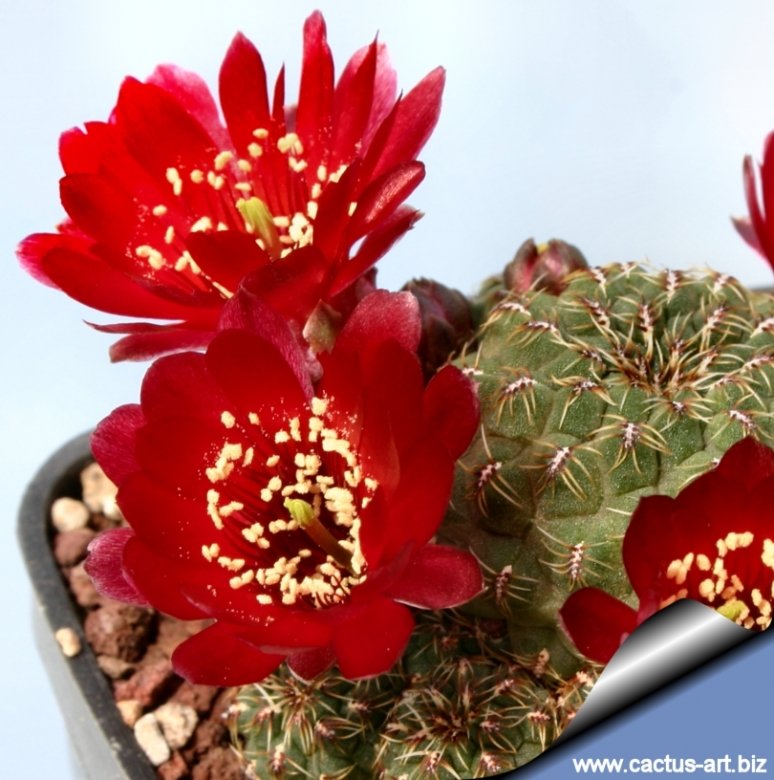
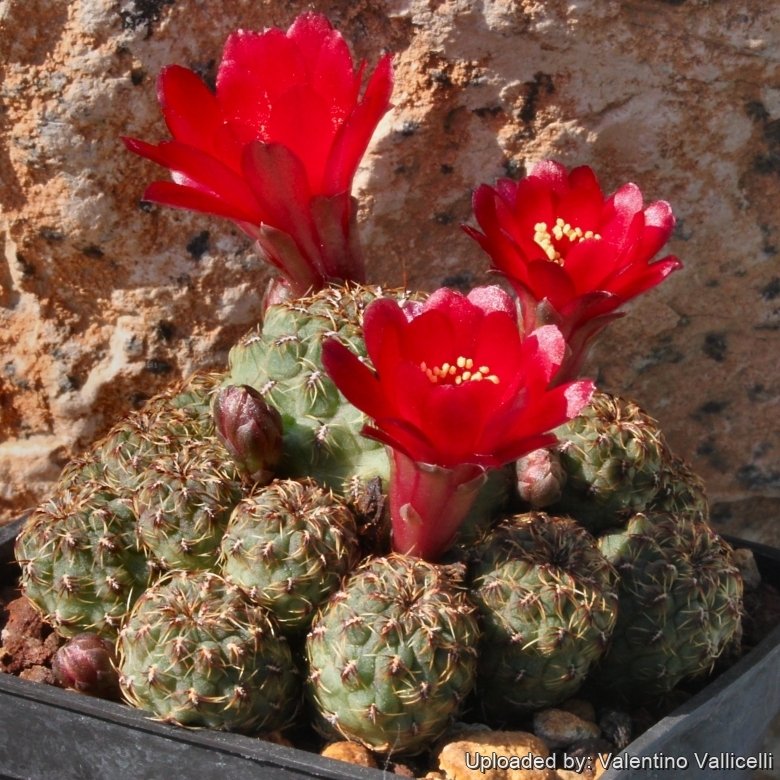
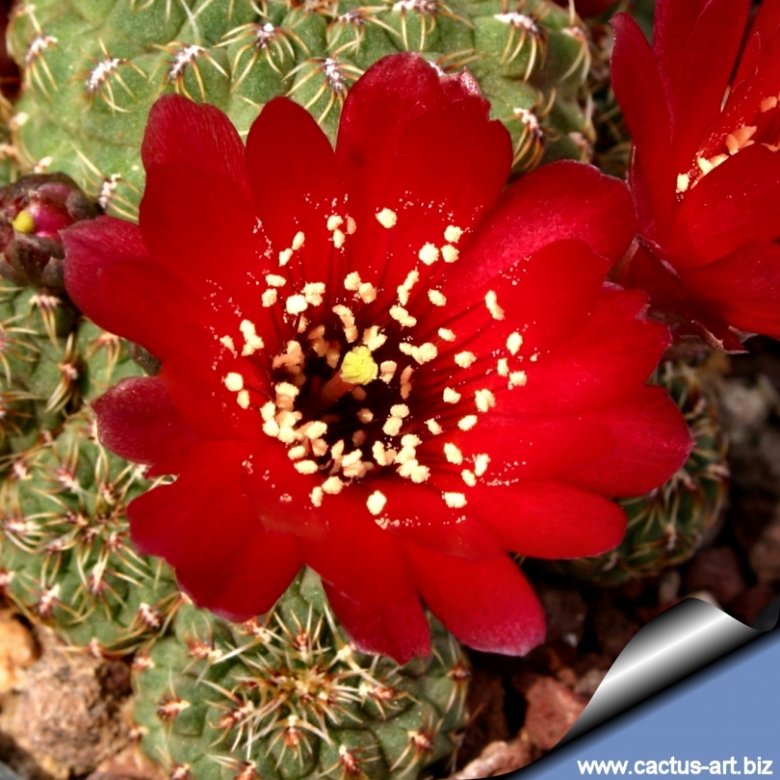
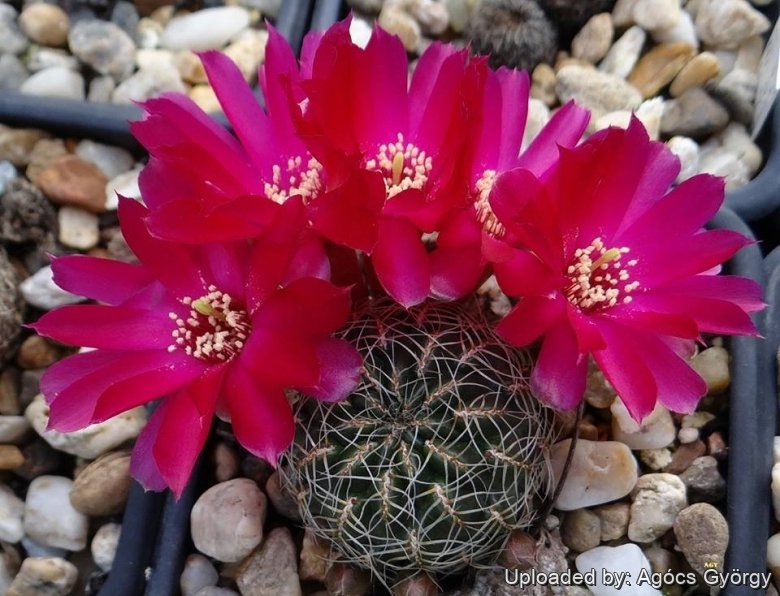
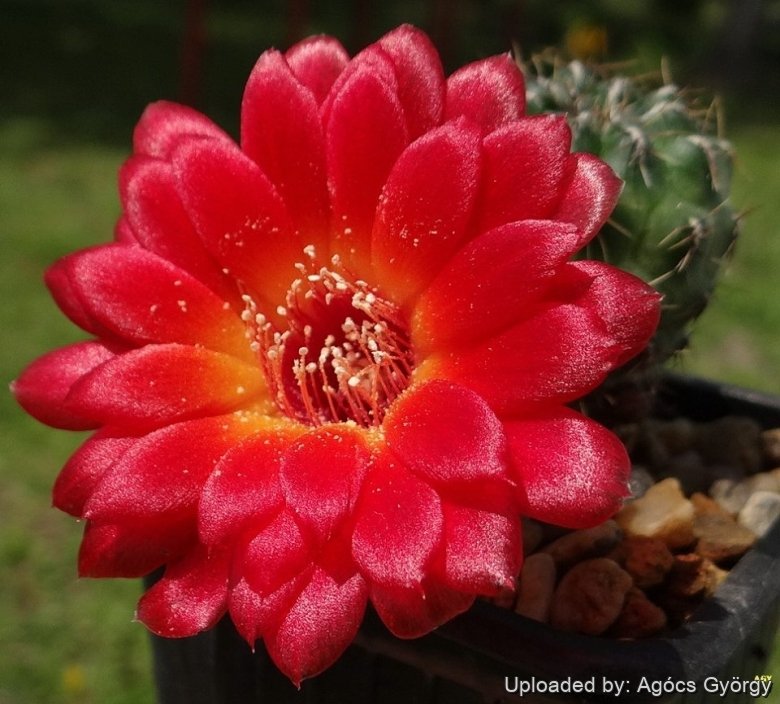
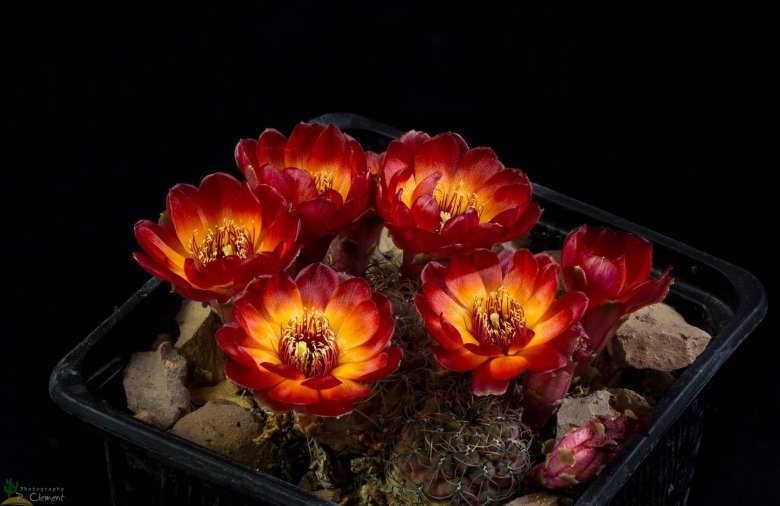
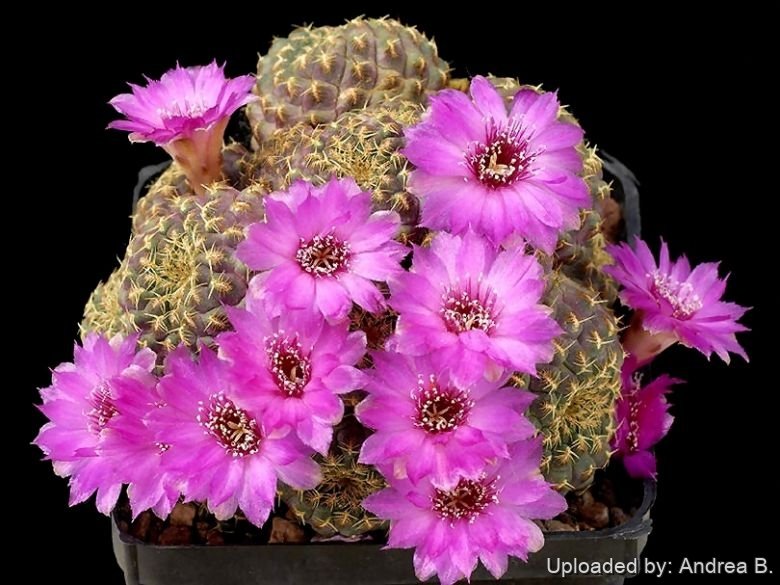
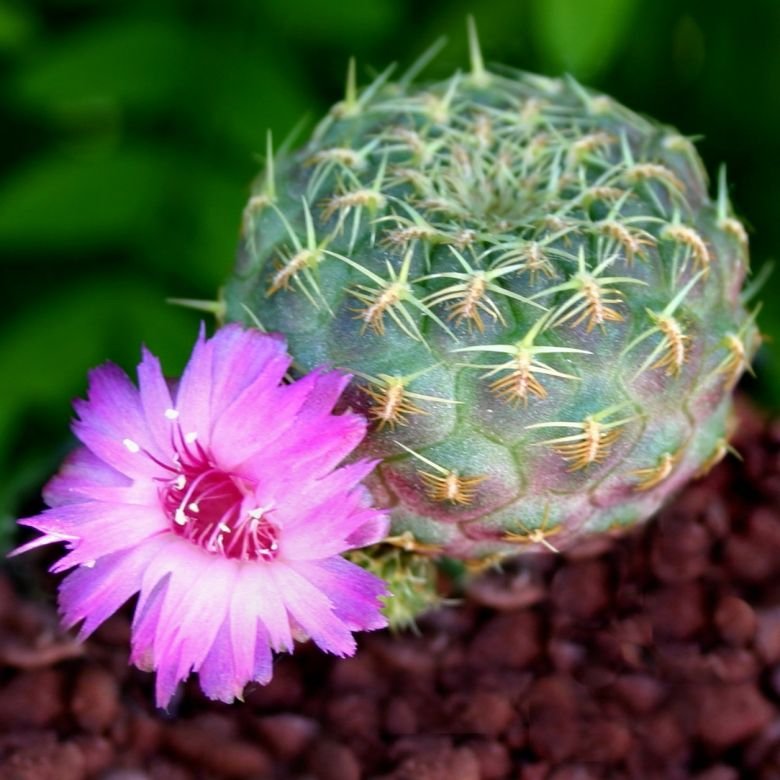
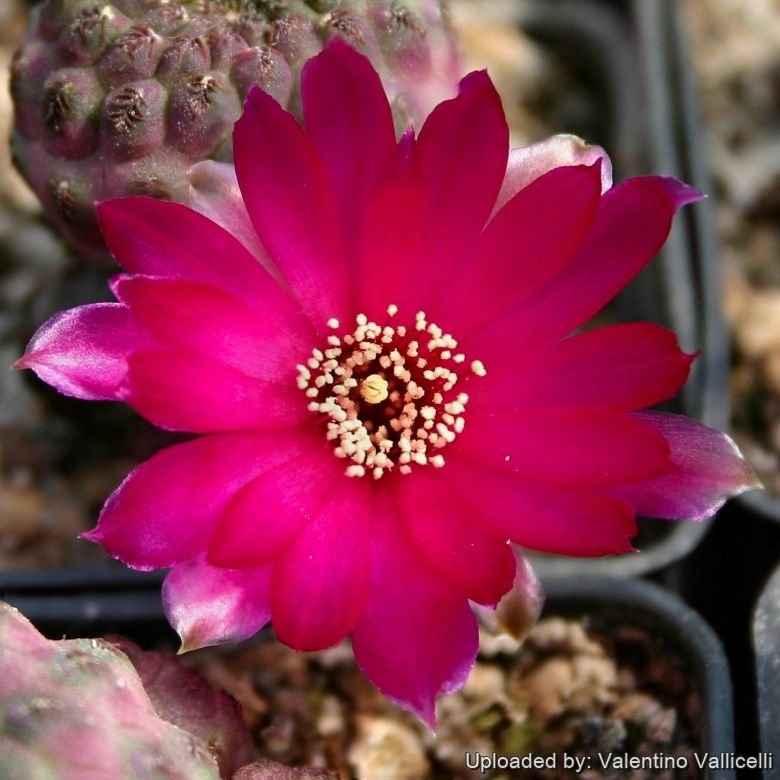
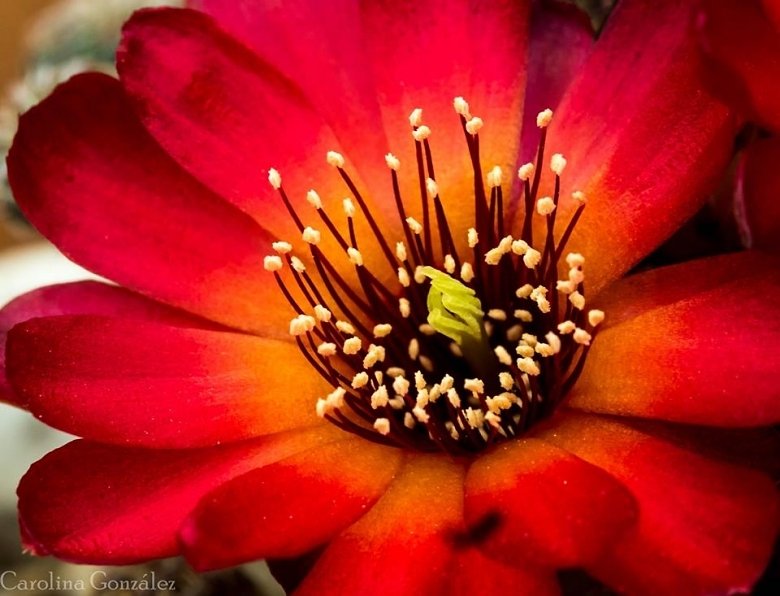
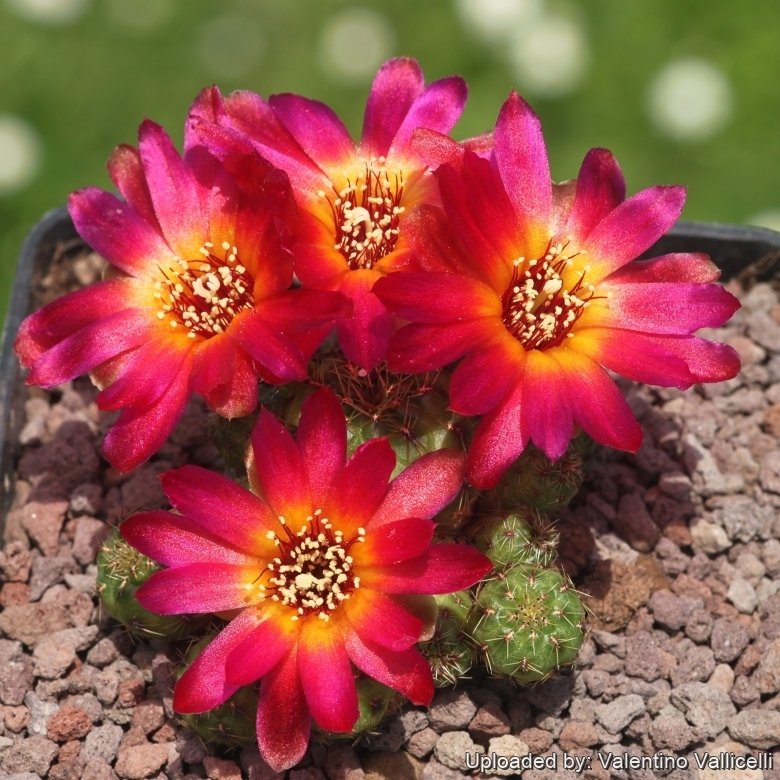
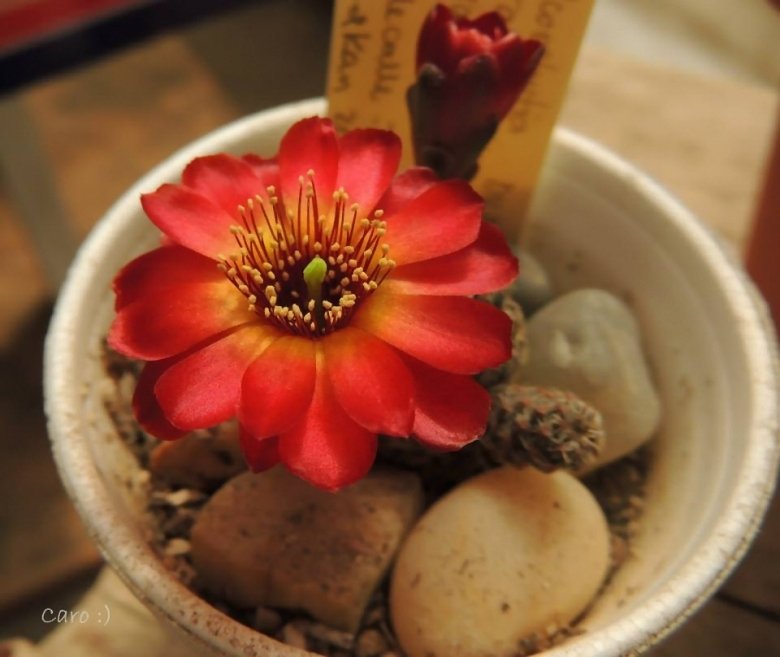
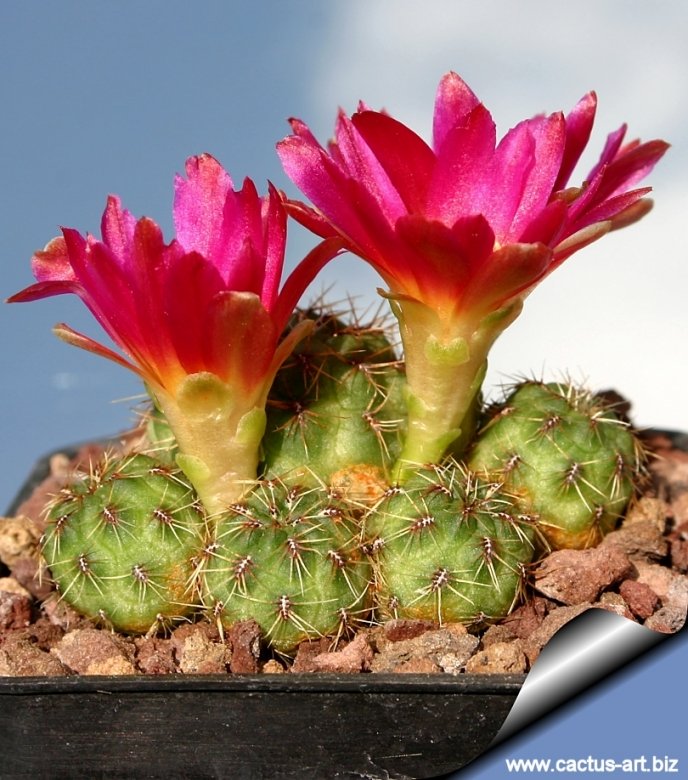
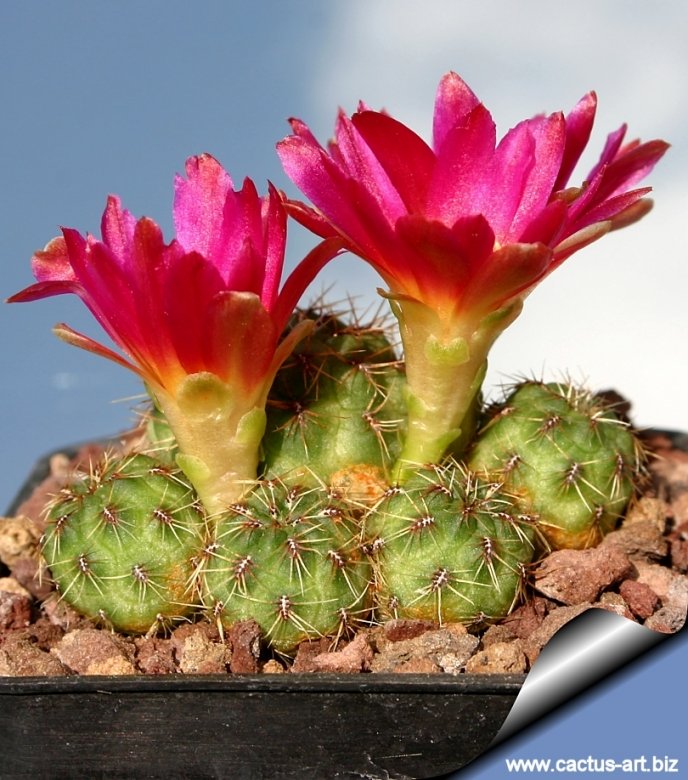
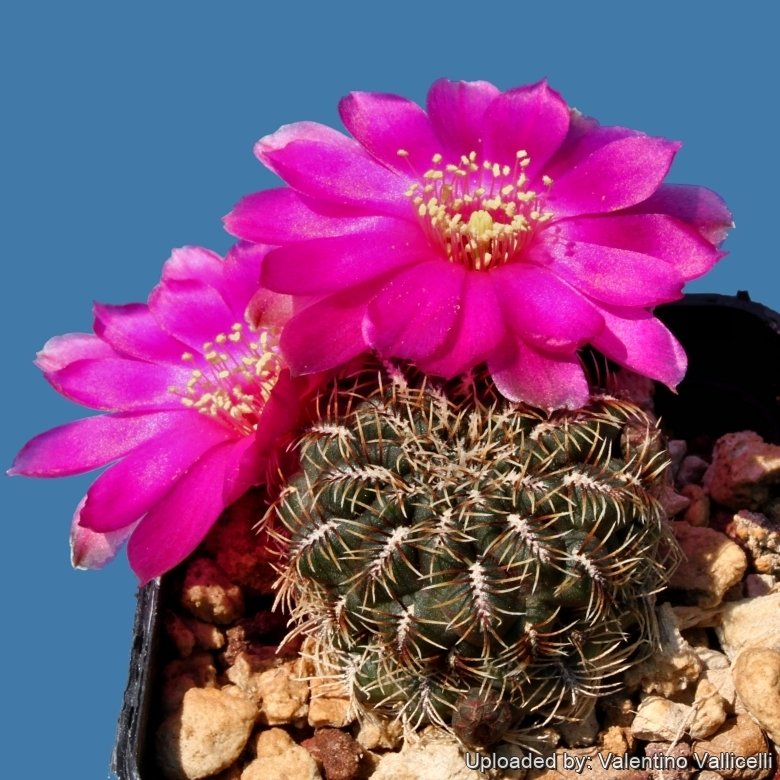
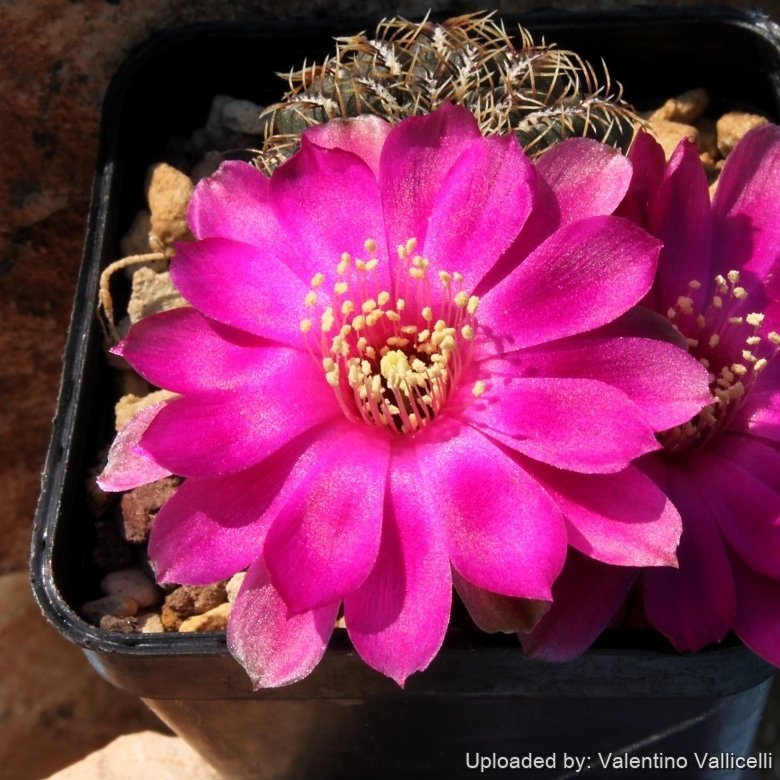
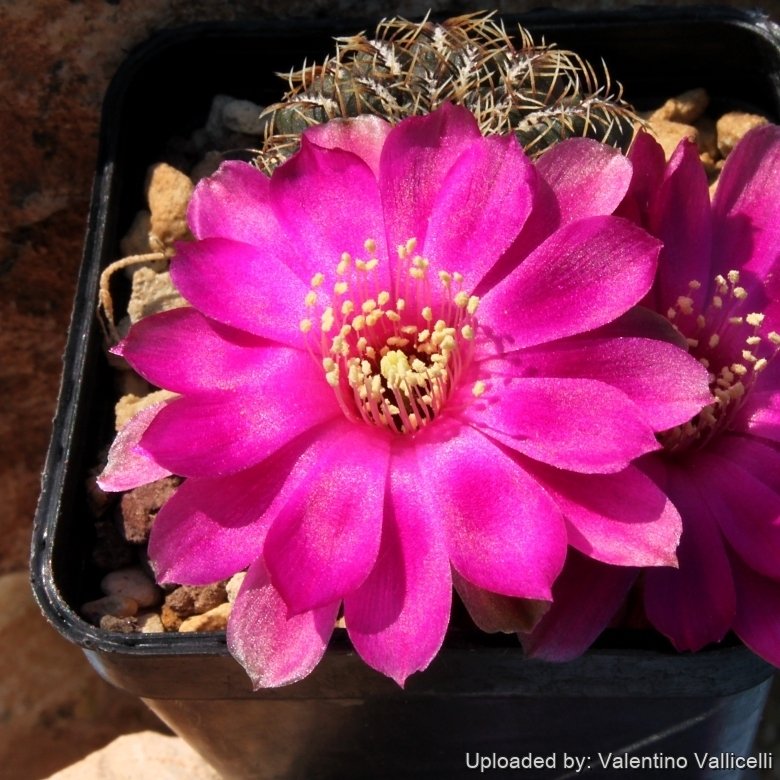
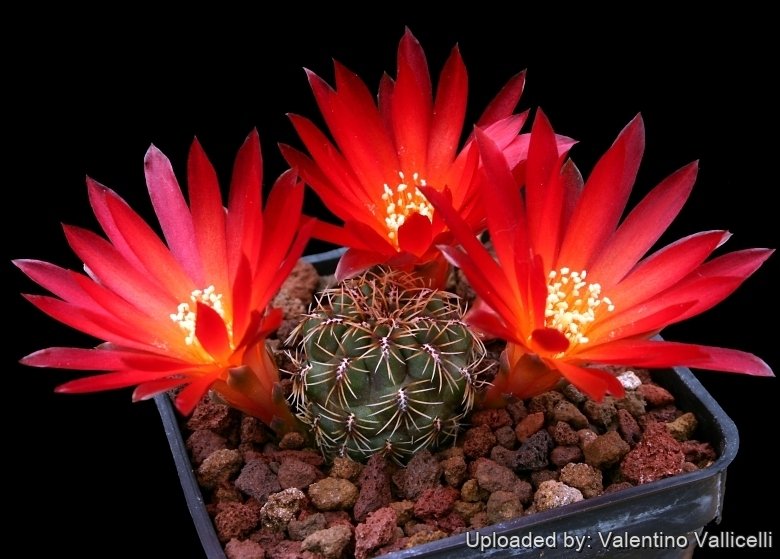
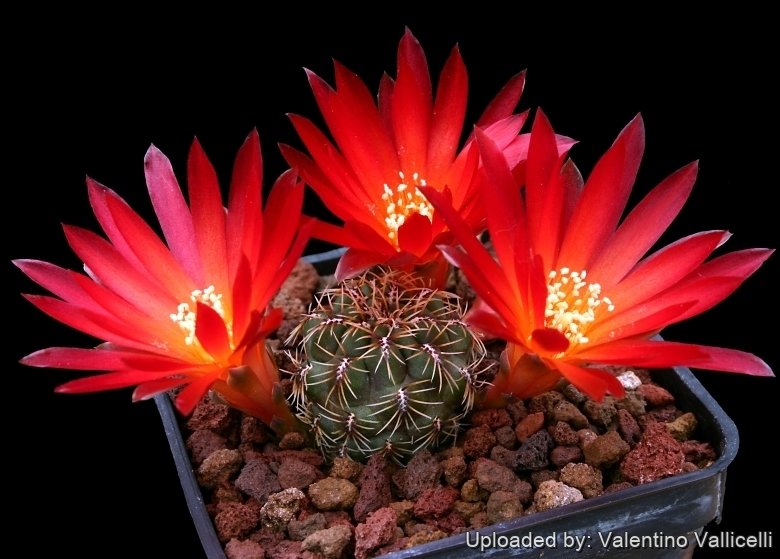
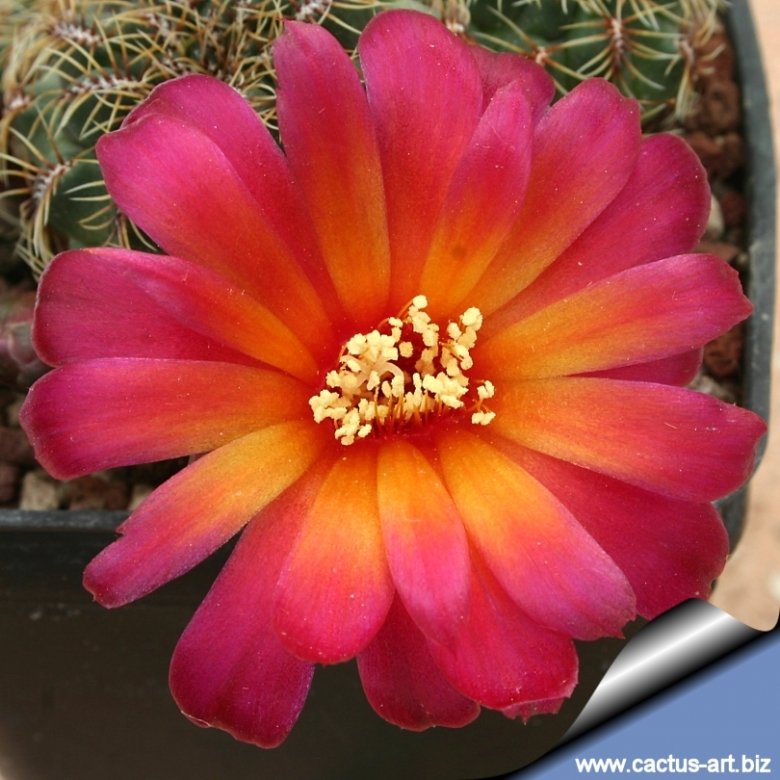
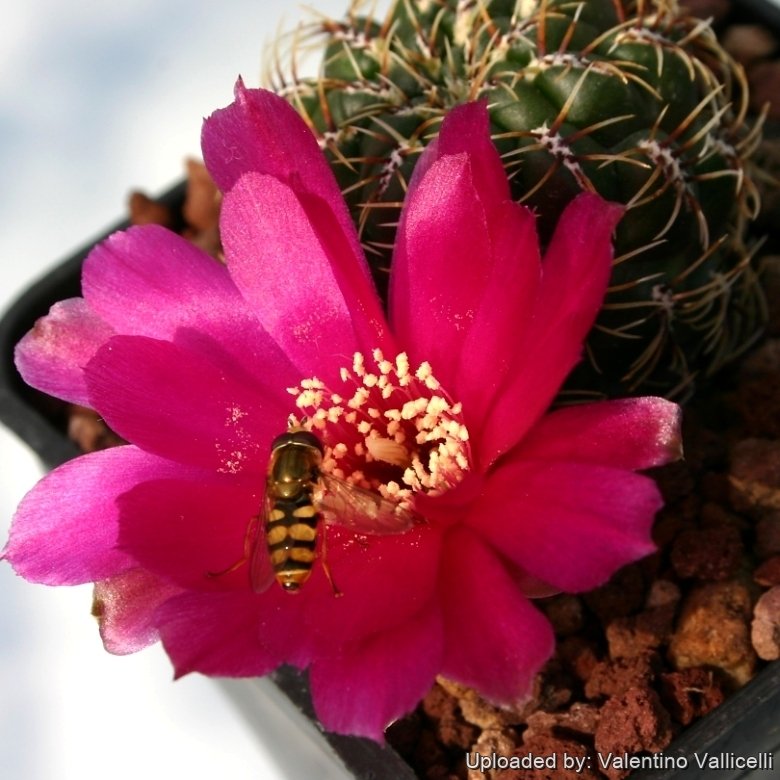
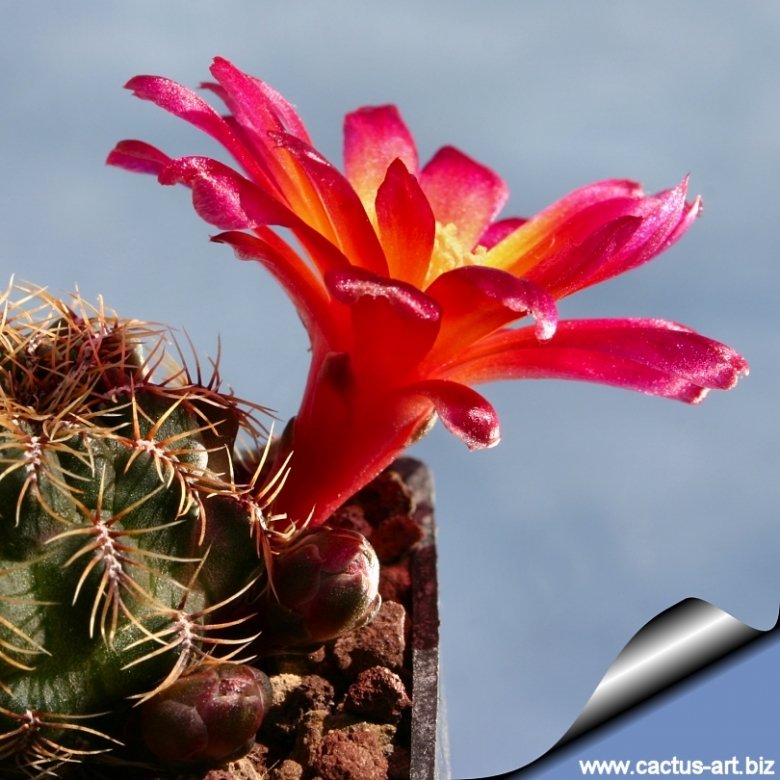
Flowers: From the basal part of the stem, 20 - 50 mm long, 35 - 50 mm wide Orange, Orange-red, lilac or dark magenta, often bi coloured, with yellow or white throats. Floral tube funnel-shaped yellowish-green or yellowish-red with tan coloured scales,It is a species with very variable flower colours.
Phenology: Flowers are produced in late spring and remain open for three or four days.
Fruit: Dark brownish red approx 4-5 mm wide.
Origin and Habitat
Chuquisaca, Bolivia
Cultivation and Propagation
Rebutia canigueralii is a mountainous plants with a thick taproots and is susceptible to overwatering, it grows rather slowly and need a very good drainage to avoid rotting. It requires also an appropriate air circulation and is sometime grafted to avoid root problems.
Soil: It loves a very permeable, coarse mineral soil.
Repotting: It require a deep pot suited to accommodate the swollen root, repotting with fresh potting-mix should be done every other year or when the plant has outgrown its pot. However, repotting doesn’t necessarily mean they’ll need larger containers. To prevent rottenness it is also advisable to surround its root neck by very rough sand or grit, this help a fast water drainage.
Sun Exposure: Light shade when young, full sun later ( light shadow my be useful in the hot summer days)
Hardiness: Plants are and quite frost hardy -5 (-15)° C but preferably overwinter in a cool place (at 0/10°C). They need to be kept in a cool place during winter rest. This is important for the flowers, as well as for their health. Without this cool winter period, they normally won’t get many buds.
Watering: It requires moderately watering through the growing season. This can be done weekly or more frequently during the summertime, if the weather is sunny enough, but allow to dry fully before watering again. Kept this way, plants will show a healthy growth. Keep rather dry as soon as the temperature starts dropping in October and keep it strictly dry throughout the winter quiescent period since ot is very sensitive to any moisture excesses. The plants may survives outside without protection in winter (cold hardy to -5° ) but is then somewhat prone to rot, too.
Fertilization: Give an occasional high potassium liquid feed during the active growing period.
Garden uses: It is a fine plant for a rock garden or container, contrasts well with agaves, yuccas, and low-growing flowering plants. Nice planted with Agave utahensis, another very hardy species.
Pest and diseases: They are generally fairly easy to grow, especially if kept pest-free. They are susceptible to, scale insects and spider mite. Watch carefully for infestations of stem and root mealy bugs, and damage from these may well initiate fungal attack.
Propagation: Propagation: Seed, cutting, grafting. Take cuttings spring or summer, let them dry till the ends callous well. Then replant them in fresh cactus soil that is ever so slightly moist, and keep it that way till they root. Surface sowing is the best; seeds germinate in 14-28 days at 20° C, remembering that seedlings dislike strong light and dry conditions.
Bibliography
Major references and further lectures
-
James Cullen, Sabina G. Knees, H. Suzanne Cubey “The European Garden Flora Flowering Plants: A Manual for the Identification of Plants Cultivated in Europe, Both Out-of-Doors and Under Glass” Cambridge University Press, 11/Aug./2011
-
David Hunt, Nigel Taylor “The New Cactus Lexicon” DH Books, 2006
-
Edward F. Anderson “The Cactus Family” Timber Press, 2001
-
Anderson E. F.: “The Cactus Family” Timber Press, Portland, Oregon, 2001
-
Ritter Fr.: “Kakteen in Südamerika” Spangenberg, 1980
-
John Pilbeam “Sulcorebutia and Weingartia: A Collector’s Guide” Timber Press, 1985
-
E Haustein “Der Kosmos Kakteenfuehrer (the Kosmos Cactus Guide)” Balogh Scientific Books 01 December 1998
-
Cullmann W., Götz E., Gröner G.”Kakteen: Kultur, Vermehrung und Pflege - Lexikon der Gattungen und Arten” Ulmer, Stuttgart, 1984
From llifle page Aylostera zavaletae
Description
Sulcorebutia zavaletae is a low-growing clustering cactus, with globular stems, about 15 cm wide and wide magenta red flowers, with paler inner petals. This species is widely grown in cultivation and is generally included within (as a synonym of) Rebutia canigueralii and barely distinguishable from Sulcorebutia canigueralii var. applanata (S. verticillacantha var. applanata), which if determined to be so will mean that at varietal level this last name has priority, however it seems distinct enough, and is here maintained as a race or morphological form.
Stem: Round, depressed at apex, in habitat about 15 mm diameter (in cultivation it gets to about 2 or 3 cm), sprouting freely. Dark green in colour and with a strong tap-root which is about 12 mm thick at soil level and 50-60 mm long.
Tubercles: about 4 mm high, 3 mm diameter on 9 ill-defined spiralling ribs.
Areoles: 3 to 5 mm long, 1 mm wide, 3 mm apart, linear, with some white felt.
Radial spines: In a comb-like pattern, 4 or 5 on each side, 9 or 10 in all (or more later), fine bristle-like only 2-3 mm long, lying rather flat to stem. Whitish, brown at base.
Central spines: There are no central spines.
Flowers: From base of stem, 40 mm long, 35 mm. Ovary 4 mm diameter, whitish and bare. Tube 15 mm long, 2 mm diameter only, with outstanding, brownish pointed scales 4-6 mm long. Outer petals lanceolate, 18 mm long, 4 mm wide, magenta- red on upper surface, brownish on under side.
Origin and Habitat
Sulcorebutia zavaletae occurs in the Rio Grande basin, Zudanez Province, Chuquisaca Departments, Bolivia.
Altitude range: It grows at around 2000-2800 metres above sea level.
Bibliography
Major references and further lectures
-
Cyril Marsden, Herbert Spencer Jackson “Rebutia, Including Aylostera and Sulcorebutia” Macmillan, 1968
-
John Pilbeam “Sulcorebutia and Weingartia: A Collector’s Guide” Timber Press, 1985
-
Brinkmann, “Die Gattung Sulcorebutia” p 61, 1976
-
Cardenas, Kakteen und andere Sukkulenten 16:177, 1965
Source: Aylostera zavaletae, LLIFLE - Encyclopedia of living forms, CC-BY-SA, retrieved 2026-10-25.
From llifle page Rebutia pulchra
Description
It is a low growing, mound forming, cactus which branches profusely from the base.
Stem: Dull olive-green tinged with red till dark violet, individual stems 40-50 mm in diameter, 20-30 mm tall. The stem is covered by flat tubercles (5mm wide) which vary in colour between dark green and violet. In older plants tubercles are arranged in up to 16 spiral line merging in the apex.
Roots: Conical
Areoles: Long narrow with short white felt.
Radial spines: 10-12 yellow/brown, fine, bristle-like 2-4(-10) mm long. Pectinated, ± pointing diagonally and downward.
Central spines: Usually absent or 1-2 more or less erect.
Flowers: Pale to dark magenta or red sometimes bicoloured with white throats. 3-4 cm long and in diameter. Floral tube funnel-shaped yellowish green with tan coloured scales,
Blooming season: Flowers are produced in late spring and remain open for three or four days.
Fruit: Dark brownish red., 4 - 5 mm wide.
Cultivation and Propagation
It loves a very permeable, coarse mineral soil as well as to be strictly kept dry throughout the winter quiescent period since it is very sensitive to any moisture excesses. To prevent rottenness it is also advisable to surround its root neck by very rough sand or grit, this help a fast water drainage and an appropriate air circulation.
For its sensitive roots this species is frequently grafted to avoid root problems.
Watering Needs: Water moderately in the growing season, keep dry during the winter rest
Frost Tolerance: Plants are and quite frost hardy -5 (-15)° C but preferably overwinter in a cool place (at 0/10°C) this is important for the flowers as well as for plants health. Without this cool winter period they normally wont get any buds.
Sun Exposure: Needs a full sun exposure (light shadow my be useful in the hottest summer days).
Propagation: Seed, cutting, grafting.
Source: Rebutia pulchra, LLIFLE - Encyclopedia of living forms, CC-BY-SA, retrieved 2026-10-25.
From llifle page Rebutia vasqueziana
Origin and Habitat
Sucre to Ravelo, 3250 m, Chuquisaca (Bolivia)
Source: Rebutia vasqueziana, LLIFLE - Encyclopedia of living forms, CC-BY-SA, retrieved 2026-10-25.
From llifle page Sulcorebutia tarabucoensis subs. rauschii
Description
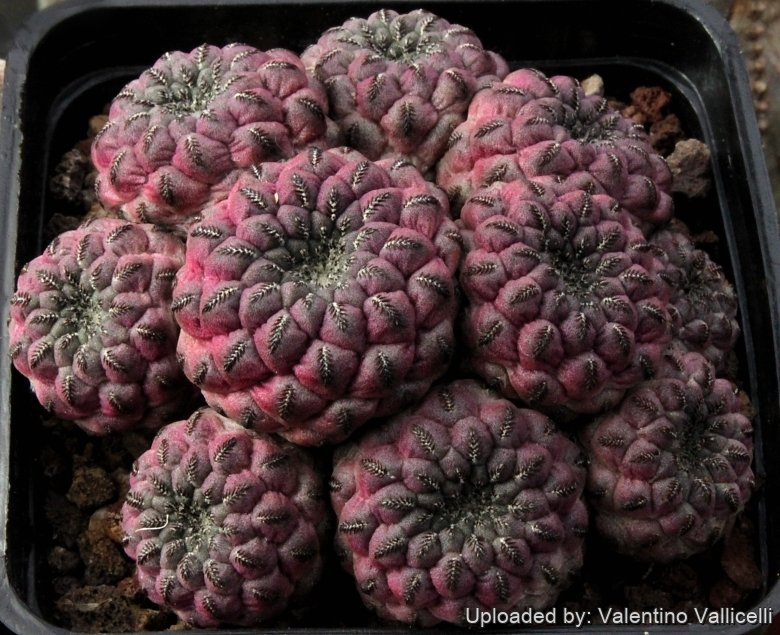
Rebutia canigueralii subs. rauschii, better known as Sulcorebutia rauschii, is a local or morphological form of the variable Rebutia canigueralii . It is a miniature clustering species (rarely solitary), readily forms clumps of many purple heads with characteristic very short, black spines form of a fishbone.
Stem: Individual stems 2(4) cm tall, 3(5) cm in diameter. The stem is covered by flat tubercles (5 mm wide) which vary in colour between dark green and violet. In older plants tubercles are arranged in up to 16 spiral line merging in the apex.
Areoles: Long narrow with short white felt.
Spines: 9-11 short black radial spines, 1 to 2 mm long, pointing diagonally and downward, completely flattened against the tubercles, they take the characteristic form of a fishbone.
Roots: Conical.
Flower: 20-50 mm long, 35-50 mm wide; floral tube funnel-shaped yellowish green with tan coloured scales, tepals deep magenta with a clearer throat.
Fruit: Reddish brown, 4-5 mm wide.
Blossoming time: Late spring.
Origin and Habitat
Sucre, Chuquisaca, Bolivia
Cultivation and Propagation
Rebutia rauschii is a mountainous plants with a thick taproots and is susceptible to overwatering, it grows rather slowly and need a very good drainage to avoid rotting. It requires also an appropriate air circulation and is sometime grafted to avoid root problems.
Soil: It loves a very permeable, coarse mineral soil.
Repotting: It require a deep pot suited to accommodate the swollen root, repotting with fresh potting-mix should be done every other year or when the plant has outgrown its pot. However, repotting doesn’t necessarily mean they’ll need larger containers. To prevent rottenness it is also advisable to surround its root neck by very rough sand or grit, this help a fast water drainage.
Sun Exposure: Light shade when young, full sun later ( light shadow my be useful in the hotsummer days)
Hardiness: Plants are and quite frost hardy -5 (-15)° C but preferably overwinter in a cool place (at 0/10°C). They need to be kept in a cool place during winter rest. This is important for the flowers, as well as for their health. Without this cool winter period, they normally won’t get many buds.
Watering: It requires moderately watering through the growing season. This can be done weekly or more frequently during the summertime, if the weather is sunny enough, but allow to dry fully before watering again. Kept this way, plants will show a healthy growth. Keep rather dry as soon as the temperature starts dropping in October and keep it strictly dry throughout the winter quiescent period since ot is very sensitive to any moisture excesses. The plants may survives outside without protection in winter (cold hardy to -5° ) but is then somewhat prone to rot, too.
Fertilization: Give an occasional high potassium liquid feed during the active growing period.
Garden uses: It is a fine plant for a rock garden or container, contrasts well with agaves, yuccas, and low-growing flowering plants. Nice planted with Agave utahensis, another very hardy species.
Pest and diseases: They are generally fairly easy to grow, especially if kept pest-free. They are susceptible to, scale insects and spider mite. Watch carefully for infestations of stem and root mealy bugs, and damage from these may well initiate fungal attack.
Propagation: Propagation: Seed, cutting, grafting. Take cuttings spring or summer, let them dry till the ends callous well. Then replant them in fresh cactus soil that is ever so slightly moist, and keep it that way till they root. Surface sowing is the best; seeds germinate in 14-28 days at 20° C, remembering that seedlings dislike strong light and dry conditions.
Bibliography
Major references and further lectures
-
Edward Anderson “The Cactus family” Timber Press, Incorporated, 2001
-
James Cullen, Sabina G. Knees, H. Suzanne Cubey “The European Garden Flora Flowering Plants: A Manual for the Identification of Plants Cultivated in Europe, Both Out-of-Doors and Under Glass” Cambridge University Press, 11/Aug/2011
-
David R Hunt; Nigel P Taylor; Graham Charles; International Cactaceae Systematics Group. “The New Cactus Lexicon” dh books, 2006
-
Urs Eggli, Leonard E. Newton: “Etymological Dictionary of Succulent Plant Names” Springer, Berlin/Heidelberg 2010
Source: Sulcorebutia tarabucoensis subs. rauschii, LLIFLE - Encyclopedia of living forms, CC-BY-SA, retrieved 2026-10-25.
From llifle page Sulcorebutia vasqueziana subs. losenickyana
Description
Rebutia canigueralii var. losenickyana, better known as Sulcorebutia losenickyana, is a local or morphological form of the variable Rebutia canigueralii. It is a choice solitary plant with dark green stems, white or brownish pectinated spines and profuse brownish or reddish flowers. This cactus is indeed beautiful even without its blooms. It is very variable.
Habit: In habitat it is a slow growing generally solitary cactus, but in cultivation may forms clumps of many heads.
Stem: Rapidly offsetting from the base, small, dull grey-green, individual stems 2,5 cm tall, 3 cm in diameter (often larger in culture).
Ribs: With raised tubercles (3-5 mm wide). In older plants tubercles are arranged in up to 13(-16) spiral line merging in the apex.
Areoles: Narrow with short white felt 5 mm long, 1 mm wide.
Roots: Conical multi-branched.
Radial spines: 11 to 14, fine, bristly, 1,5-3 mm long tight, pectinate, pointing diagonally and downward. Whitish with brownish base, golden, brown or almost black partially interlaced. Spines are very variable even within the same population.
Central spines: None or 1 to 2 ± distant and erect, whitish with darker base.
Flowers: Buds greenish, brownish to reddish, from the basal, older areoles, up to 40 mm long and 50 mm wide, odourless to slightly muffin smelling. More or less bi-coloured, red, often more brownish or violet at the tips, throat usually paler red or fading in orange or yellow, but less frequently uniformly red , light-violet or even white. Floral tube funnel-shaped yellowish-green or yellowish-red with tan coloured scales. Filaments yellowish with reddish bases, style yellowhish, with 5-6 stigma lobes.
Phenology: Flowers are produced in late spring and remain open for three or four days.
Fruit: Reddish to brownish approx 6 mm wide, with brown scales. Under the lowest scales usually it is possible to find some fine, white hair.
Seeds: 1,2-1,4 mm long and 1-1,2 mm wide.
Origin and Habitat
Chuquisaca and Potosí, Bolivia.
Altitude: 2400-3600 metres above sea level.
Habitat: It grows in sandstone hill with large boulders and rocky slopes mainly in deep soil in the open or among clumps of grass. The climate is very foggy.
Cultivation and Propagation
It loves a very permeable, coarse mineral soil as well as to be strictly kept dry throughout the winter quiescent period since it is very sensitive to any moisture excesses, To prevent rottenness it is also advisable to surround its root neck by very rough sand or grit, this help a fast water drainage and an appropriate air circulation.
For its sensitive roots this species is frequently grafted to avoid root problems.
Watering Needs: Water moderately in the growing season, keep dry during the winter rest
Frost Tolerance: Plants are and quite frost hardy -5 (-15)° C but prefeably overwinter in a cool place (at 0/10°C) this is important for the flowers as well as for plants health. Without this cool winter period they normally wont get any buds.
Sun Exposure: Needs a full sun exposure ( light shadow my be useful in the hottest summer days)
Propagation: Seed, cutting, grafting.
Source: Sulcorebutia vasqueziana subs. losenickyana, LLIFLE - Encyclopedia of living forms, CC-BY-SA, retrieved 2026-10-25.
From llifle page Weingartia frankiana
Description
Sulcorebutia frankiana (often listed as Weingartia frankiana) is one of the several forms of the very variable Rebutia canigueralii which form a complex of related taxon. The “frankiana” distinguish for the small-bodies with fox-brown spines and pink to magenta flowers.
Habit: It is a slow growing solitary cactus occasionally offsetting from the base to form clumps of many heads.
Stem: Solitary or offsetting from the base, small, dark-green, green to dark purple A characteristic of this species is that the offsets develop roots while still attached to the mother. Individual stems 2-4 cm tall, 3-5(-6) cm in diameter.
Ribs: With raised tubercles. In older plants tubercles are arranged in up to 13 spiral line merging in the apex.
Areoles: Narrow with short white felt.
Roots: Conical.
Radial spines: 10-18 fine, bristly, tight, pectinate, pointing diagonally and downward, brown, fox-brown or reddish. Sometime interlaced.
Central spines: None.
Flowers: About 4 cm in diameter, from the basal part of the stem, usually pink to dark-magenta or dark-red.
Phenology: Flowers are produced in late spring and remain open for three or four days.
Origin and Habitat
Sucre to Los Alamos and adjacent areas, Chuquisaca, Bolivia.
Altitude: 2700-3400 metres above sea level.
Habitat and Ecology: Sulcorebutia frankiana is found in rocky outcrops on top of hills and at the base of rocky ridges in deep soil amongst grass and shrubs together with a Echinopsis obrepanda. It is also often found growing close to Rebutia canigueralii subs. alba (Sulcorebutia alba) and flowering at the same time with no apparent hybridization.
Cultivation and Propagation
Rebutia canigueralii var. frankiana is a mountainous plants with a thick taproots and is susceptible to overwatering, it grows rather slowly and need a very good drainage to avoid rotting. It requires also an appropriate air circulation and is sometime grafted to avoid root problems.
Soil: It loves a very permeable, coarse mineral soil.
Repotting: It require a deep pot suited to accommodate the swollen root, repotting with fresh potting-mix should be done every other year or when the plant has outgrown its pot. However, repotting doesn’t necessarily mean they’ll need larger containers. To prevent rottenness it is also advisable to surround its root neck by very rough sand or grit, this help a fast water drainage.
Sun Exposure: Light shade when young, full sun later ( light shadow my be useful in the hot summer days)
Hardiness: Plants are and quite frost hardy -5 (-15)° C but preferably overwinter in a cool place (at 0/10°C). They need to be kept in a cool place during winter rest. This is important for the flowers, as well as for their health. Without this cool winter period, they normally won’t get many buds.
Watering: It requires moderately watering through the growing season. This can be done weekly or more frequently during the summertime, if the weather is sunny enough, but allow to dry fully before watering again. Kept this way, plants will show a healthy growth. Keep rather dry as soon as the temperature starts dropping in October and keep it strictly dry throughout the winter quiescent period since ot is very sensitive to any moisture excesses. The plants may survives outside without protection in winter (cold hardy to -5° ) but is then somewhat prone to rot, too.
Fertilization: Give an occasional high potassium liquid feed during the active growing period.
Garden uses: It is a fine plant for a rock garden or container, contrasts well with agaves, yuccas, and low-growing flowering plants. Nice planted with Agave utahensis, another very hardy species.
Pest and diseases: They are generally fairly easy to grow, especially if kept pest-free. They are susceptible to, scale insects and spider mite. Watch carefully for infestations of stem and root mealy bugs, and damage from these may well initiate fungal attack.
Propagation: Seed, cutting, grafting. Take cuttings spring or summer, let them dry till the ends callous well. Then replant them in fresh cactus soil that is ever so slightly moist, and keep it that way till they root. Surface sowing is the best; seeds germinate in 14-28 days at 20° C, remembering that seedlings dislike strong light and dry conditions.
Bibliography
Major references and further lectures
-
James Cullen, Sabina G. Knees, H. Suzanne Cubey “The European Garden Flora Flowering Plants: A Manual for the Identification of Plants Cultivated in Europe, Both Out-of-Doors and Under Glass” Cambridge University Press, 11/Aug./2011
-
David Hunt, Nigel Taylor “The New Cactus Lexicon” DH Books, 2006
-
Edward F. Anderson “The Cactus Family” Timber Press, 2001
-
Anderson E. F.: “The Cactus Family” Timber Press, Portland, Oregon, 2001
-
Ritter Fr.: “Kakteen in Südamerika” Spangenberg, 1980
-
John Pilbeam “Sulcorebutia and Weingartia: A Collector’s Guide” Timber Press, 1985
Source: Weingartia frankiana, LLIFLE - Encyclopedia of living forms, CC-BY-SA, retrieved 2026-10-25.
From llifle page Weingartia pasopayana
Description
It is small-headed low growing, mound forming, cactus that forms large clumps, sometime with hundreds of heads. The tiny spines are held close to the body giving it the canigueralii look. The flowers are blood red.
Stem: Flattened globose, apex depressed which, branches profusely from the base. Dull olive-green, individual stems 20-40 mm in diameter, 20-30 mm tall. The stem is covered by flat tubercles (5mm wide). In older plants tubercles are arranged in up to 16 spiral line merging in the apex.
Areoles: Long narrow with short white felt.
Radial spines: 8-12 yellow/brown, fine, bristle-like 2-10 mm long. Pectinated, ± pointing diagonally and downward.
Central spines:: Usually absent.
Flowers: Very dark magenta or red sometimes with a paler throats. 3-4 cm long and in diameter. Floral tube funnel-shaped yellowish green with tan coloured scales.
Blooming season: Flowers are produced in late spring and remain open for three or four days.
Fruit: Dark brownish red., 4 - 5 mm wide.
Origin and Habitat
Road Presto - Pasopaya, Zudanez, Chuquisaca, Bolivia 2700-3200m
Cultivation and Propagation
S. pasopayana loves a very permeable, coarse mineral soil as well as to be strictly kept dry throughout the winter quiescent period since it is very sensitive to any moisture excesses, To prevent rottenness it is also advisable to surround its root neck by very rough sand or grit, this help a fast water drainage and an appropriate air circulation.
For its sensitive roots this species is frequently grafted to avoid root problems.
Watering Needs Water moderately in the growing season, keep dry during the winter rest
Frost Tolerance: Plants are and quite frost hardy -5 (-15)° C but prefeably overwinter in a cool place (at 0/10°C) this is important for the flowers as well as for plants health. Without this cool winter period they normally wont get any buds.
Sun Exposure: Needs a full sun exposure ( light shadow my be useful in the hottest summer days)
Propagation: Seed, cutting, grafting
Source: Weingartia pasopayana, LLIFLE - Encyclopedia of living forms, CC-BY-SA, retrieved 2026-10-25.
From llifle page Weingartia tarabucoensis
Description
Sulcorebutia tarabucoensis, also known as Weingartia tarabucoensis , is one of the forms of Rebutia canigueralii which is a widespread and morphologically variable taxon. It is a small globular cactus with a long taproot, distinguished from the type species for its hair-like, fine, bristly spines, up to 10 mm long, white, cream-coloured or yellowish, tight, interlaced, and more or less pectinated. From the basal part of the stem it produces numerous, vivid cherry-red or dark magenta flowers about 35-50 mm wide. Floral tube funnel-shaped yellowish-green or yellowish-red with tan coloured scales. Blossoms appear most heavily in spring and remain open for three or four days. Sulcorebutia tarabucoensis belongs to a group of easily cultivated plants, decorative with pleasing appearance of stem and flower alike.
Derivation of specific name: “tarabucoensis” for the occurrence near Tarabuco, Chuquisaca, Bolivia.
Origin and Habitat
Tarabuco and adjacent areas, Chuquisaca, Bolivia.
Altitude range: 3090-3770 metres above sea level.
Source: Weingartia tarabucoensis, LLIFLE - Encyclopedia of living forms, CC-BY-SA, retrieved 2026-10-25.
From llifle page Sulcorebutia rauschii f. aureispina
Description
Rebutia canigueralii subs. rauschii f. aureispina (SulcoSN’>10863’ alt=‘5130’>Rebutia canigueralii#SN#5130’>Sulco[[Rebutia canigueraliiSN’ style=‘border:none;’> cv. Yellow Spines) is one of the many geographical form of the very variableRebutia canigueralii. Many of its morphological and geographical variant was early classified as different independent species, but nowadays all this plant are considered part of a multiform species, where each form is linked to others by populations of plants with intermediate characteristics. Rebutia canigueralii subs. rauschii f. aureispina has short yellow pectinated spines on the typical mauve body of SulcoSN’>10863’ alt=‘5130’>Rebutia canigueralii#SN#5130’>Sulco[[Rebutia canigueraliiSN’ style=‘border:none;’>. It is very nice and distinctive.
Habit: It is a low growing miniature cactus species, that readily forms clumps of many heads.
Stem: Individual stems 2(4) cm tall, 3(5) cm in diameter. The stem is covered by flat mauve and green coloured tubercles (about 5 mm wide)
Areoles: Long narrow with short white felt.
Spines: 9-11 short yellow radial spines, 1 to 5 mm long, pointing diagonally and downward, completely flattened against the tubercles, they take the characteristic form of a fishbone.
Roots: Conical.
Flower: 20-50 mm long, 35-50 mm wide; floral tube funnel-shaped yellowish green with tan coloured scales, tepals deep magenta with a clearer throat.
Blossoming time: Late spring.
Cultivation and Propagation
Rebutia canigueralii subs. rauschii f. aureispina is a mountainous plants with a thick taproots and is susceptible to overwatering, it grows rather slowly and need a very good drainage to avoid rotting. It requires also an appropriate air circulation and is sometime grafted to avoid root problems.
Soil: It loves a very permeable, coarse mineral soil.
Repotting: It require a deep pot suited to accommodate the swollen root, repotting with fresh potting-mix should be done every other year or when the plant has outgrown its pot. However, repotting doesn’t necessarily mean they’ll need larger containers. To prevent rottenness it is also advisable to surround its root neck by very rough sand or grit, this help a fast water drainage.
Sun Exposure: Light shade when young, full sun later ( light shadow my be useful in the hotsummer days)
Hardiness: It is cold resistant to -10° ( or less depending on clones) for short periods of time. They need to be kept in a cool place during winter rest. This is important for the flowers ,as well as for their health. Without this cool winter period, they normally won’t get many buds.
Watering: It requires moderately watering through the growing season. This can be done weekly or more frequently during the summertime, if the weather is sunny enough, but allow to dry fully before watering again. Kept this way, plants will show a healthy growth. Keep rather dry as soon as the temperature starts dropping in October and keep it strictly dry throughout the winter quiescent period since ot is very sensitive to any moisture excesses. The plants may survives outside without protection in winter (cold hardy to -5° ) but is then somewhat prone to rot, too.
Fertilization: Give an occasional high potassium liquid feed during the active growing period.
Garden uses: It is a fine plant for a rock garden or container, contrasts well with agaves, yuccas, and low-growing flowering plants. Nice planted with Agave utahensis, another very hardy species.
Pest and diseases: They are generally fairly easy to grow, especially if kept pest-free. They are susceptible to, scale insects and spider mite. Watch carefully for infestations of stem and root mealy bugs, and damage from these may well initiate fungal attack.
Propagation: Propagation: Seed, cutting, grafting. Take cuttings spring or summer, let them dry till the ends callous well. Then replant them in fresh cactus soil that is ever so slightly moist, and keep it that way till they root. Surface sowing is the best; seeds germinate in 14-28 days at 20° C, remembering that seedlings dislike strong light and dry conditions.
Source: Sulcorebutia rauschii f. aureispina, LLIFLE - Encyclopedia of living forms, CC-BY-SA, retrieved 2026-10-25.
From llifle page Sulcorebutia rauschii f. violacidermis
Description
Miniature clustering species (rarely solitary), readily forms clumps of many heads
Stem: individual stems 2(4) cm tall, 3(5) cm in diameter. The stem is covered by flat tubercles (5mm wide), which vary in colour between violet-green and bright mauve. In older plants tubercles are arranged in up to 16 spiral line merging in the apex.
Areoles: Long, narrow, with short white felt.
Spines: 9-11, short, black radial spines, 1 to 2 mm long, pointing diagonally and downward, completely flattened against the tubercles. They take the characteristic form of a fishbone.
Roots: Conical
Flower: 20 - 50 mm long, 35 - 50 mm wide; floral tube funnel-shaped yellowish green with tan coloured scales, tepals deep magenta with a clearer throat.
Fruit: Reddish brown, 4 - 5 mm wide.
Phenology: Blossoming time: late spring.
Cultivation and Propagation
It’s very difficult to find high quality plants of this species in cultivation, S. rauschii loves a very permeable, coarse mineral soil. It must strictly be kept dry throughout the winter quiescent period since it is very sensitive to any moisture excesses, To prevent rottenness it is also advisable to surround its root neck by very rough sand or grit. This helps a fast water drainage and an appropriate air circulation.
For its sensitive roots this species is frequently grafted to avoid root problems. Plants grafted on Opuntia compressa are easy to grow and quite frost hardy -5 (-10)° C
Watering Needs: Water moderately in the growing season, keep dry during the winter rest
Frost Tolerance: Overwinter in a cool place (at 0/10°C). This is important for the flowers as well as for plants’ health. Without this cool winter period they normally won’t get any buds.
Propagation: Seed, cutting, grafting.
Sun Exposure: Needs a full sun exposure (light shadow may be useful in the hottest summer days)
Propagation: Seed, cutting, grafting.
Source: Sulcorebutia rauschii f. violacidermis, LLIFLE - Encyclopedia of living forms, CC-BY-SA, retrieved 2026-10-25.
From llifle page Sulcorebutia callecallensis
Description
Rebutia canigueralii var. callecallensis is one of the innumerable local form of the very variable Rebutia canigueralii with tiny clustering stems short, pectinate adpressed, bright spines and outstanding bicoloured yellow-red blooms.
Habit: It is a low-growing clustering cactus that may forms clumps of many heads, in habitat the plant retract almost completely below soil level during time of drought .
Stem: Rapidly offsetting from the base, very small, typically light-green or (rarely) dark purple. A characteristic of this species is that the offsets develop roots while still attached to the mother. Individual stems 1-2 cm talland in diameter (or a little more in cultivation).
Ribs: With slightly raised tubercles (about 3-4 mm wide) . In older plants tubercles are arranged in up to 8-13 spiral line merging in the apex.
Areoles: 2-3 mm long, narrow with short white felt.
Roots: Conical.
Radial spines: 11 to 14, fine, bristly, 1,5-2 (or more) mm long tight, pectinate, pointing diagonally and downward, that recurve and hug the tubercles so as not to be felt. Straw to amber with darker bases. Not interlaced.
Central spines: None.
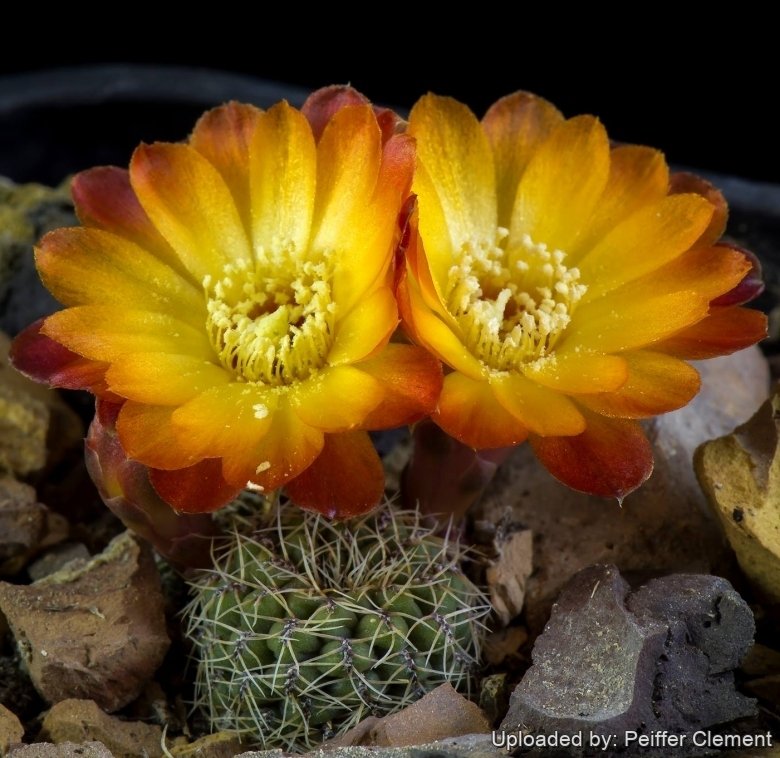
Flowers: From the basal part of the stem, 20 - 50 mm long, 35 - 50 mm wide nearly all bi-coloured orange or red, with yellow throats, some with shimmering blue tips of the petals. Some of these flowers appear almost three-coloured, which of course makes them particularly attractive. However, there are small populations of plants with darker, reddish shaded epidermis with almost pure red flowers . Elsewhere, there are only yellow to yellow-orange-colored flowers or purple flowers with yellow throat, a combination of colours which is rarely seen in this manner from any other Sulcorebutia.
Phenology: Flowers are produced in late spring and remain open for three or four days.
Fruit: Dark brownish red approx 4-5 mm wide.
Origin and Habitat
Cerro Calle Calle, Chuquisaca, Bolivia.
Altitude: 2900-3100.
Habitat: They grows atop a massive table mountain over large parts the summit plateau.
Cultivation and Propagation
Sulcorebutias are summer grower species easy to cultivate, more cold tolerant than most. These mountainous plants have thick taproots and are susceptible to overwatering. They requires also an appropriate air circulation and are sometime grafted to avoid root problems.
Growth rate: It is a relatively rapidly growing and easily flowering species that will make clumps given the best conditions.
Soils: It likes very coarse mineral cactus mix soil, but can become too elongated if compost is too rich.
Repotting: Use pot with good drainage.
Watering: Water moderately from Spring to Autumn, but do not overwater (Rot prone), it must be strictly kept dry throughout the winter quiescent period since it is very sensitive to any moisture excesses keep dry in winter.
Fertilization: Feed with a high potassium fertilizer in summer.
Hardiness: They need to be kept in a cool place during winter rest and are somewhat resistant to frost if kept on the dry side prior to, and during, cold weather (due to the altitude they are hardy to -7 C ° C, or less for short periods). The cold is important for the flowers, as well as for their health. Without this cool winter period, they normally won’t get any buds.
Exposition: Requires full sun or light shade and careful watering to keep plant compact with strong coloured spines. Tends to bronze in strong light, which encourages flowering and heavy spine production. Light shadow my be useful in the hottest summer days.
Uses: It is an excellent plant for container growing. It always looks good and stays small. It look fine in a cold greenhouse and frame or outdoor in a rockery.
Pests & diseases: It may be attractive to a variety of insects, but plants in good condition should be nearly pest-free, particularly if they are grown in a mineral potting-mix, with good exposure and ventilation. Nonetheless, there are several pests to watch for:
- Red spiders: Red spiders may be effectively rubbed up by watering the infested plants from above.
- Mealy bugs: Mealy bugs occasionally develop aerial into the new growth among the wool with disfiguring results, but the worst types develop underground on the roots and are invisible except by their effects.
- Sciara Flies: Sciara flies are one of the major problems for seedlings. It is a good practice to mulch your seedlings with a layer of grit, which will strongly discourage the flies.
- Scales: Scales are rarely a problem.
It is wise to treat your whole collection with a systemic insecticide twice a year in spring and autumn.
- Rot: Rot is only a minor problem with cacti if the plants are watered and “aired” correctly. If they are not, fungicides won’t help all that much. To prevent rottenness it is also advisable to surround its root neck by very rough sand or grit, this help a fast water drainage.
Propagation: Seed, cutting, grafting. Seeds germinate in 7-14 days at 21-27° C in spring, remove gradually the glass cover as soon the plants will be well rooted (ca 1-2 weeks) and keep ventilated, no full sun for young plants!
Source: Sulcorebutia callecallensis, LLIFLE - Encyclopedia of living forms, CC-BY-SA, retrieved 2026-10-25.
From llifle page Sulcorebutia canigueralii var. applanata
Description
Rebutia canigueralii var. applanata, better known as Sulcorebutia verticillacantha var. applanata, is a local or morphological form of the variable Rebutia canigueralii. It is a choice solitary plant with pectinated spines and profuse brownish or reddish flowers. This cactus is indeed beautiful even without its blooms.
Habit: It is a slow growing clustering cactus that may forms clumps of many heads.
Stem: Rapidly offsetting from the base, small, dull grey-green, individual stems 2,5 cm tall, 3 cm in diameter.
Ribs: With raised tubercles (3-5 mm wide) . In older plants tubercles are arranged in up to 13(-16) spiral line merging in the apex.
Areoles: Narrow with short white felt 5 mm long, 1 mm wide.
Roots: Conical multi-branched.
Radial spines: 11 to 14, fine, bristly, 1,5-3 mm long tight, pectinate, pointing diagonally and downward. Whitish with brownish base partially interlaced.
Central spines: None or 1 to 2 ± distant and erect, whitish with darker base.
Flowers: Buds greenish, brownish to reddish, from the basal, older areoles, up to 40 mm long and 50 mm wide, odourless to slightly muffin smelling. More or less bi-coloured, red, often more brownish or violet at the tips, throat usually paler red or fading in orange or yellow, but less frequently uniformly red , light-violet or even white. Floral tube funnel-shaped yellowish-green or yellowish-red with tan coloured scales. Filaments yellowish with reddish bases, style yellowhish, with 5-6 stigma lobes.
Phenology: Flowers are produced in late spring and remain open for three or four days.
Fruit: Reddish to brownish approx 6 mm wide, with brown scales. Under the lowest scales usually it is possible to find some fine, white hair.
Seeds: 1,2-1,4 mm long and 1-1,2 mm wide.
Origin and Habitat
Dept. Chuquisaca, Prov. Oropeza, on the south-east outskirts of the town of Sucre, on the Cerro Churuquella, 2800-2900 m (type locality), in addition, a further population is located approximately over Sucre and along the road to Poroma.
Cultivation and Propagation
Sulcorebutia canigueralii loves a very permeable, coarse mineral soil as well as to be strictly kept dry throughout the winter quiescent period since it is very sensitive to any moisture excesses, To prevent rottenness it is also advisable to surround its root neck by very rough sand or grit, this help a fast water drainage and an appropriate air circulation. For its sensitive roots this species is sometime grafted to avoid root problems.
Watering Needs: Water moderately in the growing season, keep dry during the winter rest
Frost Tolerance: Plants are and quite frost hardy -5 (-15)° C but prefeably overwinter in a cool place (at 0/10°C) this is important for the flowers as well as for plants health. Without this cool winter period they normally wont get any buds.
Sun Exposure: Needs a full sun exposure ( light shadow my be useful in the hottest summer days)
Propagation: Seed, cutting, grafting
Source: Sulcorebutia canigueralii var. applanata, LLIFLE - Encyclopedia of living forms, CC-BY-SA, retrieved 2026-10-25.
From llifle page Sulcorebutia rauschii f. cristata
Description
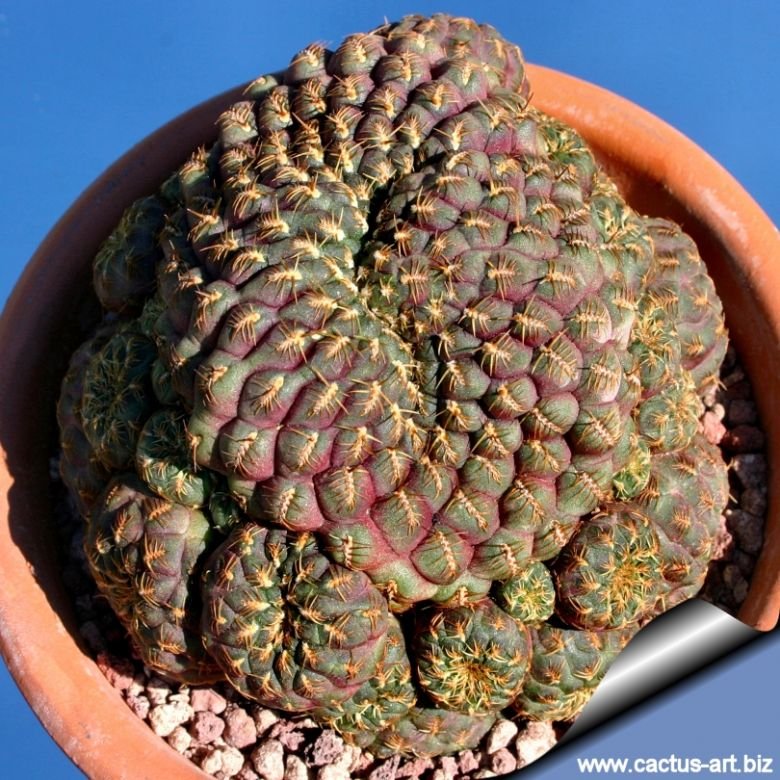
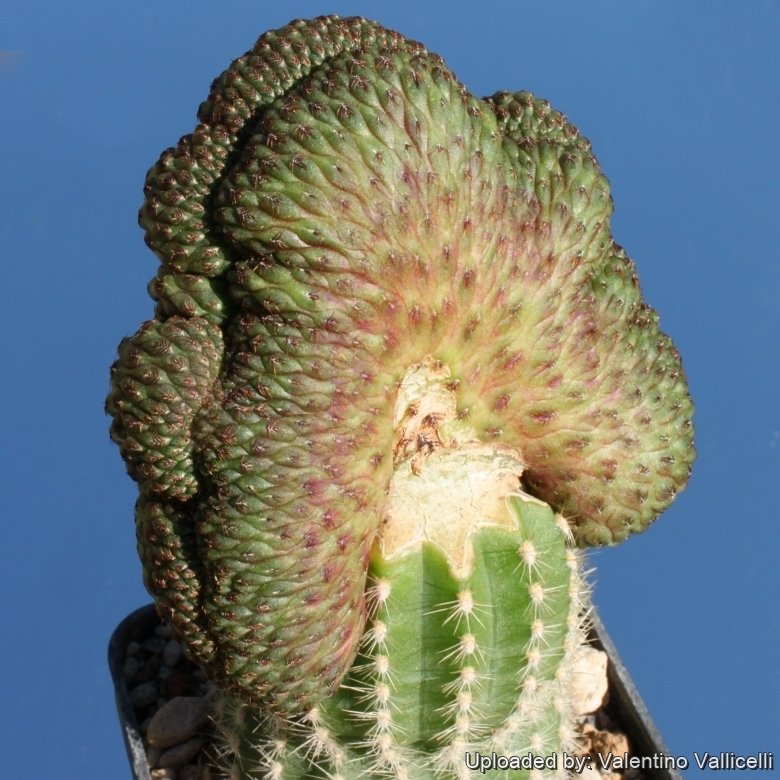
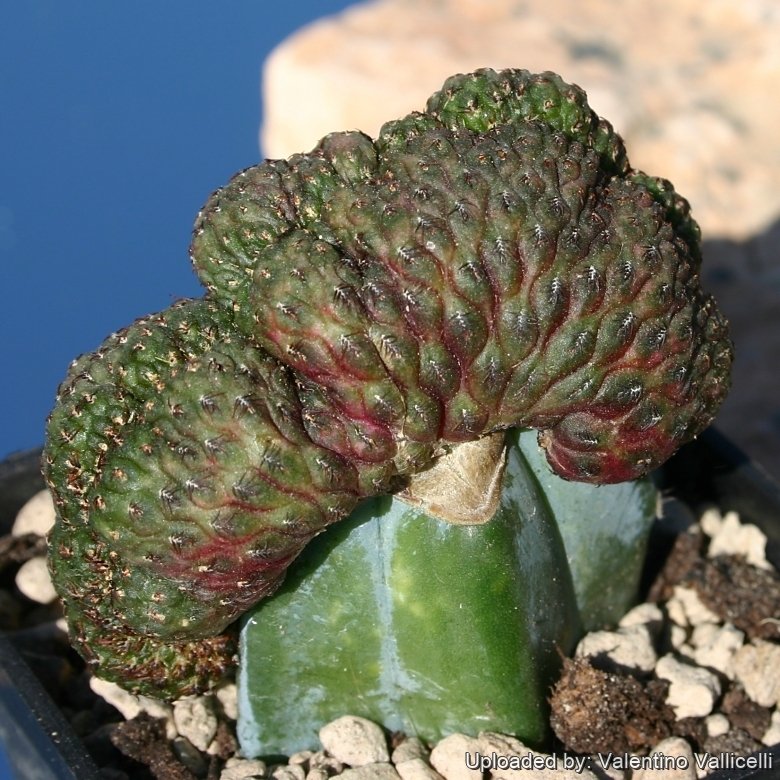
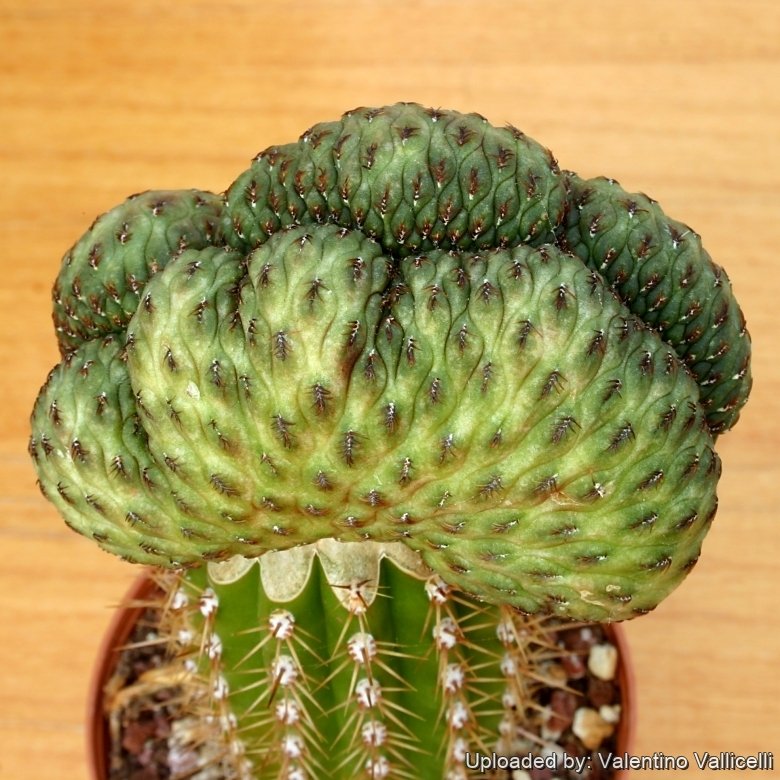
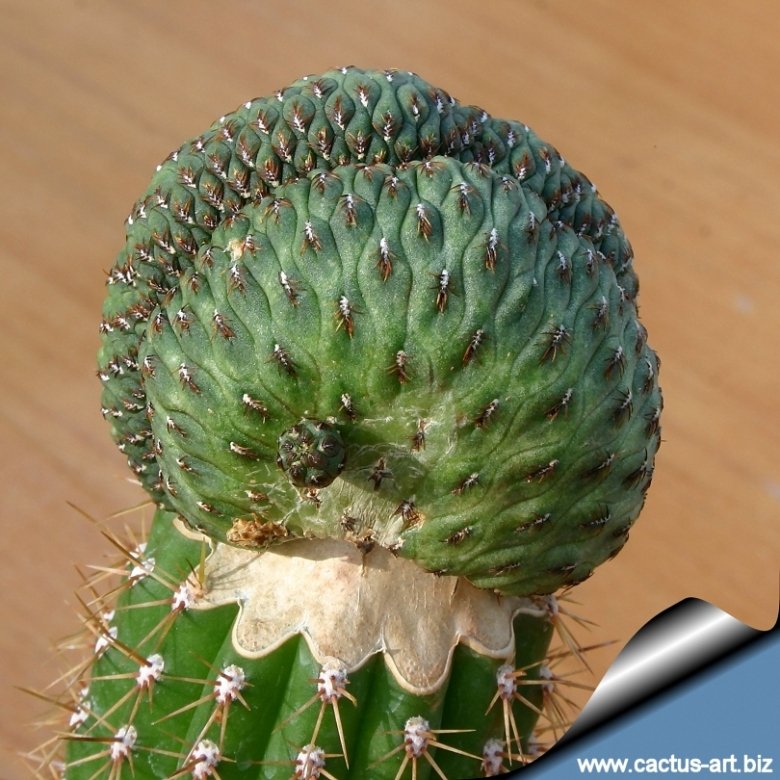
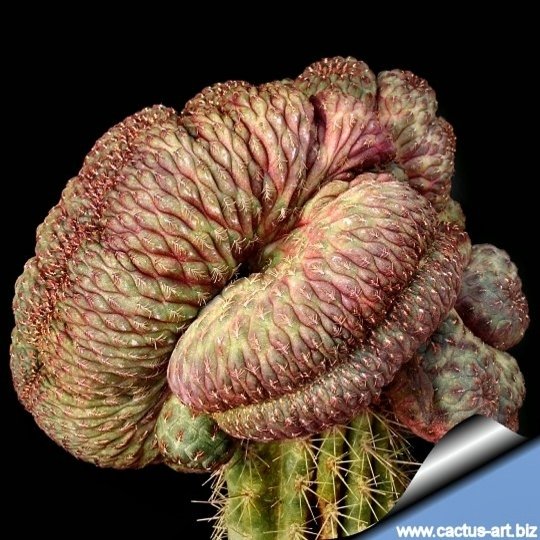
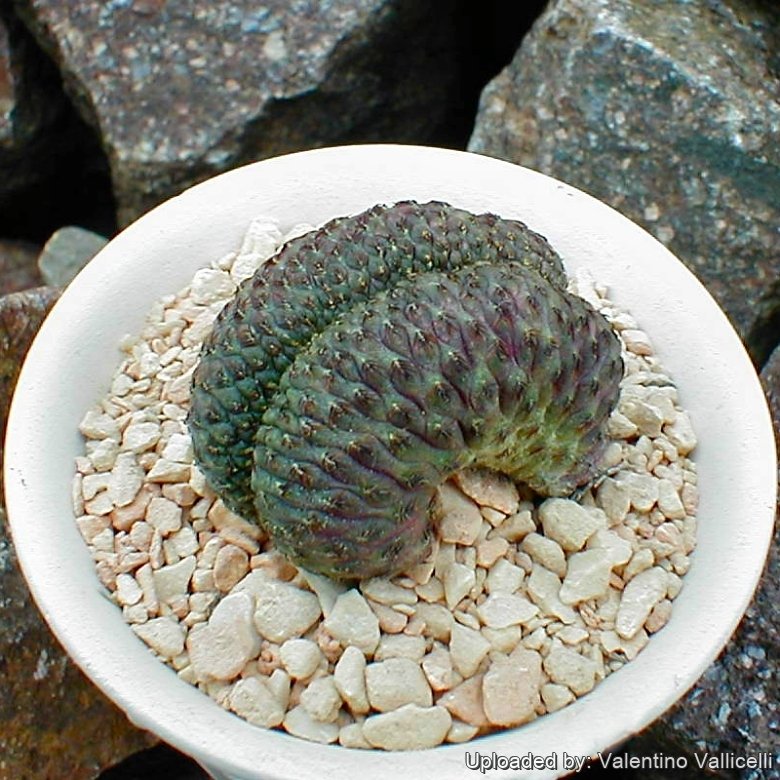
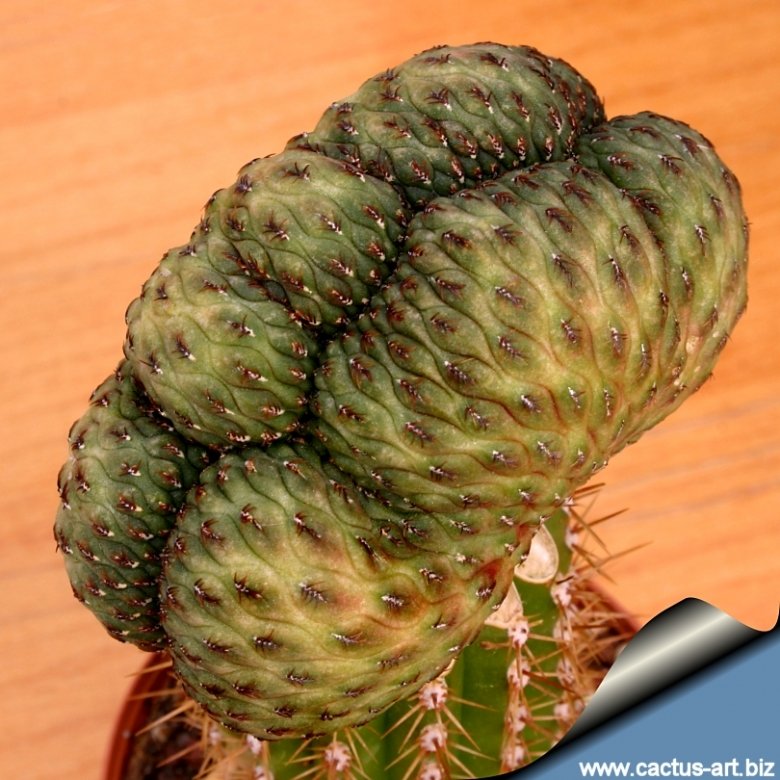
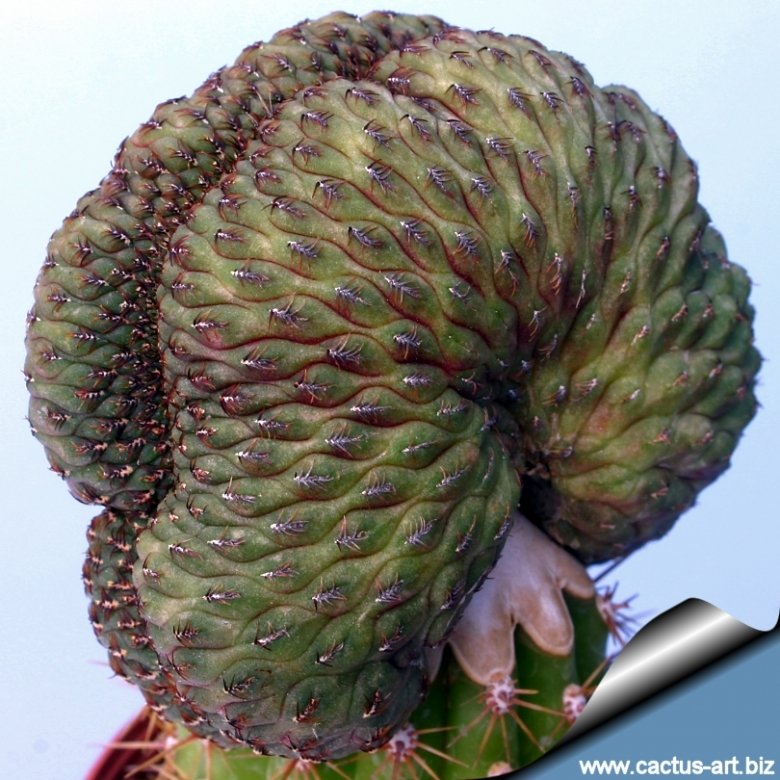
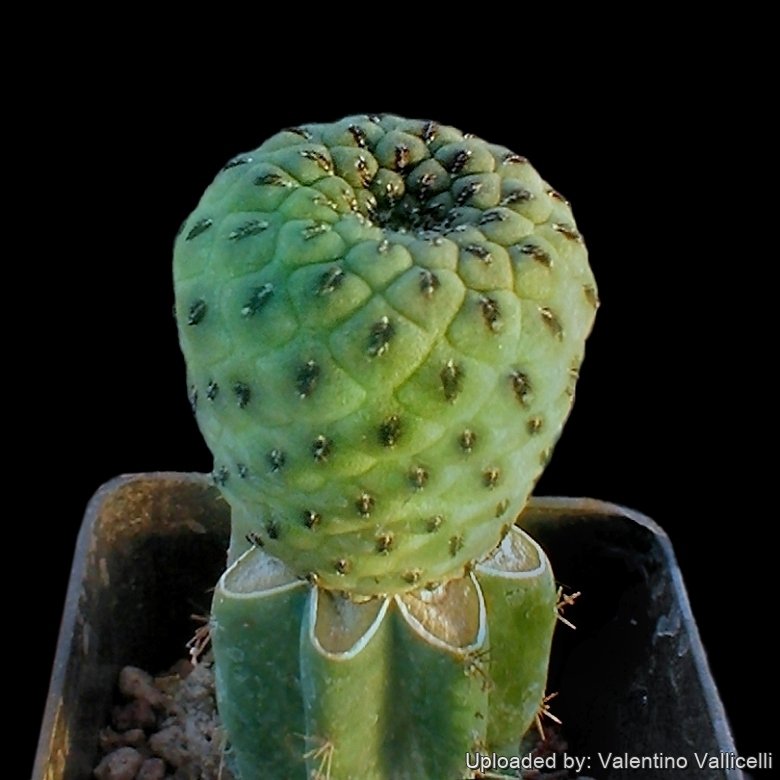
The typical Sulcorebutia rauschii is a well known miniature clustering species, that readily forms clumps of many heads with characteristic short pectinate spines. The crested form is very rare and nice..
Stem: Up to 5 cm in width. .The stem is covered by flat tubercles (5mm wide) which vary in colour between dark green and violet.
Areoles: Long narrow with short white felt.
Spines: 9-11 short black radial spines, 1 to 2 mm long, pointing diagonally and downward, completely flattened against the tubercles, they take the characteristic form of a fishbone.
Flower: 20 - 50 mm long, 35 - 50 mm wide; floral tube funnel-shaped yellowish green with tan coloured scales, tepals deep magenta with a clearer throat.
Origin and Habitat
Garden origin (Nursery produced cultivar)
Cultivation and Propagation
Very difficult to find high quality plants of this species in cultivation, S. rauschii loves a very permeable, coarse mineral soil as well as to be strictly kept dry throughout the winter quiescent period since it is very sensitive to any moisture excesses, To prevent rottenness it is also advisable to surround its root neck by very rough sand or grit, this help a fast water drainage and an appropriate air circulation.
For its sensitive roots this species is frequently grafted to avoid root problems. Water moderately in the growing season, keep dry during the winter rest. Needs a full sun, or half shaded exposure (light shadow my be useful in the hottest summer days)
Propagation: Grafting since cutting root hardly.The cause of cresting: The cause of cresting is not fully explained, biologists disagree as to why some cacti grow in this unusual form. Some speculate that it is a genetic mutation. Others say it is the result of a lightning strike or freeze damage, but whatever the stimulus, the growth point of the stem has switched from a geometric point, to a line, which folds and undulates as the crest expands. Crested Yavia are very rare, cresting occurs naturally and can be encountered in many other cactus species.
Source: Sulcorebutia rauschii f. cristata, LLIFLE - Encyclopedia of living forms, CC-BY-SA, retrieved 2026-10-25.
From llifle page Sulcorebutia rauschii f. viridermis
Description
Rebutia canigueralii subs. rauschii f. viridermis|, better known as Sulcorebutia rauschii cv. Green Form, is a morphological form of the variable Rebutia canigueralii subs. rauschii distinguished for the pure green body (not purple-violet). This cactus is indeed beautiful even without its blooms.
Habit: Miniature clustering species (rarely solitary), readily forms clumps of many heads.
Stem: Individual stems 2(4) cm tall, 3(5) cm in diameter. The stem is covered by flat tubercles (5 mm wide) which vary in colour between pale to dark green. In older plants tubercles are arranged in up to 16 spiral line merging in the apex.
Areoles: Long narrow with short white felt.
Spines: 9-11 short black radial spines, 1 to 2 mm long, pointing diagonally and downward, completely flattened against the tubercles, they take the characteristic form of a fish-bone.
Roots: Conical.
Flower: 20-50 mm long, 35-50 mm wide; floral tube funnel-shaped yellowish green with tan coloured scales, tepals deep magenta with a clearer throat.
Fruit: Reddish brown, 4-5 mm wide.
Blossoming time: Late spring.
Origin and Habitat
Zudañez, Chuquisaca, Bolivia
Cultivation and Propagation
These mountainous plants have thick taproots and are susceptible to overwatering. They loves a very permeable, coarse mineral soil as well as to be strictly kept dry throughout the winter quiescent period since it is very sensitive to any moisture excesses, To prevent rottenness it is also advisable to surround its root neck by very rough sand or grit, this help a fast water drainage. They requires also an appropriate air circulation and are sometime grafted to avoid root problems. They need to be kept in a cool place during winter rest (at 0-10°C). This is important for the flowers ,as well as for their health. Without this cool winter period, they normally won’t get any buds.
Grafted plants are very easy to grow, and are quite frost hardy (-5° C) if kept dry. Needs a full sun exposure ( light shadow my be useful in the hottest summer days)
Propagation: Seed, cutting, grafting.
Source: Sulcorebutia rauschii f. viridermis, LLIFLE - Encyclopedia of living forms, CC-BY-SA, retrieved 2026-10-25.
From llifle page Sulcorebutia tarabucoensis subs. aureiflora
Description
Reaching a height of 2 cm and a width of 25 mm, Sulcorebutia tarabucoensis var. aureiflora (syn: S. verticillacantha var. aureiflora) is one of the morphological forms of Rebutia canigueralii which is a widespread and variable taxon. It is ringed with bright yellow, funnel-shaped flowers which distinguishes it from the cherry-red or dark magenta flowers of standard Sulcorebutia tarabucoensis. It is a small globular cactus with a long taproot, hair-like, fine, bristly spines, up to 10 mm long, white, cream-coloured or yellowish, tight, interlaced, and more or less pectinated. Blossoms appear most heavily in spring and remain open for three or four days. S. tarabucoensis var. aureiflora belongs to a group of easily cultivated plants, decorative with pleasing appearance of stem and flower alike.
Derivation of specific name: The variety was named after the colour of its flowers, aureiflorus means golden-yellow blossoming.
Stem: Single, but often forming large tufts in culture, individual bodies spherical, up to 20 mm high and 25 mm wide, in culture more elongated, to 30-50 mm high and up to 35 mm across, yellowish grey-green to dark grey-green, sometimes tinged with violet, with a strong taproot.
Tubercles: In up to 17 spiral series, flattened, 3-4 mm long.
Areoles: white about 3 mm long, 1 mm in width.
Spines: 10-12, only radial, 3-5 mm long, straight to bent, appressed, white to yellow, base brown and somewhat bulging.
Flowers: about 30 mm long and 40 mm wide, yellow to two-colored (yellow and orange red). Tepals wholly yellow or yellow at the base and orange to red at the end, range of orange-red parts very variable.Flower tube pink with green or brown scales, inside purple pink. Filaments base red, top yellow. Anthers yellowish. Stigma greenish, stigma-lobes 5-7 white.
Fruits: Violet green to brown with pink scales.
Seeds: Up to 1.3 mm long and 1 mm wide, testa matt black, irregularly bumpy.
Comment: S. tarabucoensis var. aureiflora is especially variable in flower colouring. The petals varies from pure yellow or yellow with orange-red in their edges and tips in different proportions, so the flowers are all yellow but also orange red with yellow centre. At the type locality site, pure yellow and yellow-orange flowering plants were represented by W. Rausch at approximately the same ratio. This varieties was firstly represented in collections the following field numbers WR 479 and Lau 389. S. tarabucoensis var. aureiflora var. aureiflora (S. verticillacantha var. aureiflora) also differs from the related taxa by grey-green colouration of the epidermis, yellow to white spines and especially yellow to yellow and red flowers are unusual for Sulcorebutia tarabucoensis. Flowers of similar colour combinations can be found in a very close taxa Rebutia caniguerallii, but its spines are only about 2 mm long, it has about 13 ribs and a brown colouration of the skin. Other plants in which similarly coloured flowers can be found belong to much more distant taxa. They occur both in the Sulcorebutia hoffmanniana (Sulcorebutia seinoiana) and Sulcorebutia steinbachii (Sulcorebutia tuberculo-chrysantha, Sulcorebutia polymorpha).
Variability in flower of S. verticillacantha var. aureiflora led to the fact that F.Brandt described this taxon twice calling the yellow and red flowers form as Weingartia rubro-aurea (Sulcorebutia rubroaurea). Due to the variation in colour of var. aureiflora and rubroaurea this two varieties cannot be assessed higher than at the form level. But if S. tarabucoensis var. aureiflora should be considered as a separate species, then the correct name for this species would be Sulcorebutia callecallensis.
Origin and Habitat
Tarabuco and adjacent areas, Sucre, Bolivia.
Altitude range: Around 3400 metres above sea level.
Bibliography
Major references and further lectures
-
John Pilbeam “Sulcorebutia and Weingartia: A Collector’s Guide” Timber Press, p. 97, 1985
-
Botanica: “The Illustrated A-Z of Over 10,000 Garden Plants and how to Cultivate Them” Mynah, 1997
-
Brinkmann K.-H., “Die Gattung Sulcorebutia”, p. 57, 1976
-
Lindner P., “Přehled rodu Sulcorebutia Backeberg emend. Brederoo et Donald”, Aztekia (mimořádné číslo), p. 94, 1982
-
Rausch W., “Sulcorebutia verticillacantha var. aureiflora Rausch var. nov.”, Succulenta, 52 : 187, 1973
-
Sulcorebutia verticillacantha Ritter var. aureiflora Rausch, retrieved on 25 December 2017 from <http://kaktusylexikon.7x.cz/lexikon-kaktusu/lexikon-kaktusu/sulcorebutia/sulcorebutia-verticillacantha\>
Source: Sulcorebutia tarabucoensis subs. aureiflora, LLIFLE - Encyclopedia of living forms, CC-BY-SA, retrieved 2026-10-25.
Cultivars and forms (3)
Gallery