Publication: 1996 prov. (as: Sulcorebutia steinbachii subv. aguilari)
Description
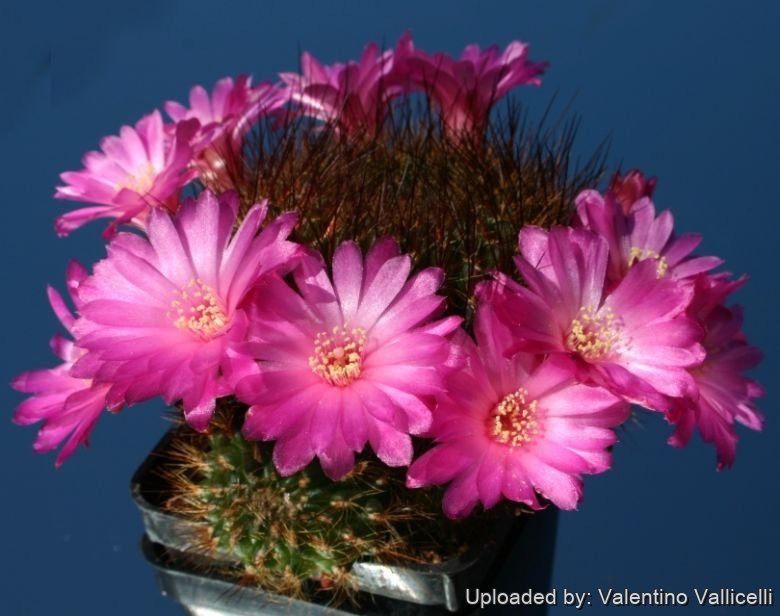
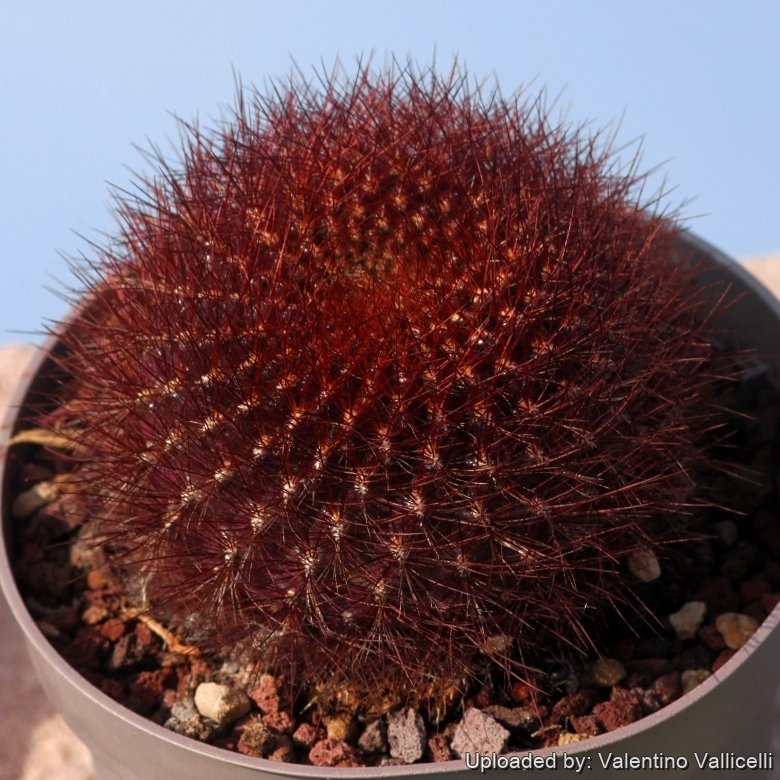
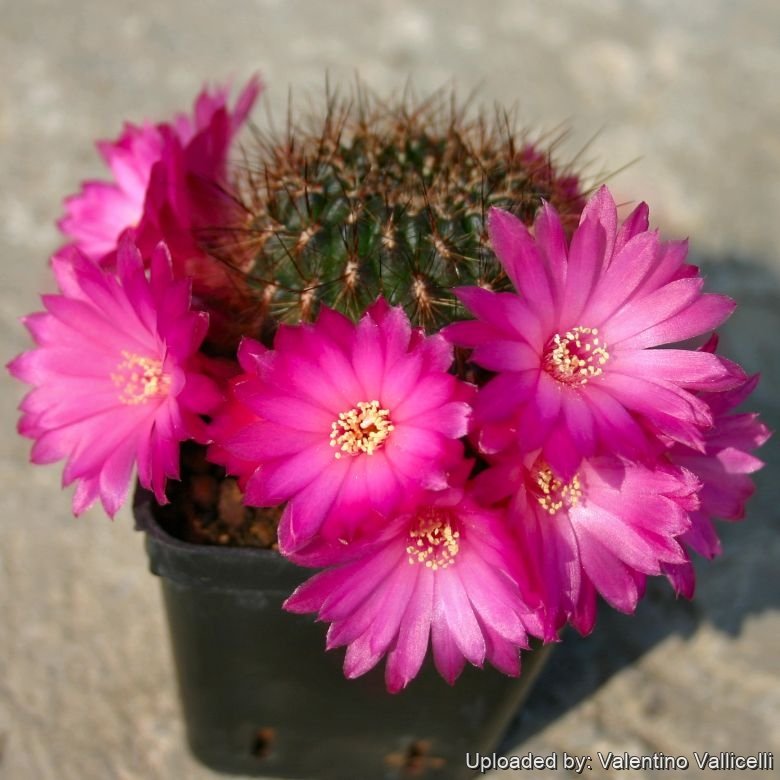
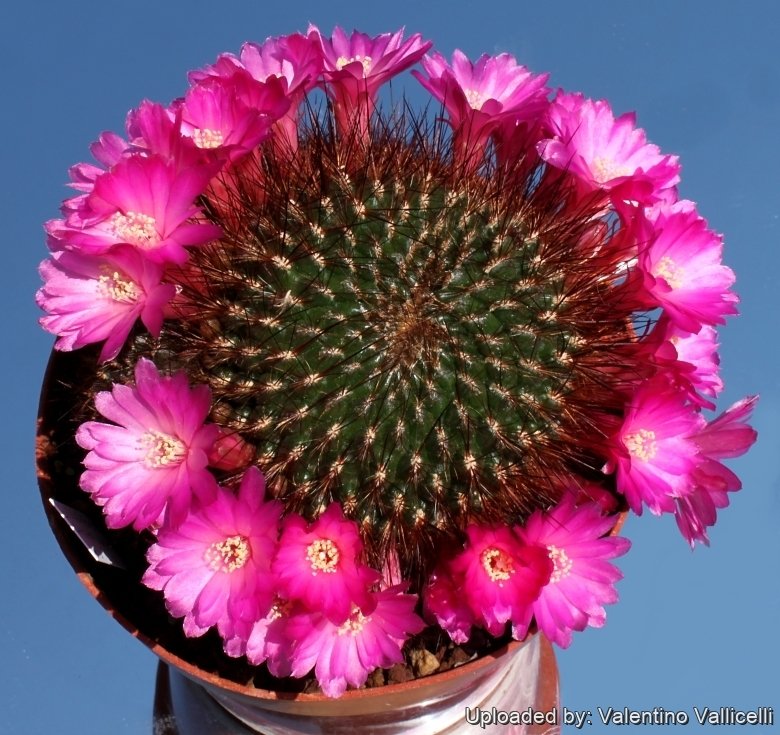
Rebutia steinbachii subv. aguilari best known as SulcoSN’>11517’ alt=‘5221’>Rebutia tiraquensis var. aguilarii#SN#11510’>Sulco[[Rebutia tiraquensis var. aguilariiSN’ style=‘border:none;’> is one of the innumerable local form of the very variable Rebutia steinbachii (= SulcoSN’>5220’ alt=‘11510’>Rebutia steinbachii#SN#5221’>Sulco[[Rebutia steinbachiiSN’ style=‘border:none;’>) It is often referred as form of SulcoSN’>12577’ alt=‘5221’>Rebutia tiraquensis#SN#11512’>Sulco[[Rebutia tiraquensisSN’ style=‘border:none;’> with attractive mahogany red spines, dark purple bodies and rings of light purple flowers in spring.
Habit: It is solitary or few branched, but readily forming, clusters or cushions in cultivation.
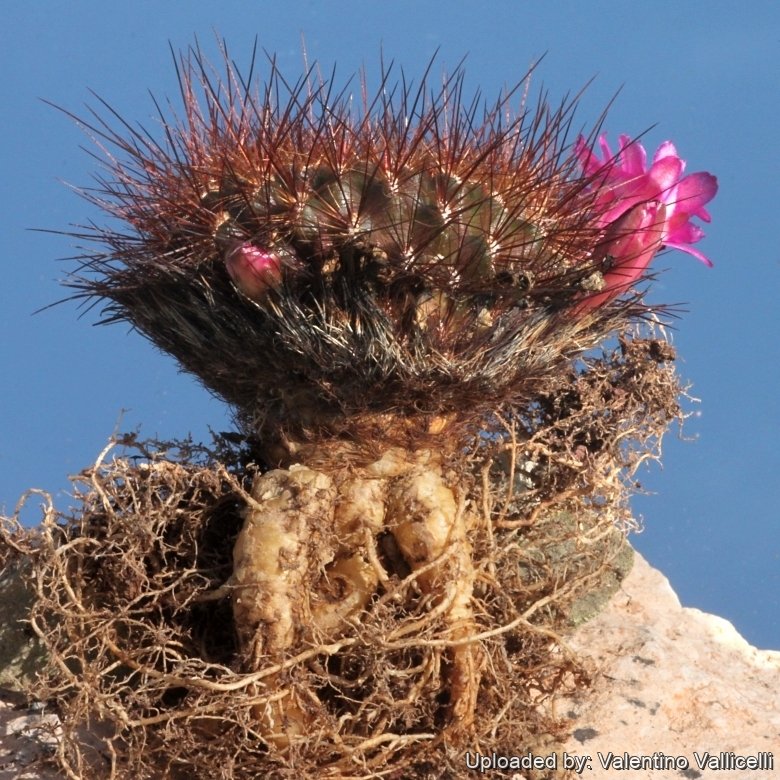
Roots: Mostly non-succulent, fibrous roots. More than 90% of the plant is concentrated in the stem.
Stem: Single heads 30–50 (or more) mm wide, soft globular, flattened and somehow apically depressed, very dark magenta-green., almost hidden under the covering of spines.
Ribs: 12-26 , spiralling, forming oblong rhomboid tubercles with well-defined grooves.
Tubercles: Conical conspicuous.
Areoles: White or yellowish, long, narrow 3-6 long, 1,5-2 mm large.
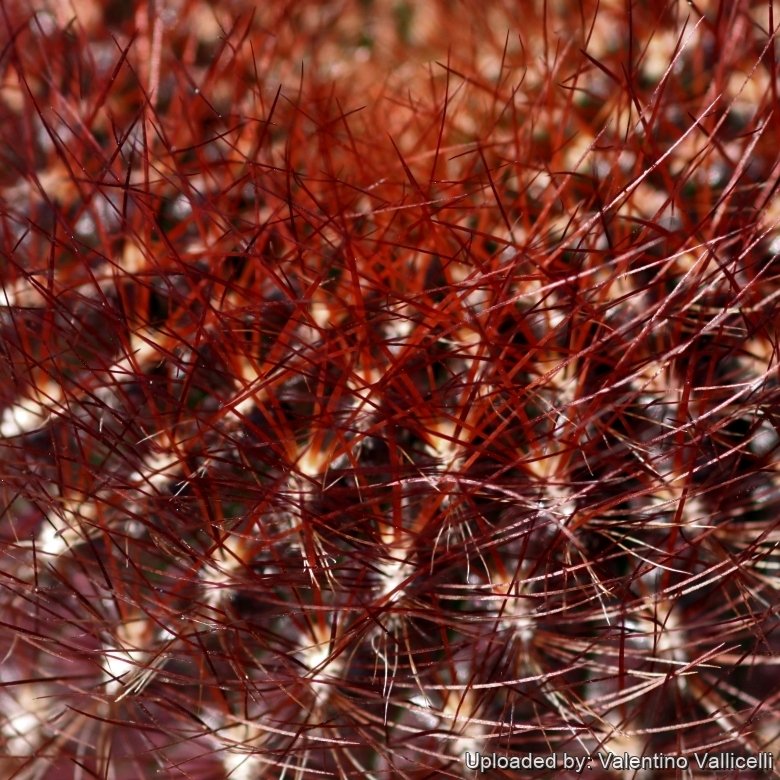
Spines: Dense, erect, thin, bristle-like and flexible, reddish to mahogany red, often more than 20 (15-40)
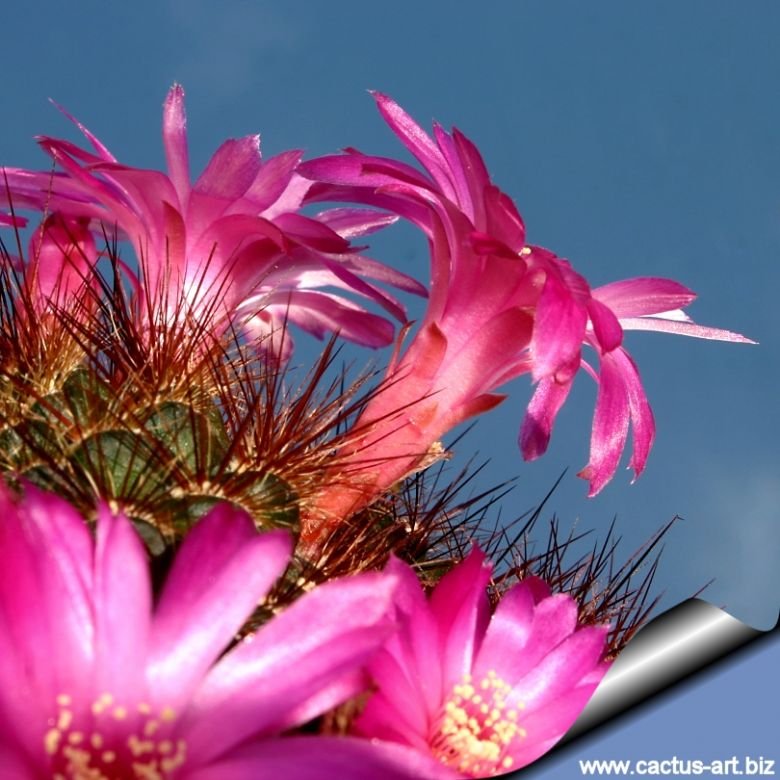
Flowers: Bright pink to light purple, numerous in a ring at the base of the plant.
Blooming season: Spring (April - May) and remain open for up to five days.
Origin and Habitat
Grows in the Cordillera de Cochabamba, in southern Bolivia.
Habitat: S. steinbachii grows mainly on a flat, dry, stony area, while the tiraquensis populations grows in a moister zone. Altitude 2950 – 3900 m.
Ecology: Thanks to the fog banks coming from the tropical lowlands of the Chaparé, the plants have enough humidity all year round to capture with their numerous spines.
Cultivation and Propagation
They are easy plant that grow large clumps and form beautiful specimens with time. During the summer it is best to keep the plants outside where the temperature can rise to over 30 C with no harm to the plant. It loves a very permeable, coarse mineral soil. From March onwards the plant will begin to grow and watering should be increased gradually until late May when the plant should be in full growth. Water regularly during the summer so long as the plant pot is allowed to drain and not sit in a tray of water. During hot weather you may need to water the plants more frequently so long as the plant is actively growing. From late September watering should be reduced to force the plant to go in to a state of semi dormancy, by October you should be back in to the winter watering regime . From November to march they must be kept strictly dry since they are very sensitive to any moisture excesses.
To prevent rottenness it is also advisable to surround its root neck by very rough sand or grit, this help a fast water drainage and an appropriate air circulation. For its sensitive roots this species is often grafted to avoid root problems.
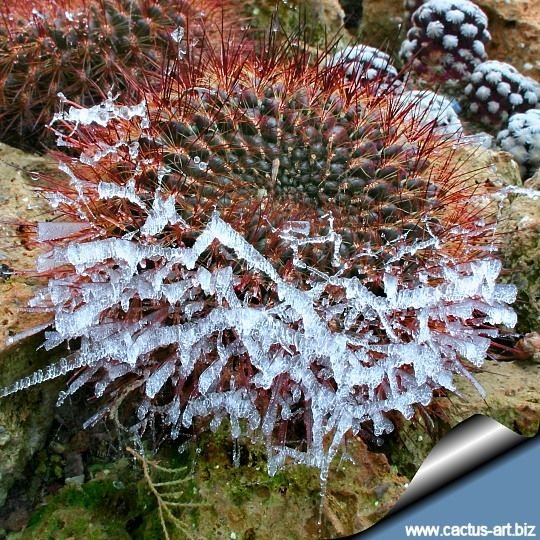
Plants are and quite frost hardy -10 (or possibly colder)° C but preferably overwinter in a cool place (at 0/10°C) this is important for the flowers as well as for plants health. Without this cool winter period they normally wont get any buds. Sun Exposure: Need full sun avoiding only the harshest summer sun, if kept too dark they may become overly lush and greener and could be prone to rotting due to over watering. Feeding may not be necessary at all if the compost is fresh then, feed in summer only if the plant hasn’t been repotted recently. Do not feed the plants from September onwards as this can cause lush growth which can be fatal during the darker cold months.Propagation: : Seed, cutting, grafting.
Notes
Sulcorebutia steinbachii is one of the most variable cactus species. The colour of the flower, the spines length, the body shape and pigmentation is extremely variable, even within a population. There are also many localized phenotypes capable of maintaining their separate identity, even though only a few kilometers apart and by former authors considered as separated species and varieties. They are nowadays considered just phenotypes of a highly polymorphic specie. These subpopulations are not only morphologically based but also geographically and can be grouped as follow:
Group 1a: Cochabamba to Chapare, northward and eastward to Tiraque
* Sulcorebutia glomerispina
* Sulcorebutia arenaceaha
* Sulcorebutia polymorphaS. kruegeri
* Sulcorebutia hoffmannianaS. glanduliflora Card. n.n.
* Sulcorebutia cochabambina
* Sulcorebutia steinbachii & vars. australis, gracilior, etc.A
Group 1b: Province Tiraque to Epizana an eastward to Comarapa, 2,800 m-3.000 m.
* Sulcorebutia tiraquensis & vars. longiseta
* Sulcorebutia spinosior & aglaia (bicolorispina)
* Sulcorebutia lepida
* Sulcorebutia krahnii
Group 2: Cerro Tunari-south and east of Cochabamba-Izata to Anzaldo, 3,400-3,900 m
* Sulcorebutia verticillacantha
* Sulcorebutia tunariensis
* S. taratensis & var. minima
* S. mizquensis
* S. pojoniensis Rausch n.n.A
Group 3: West of Cochabamba-Ayopaya, 2,000-2,500 m
* Sulcorebutia arenacea
* S. candiae
* S. menesesii & vars. kamiensis
* S. muschii
* S. glomeriseta
Group 4: Around Totora and southward toward Epizana, 2,600-3,000 m
* Sulcorebutia oenanthaA
* S. totorensis
* S. pampagrandensis
Group 5: A limited area around Pasopaya and eastwards, 2,000 m
* Sulcorebutia cardenasiana
* S. langeri
Bibliography
Major references and further lectures
-
James Cullen, Sabina G. Knees, H. Suzanne Cubey “The European Garden Flora Flowering Plants: A Manual for the Identification of Plants Cultivated in Europe, Both Out-of-Doors and Under Glass” Cambridge University Press, 11/Aug./2011
-
David Hunt, Nigel Taylor “The New Cactus Lexicon” DH Books, 2006 ISBN 0953813444, 9780953813445
-
Edward F. Anderson “The Cactus Family” Timber Press, 2001
-
John Pilbeam “Sulcorebutia and Weingartia: A Collector’s Guide” Timber Press, 1985
-
Cyril Marsden, Herbert Spencer Jackson “Rebutia, Including Aylostera and Sulcorebutia” Macmillan, 1968
Gallery