Publication: Notizbl. Bot. Gart. Berlin-Dahlem 11: 268. 1931
Description
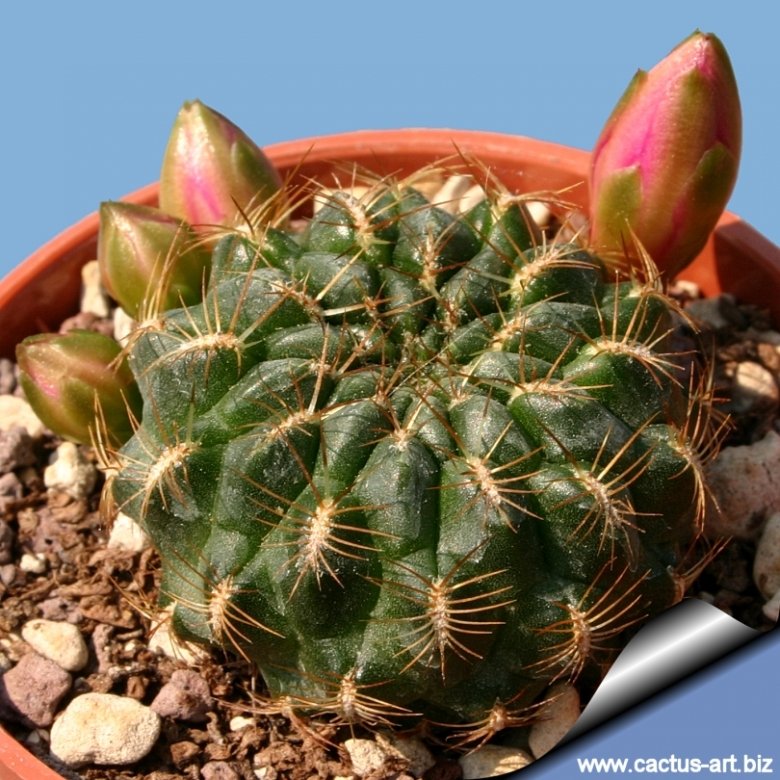
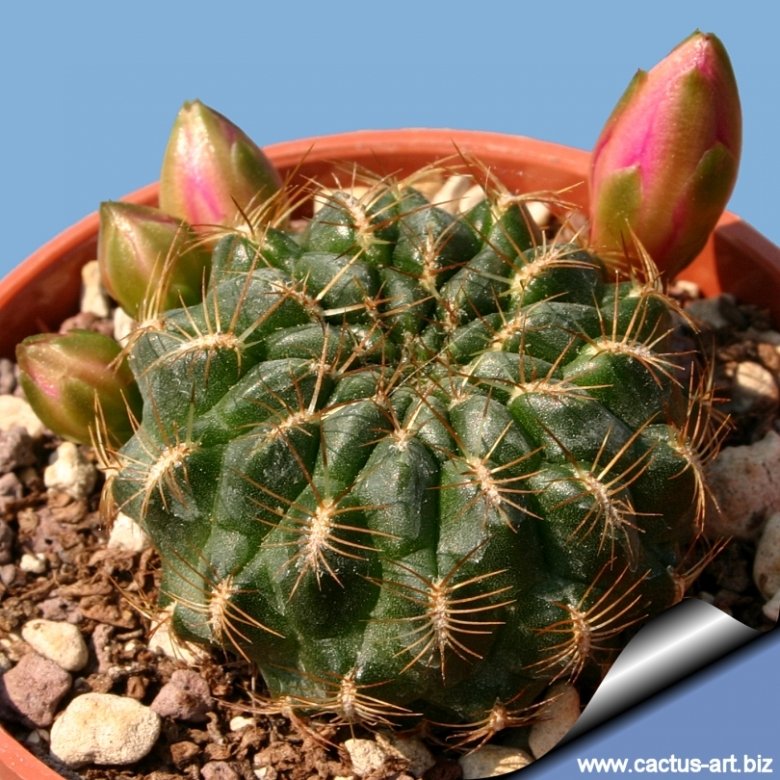
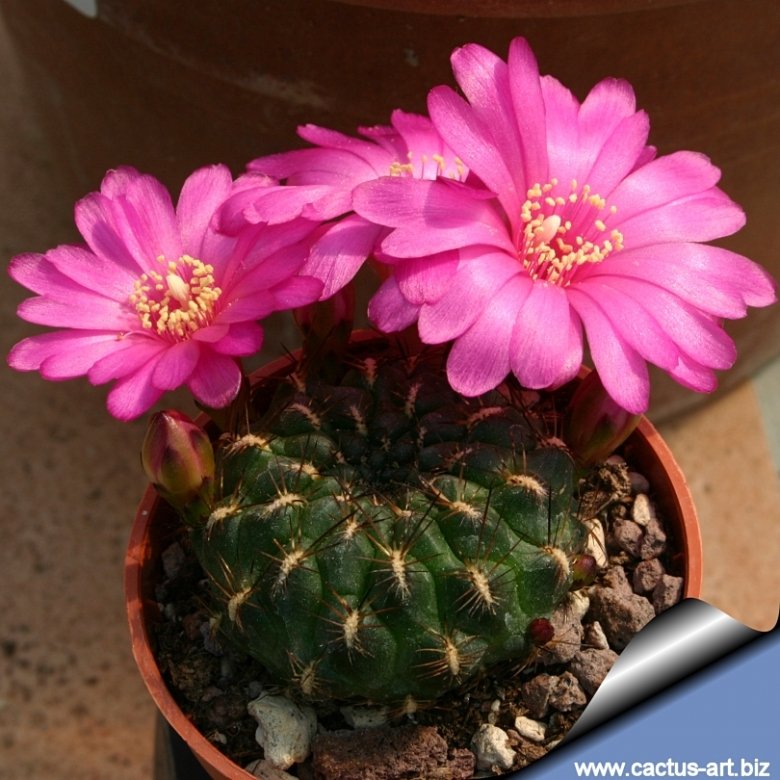
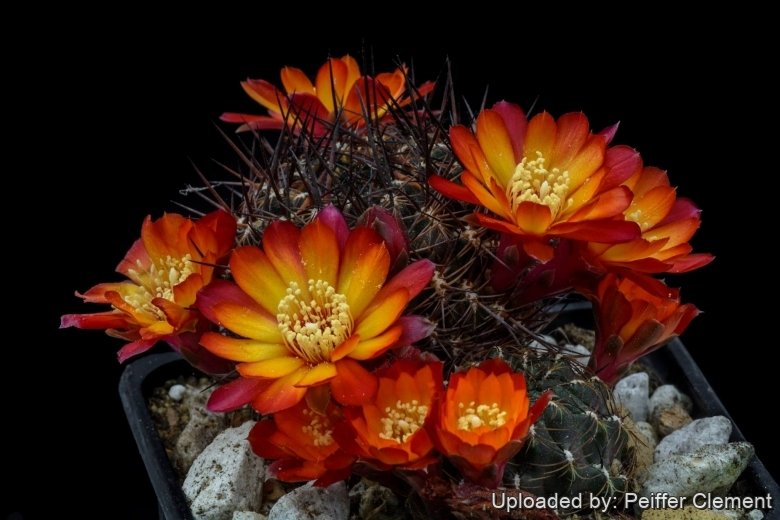
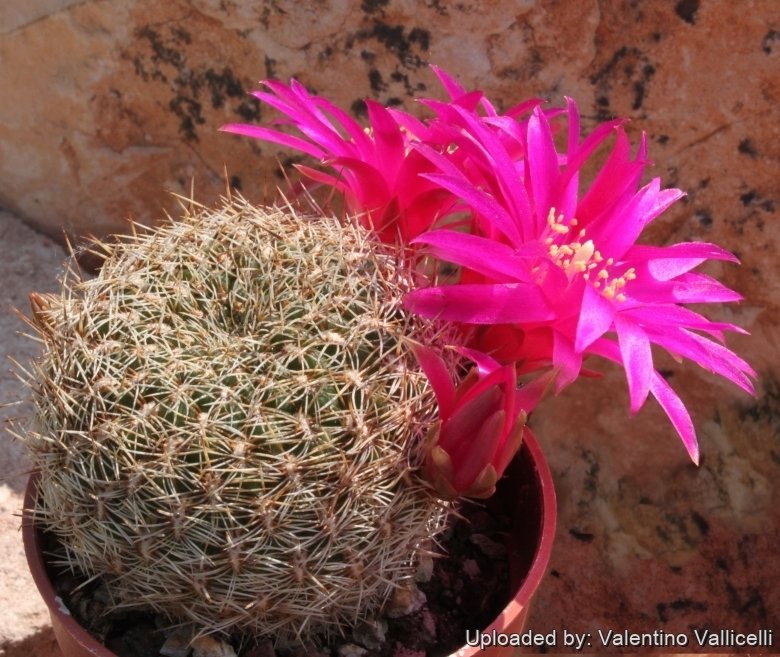
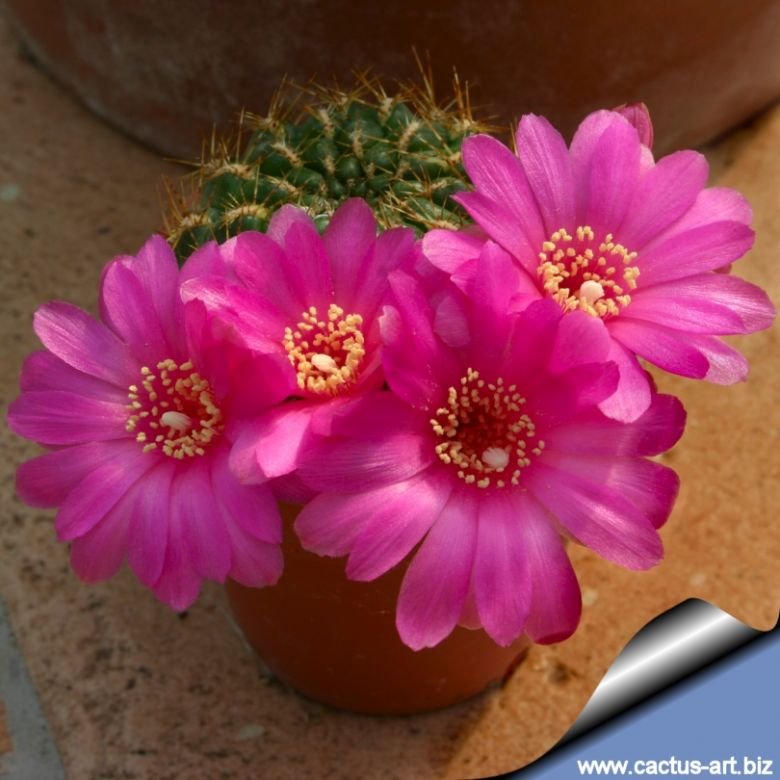
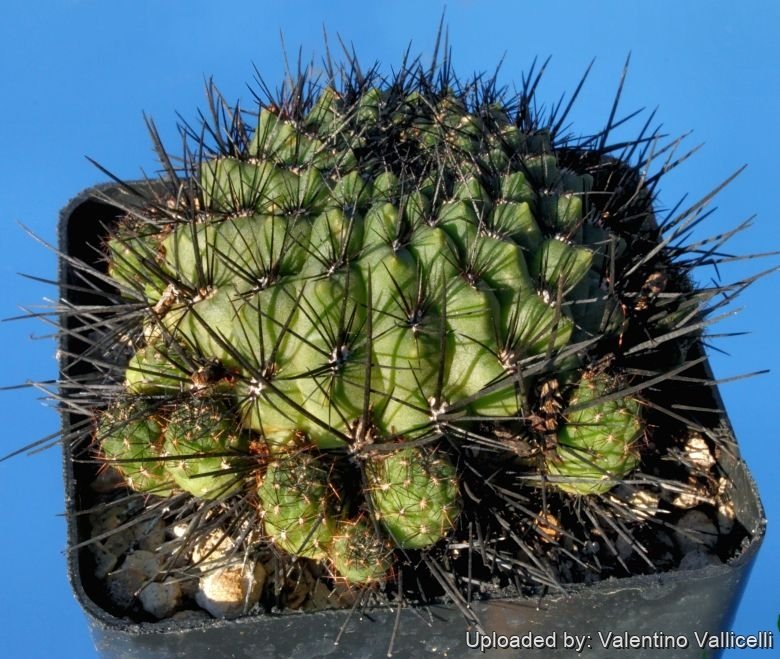
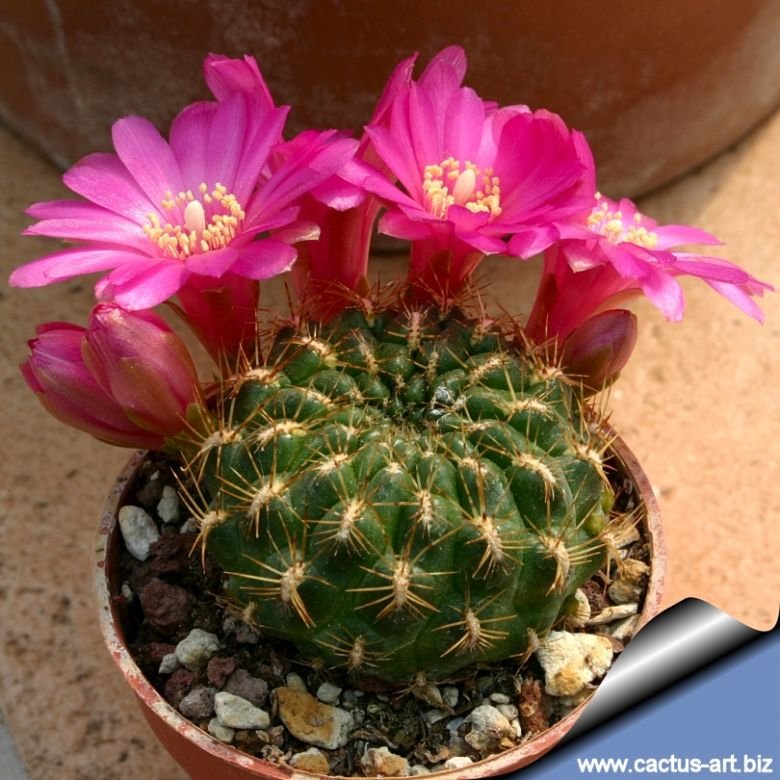
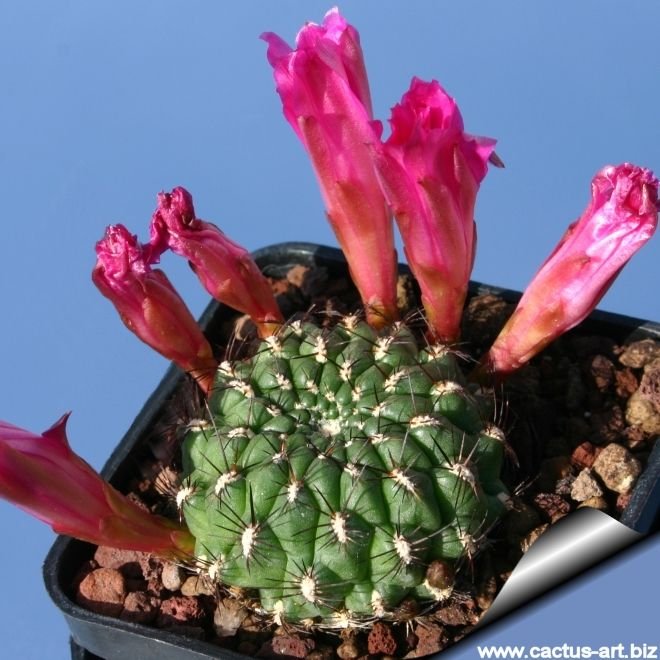
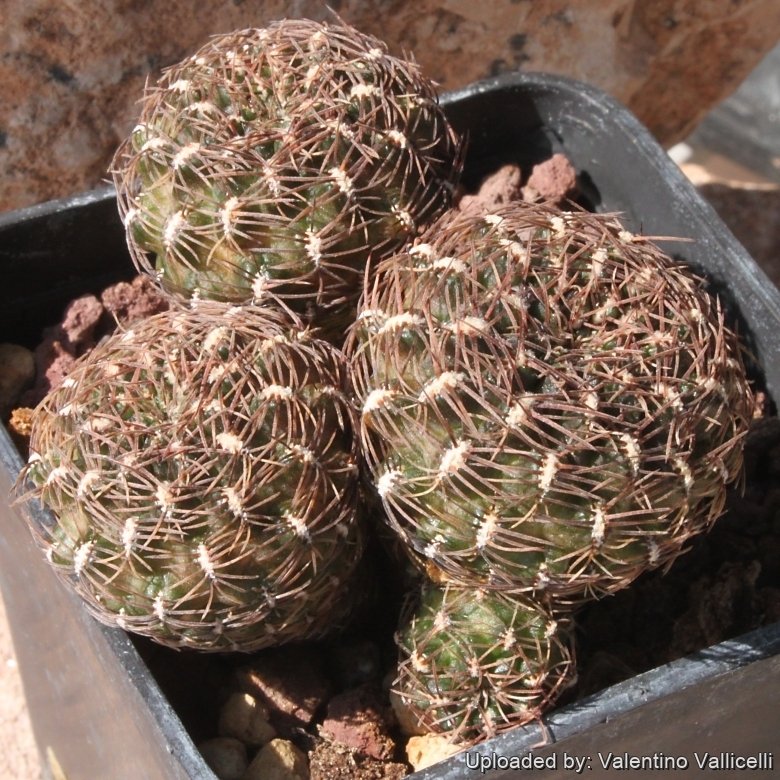
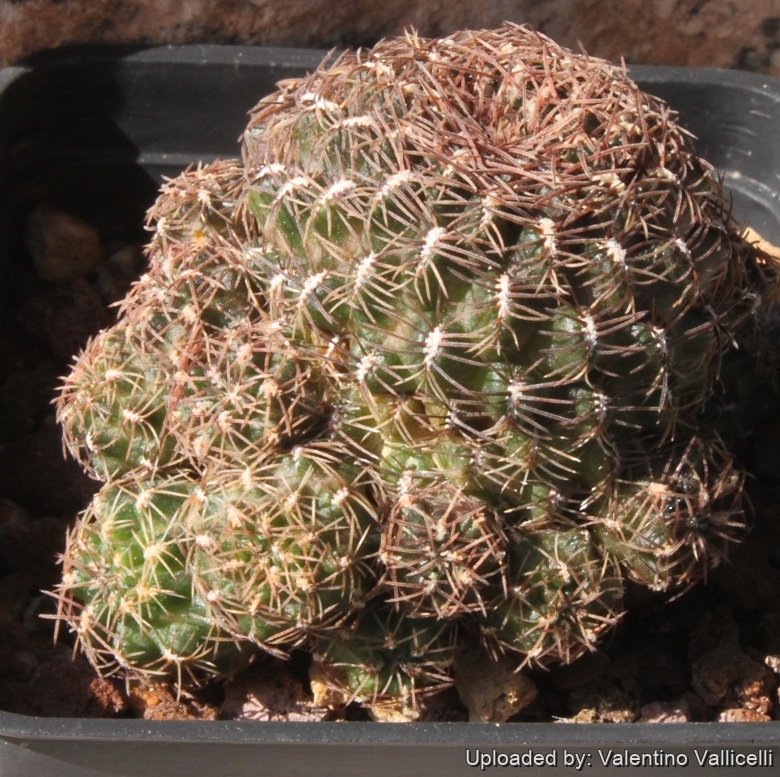
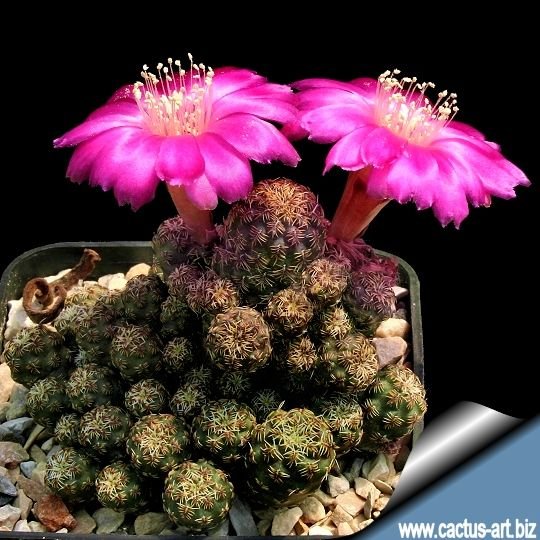
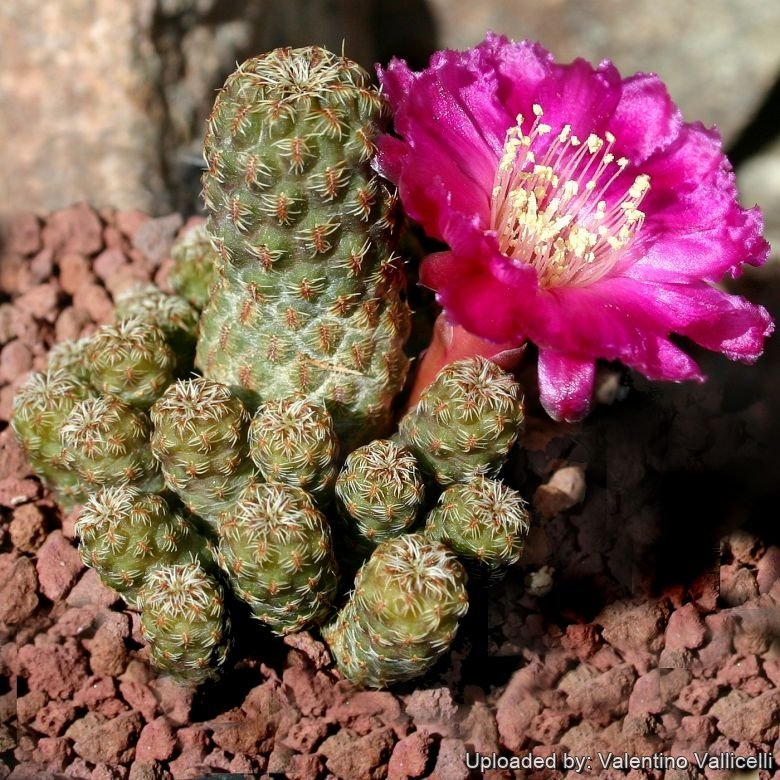
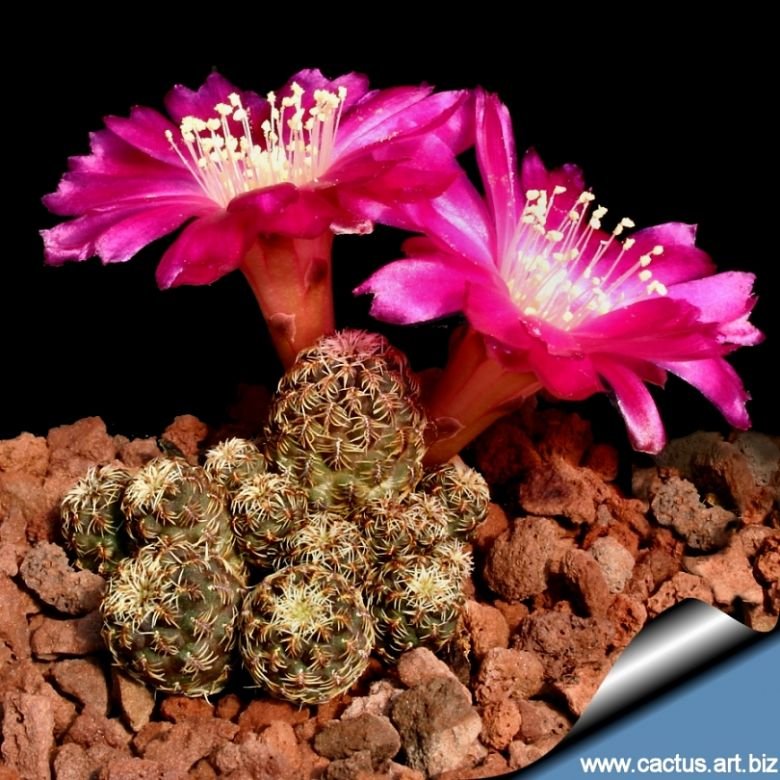
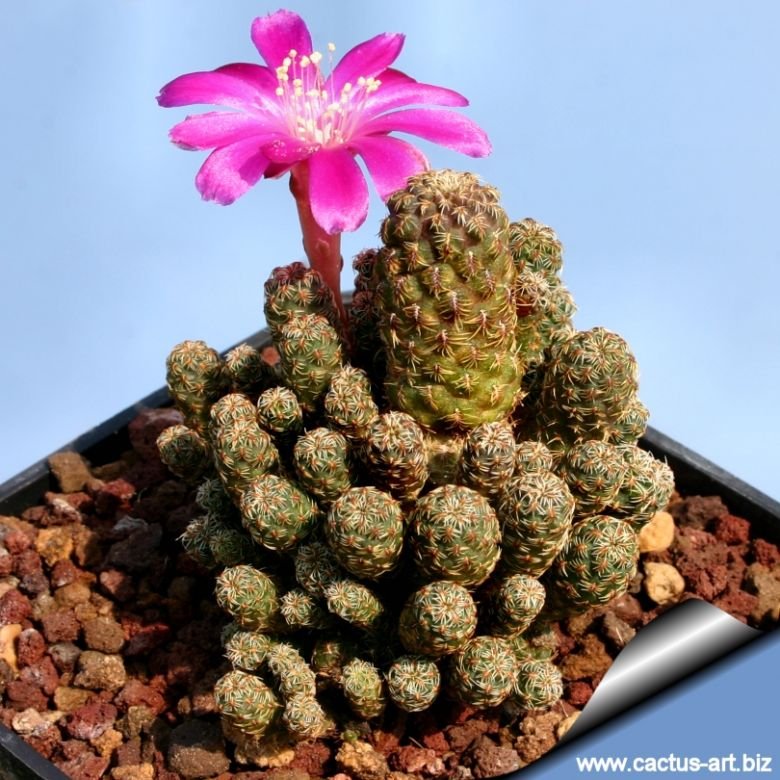
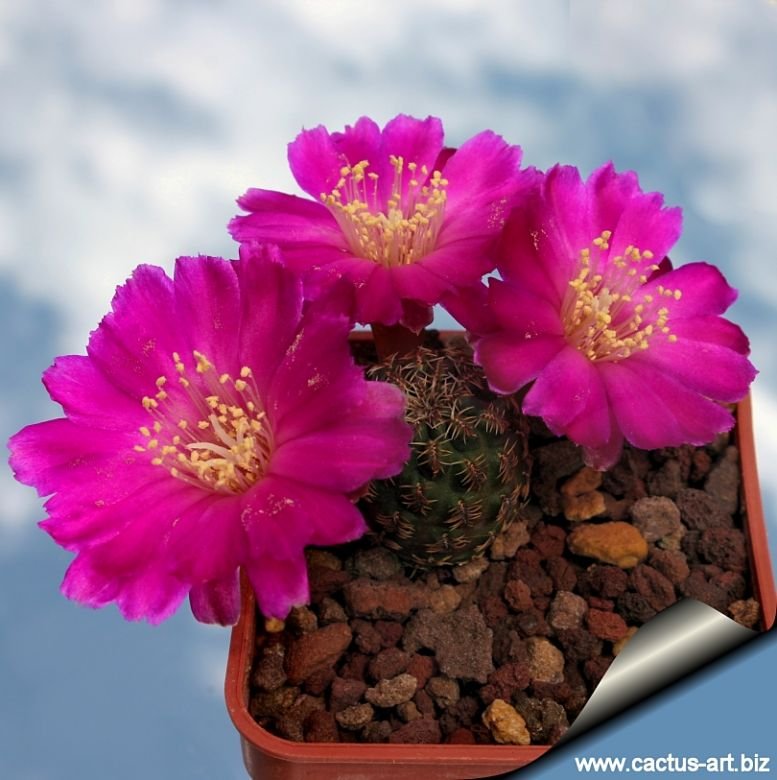
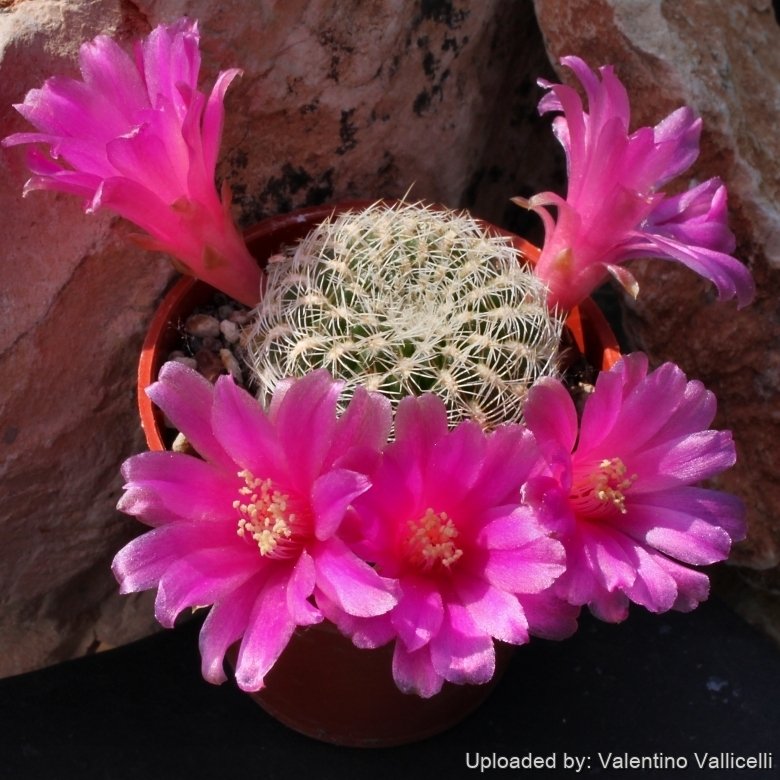
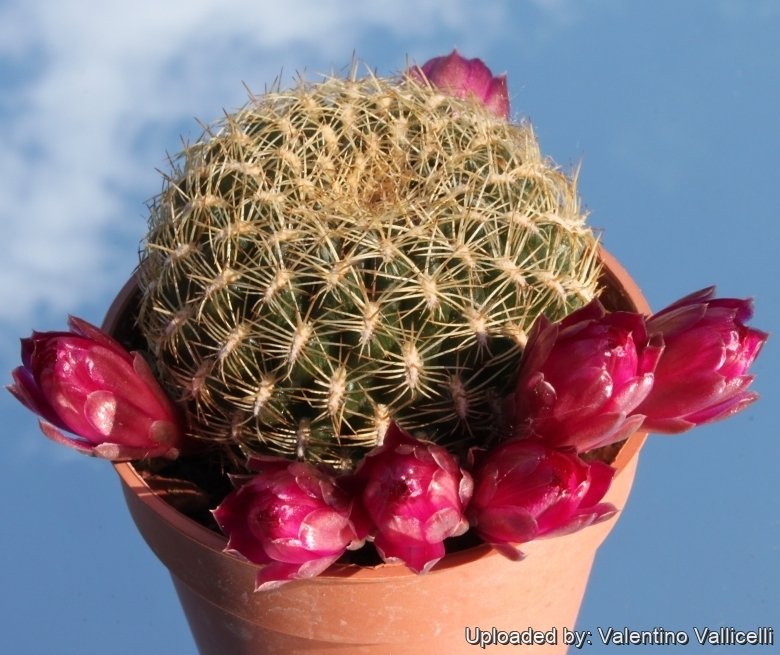
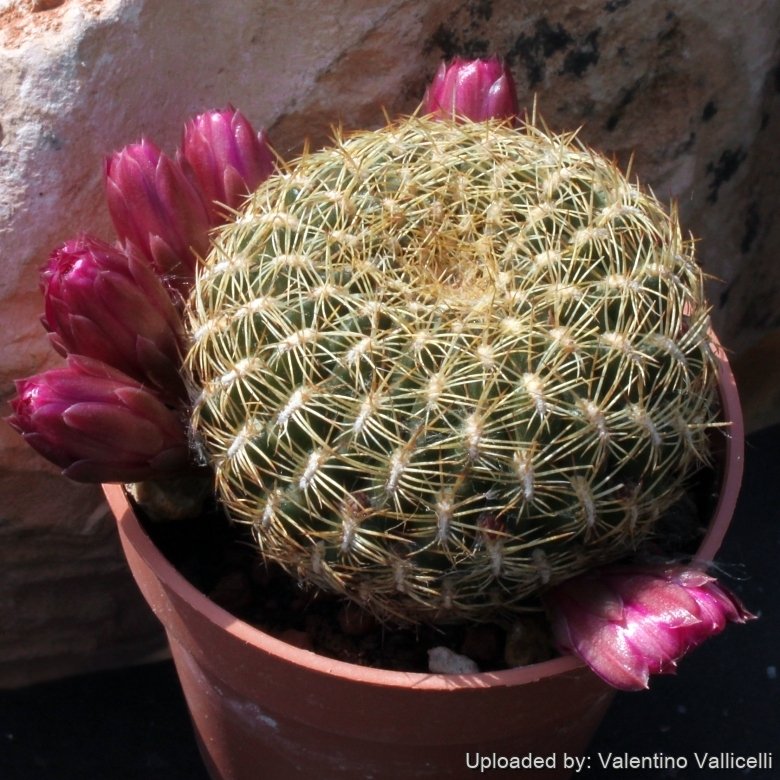
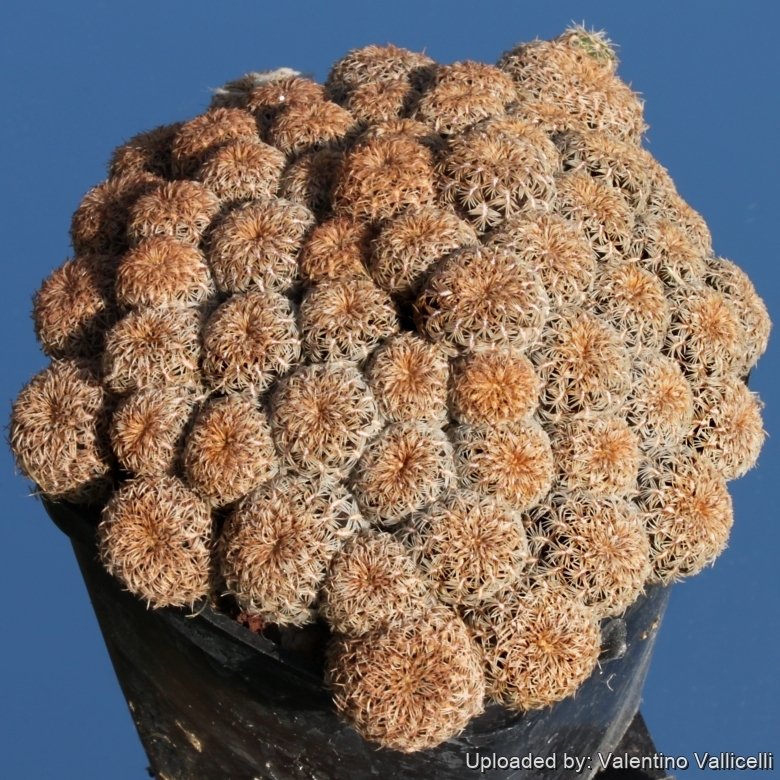
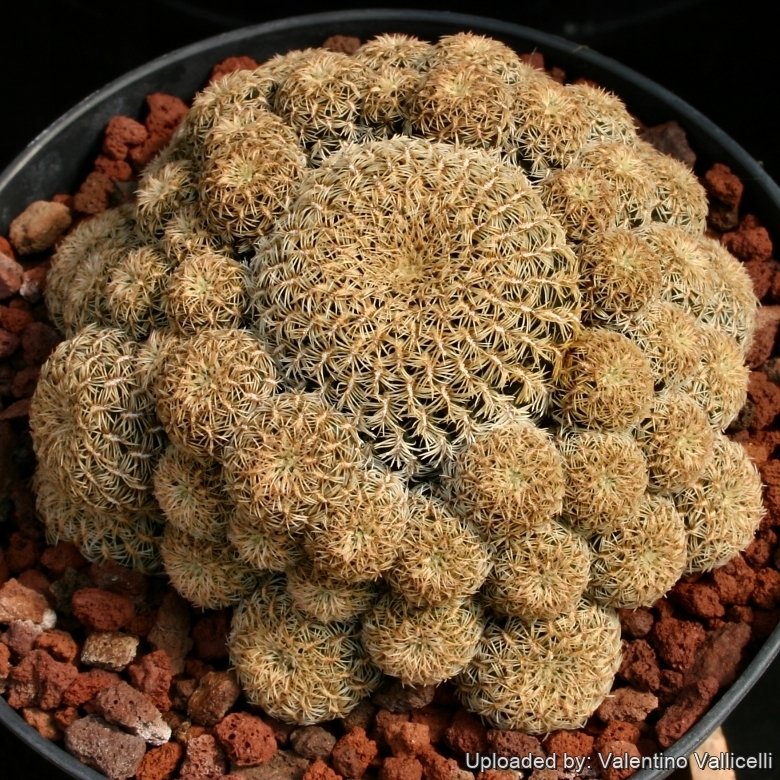
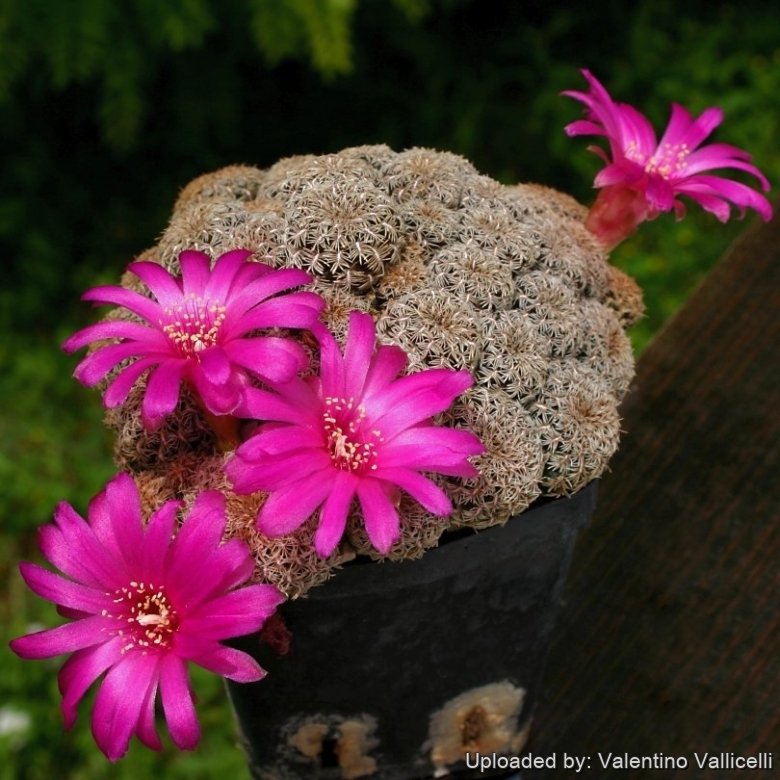
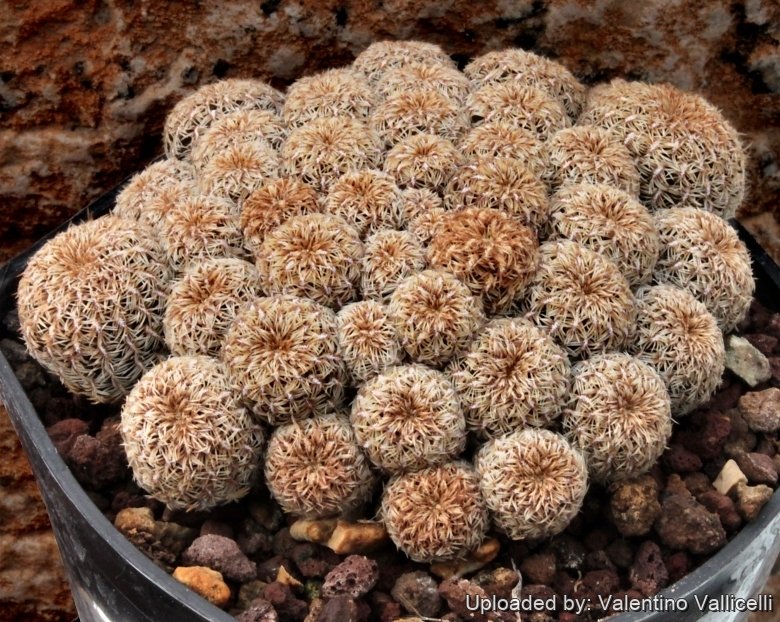
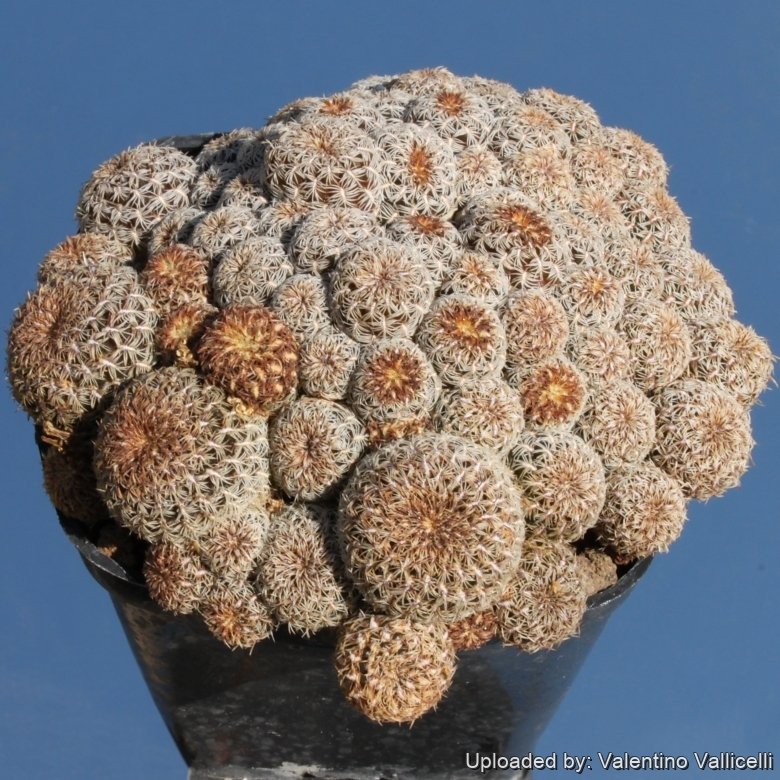
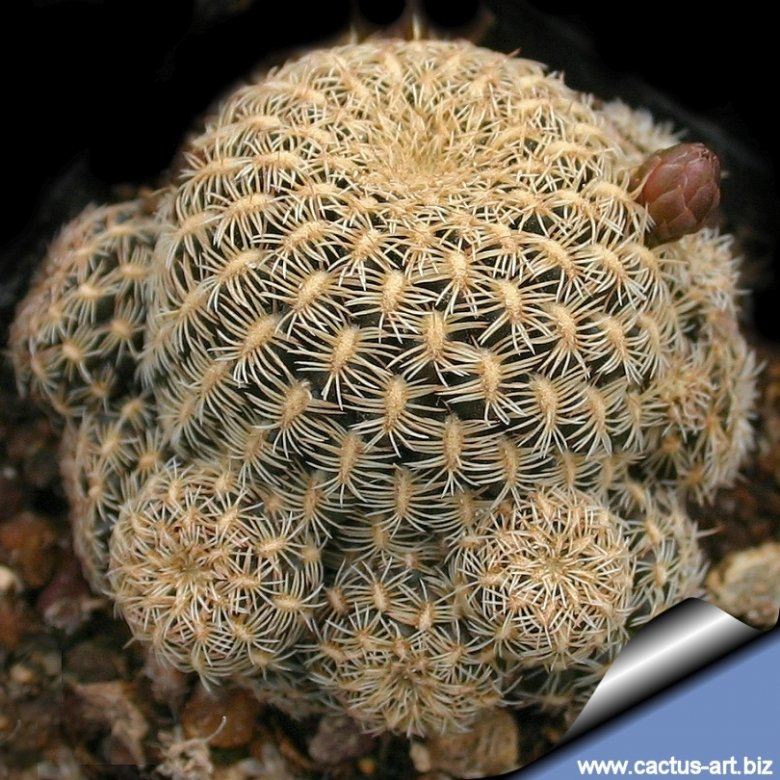
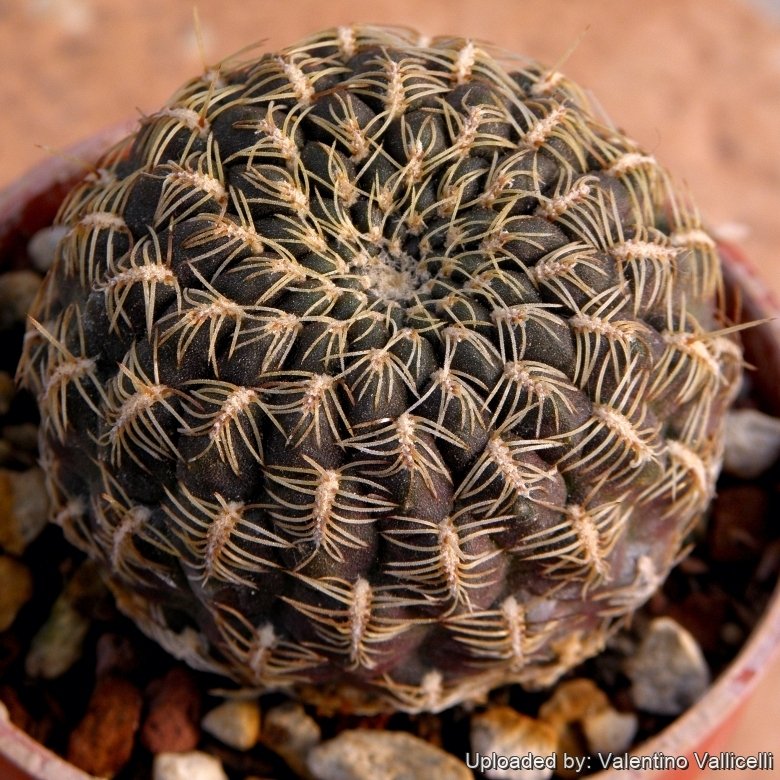
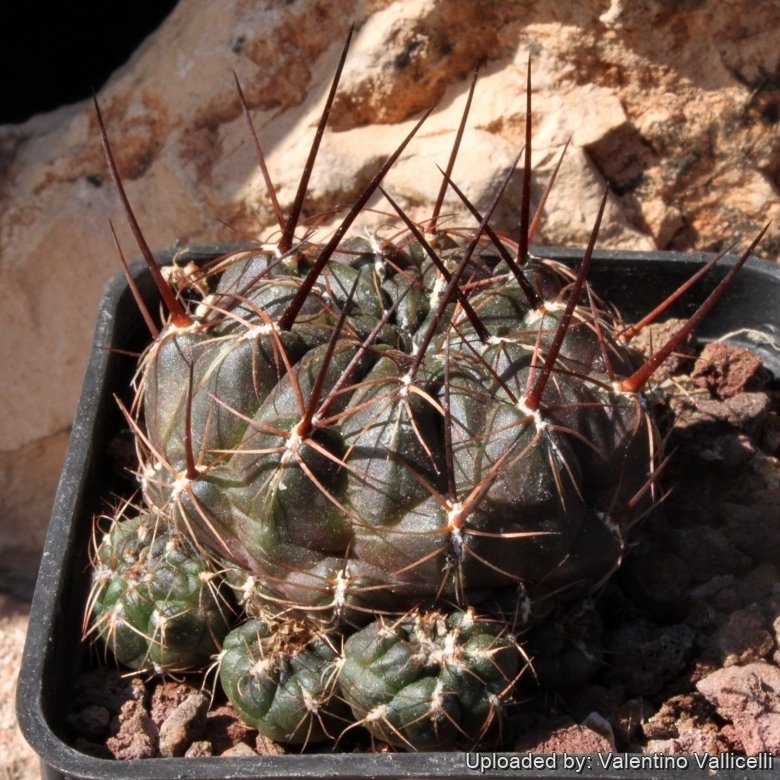
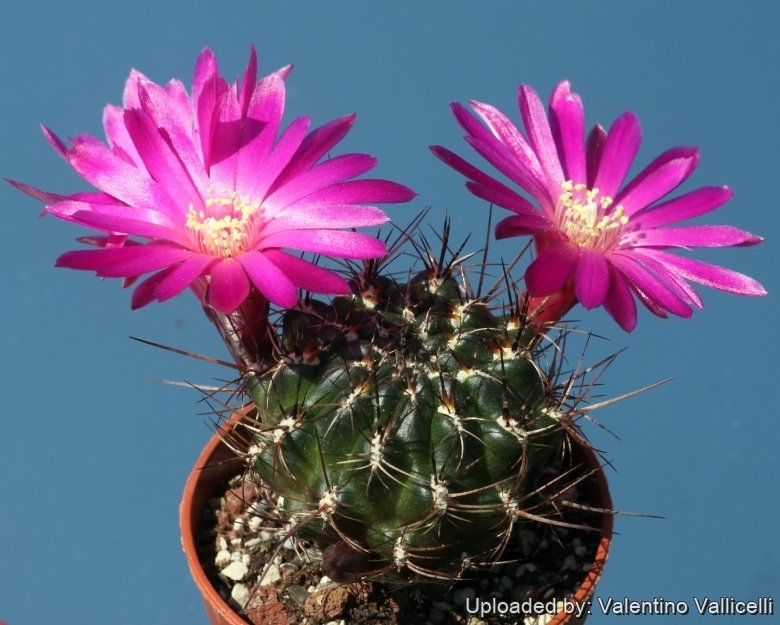
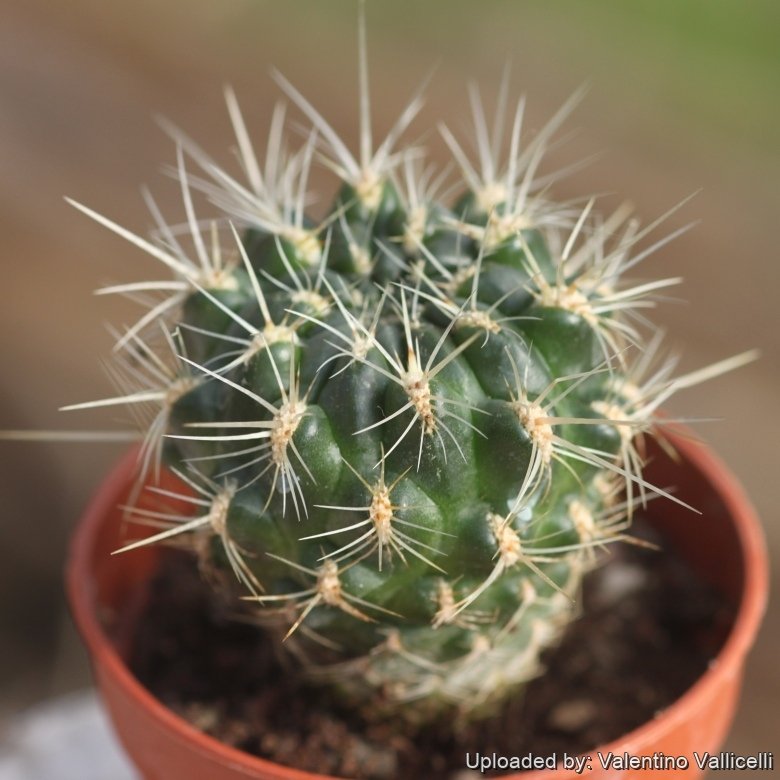
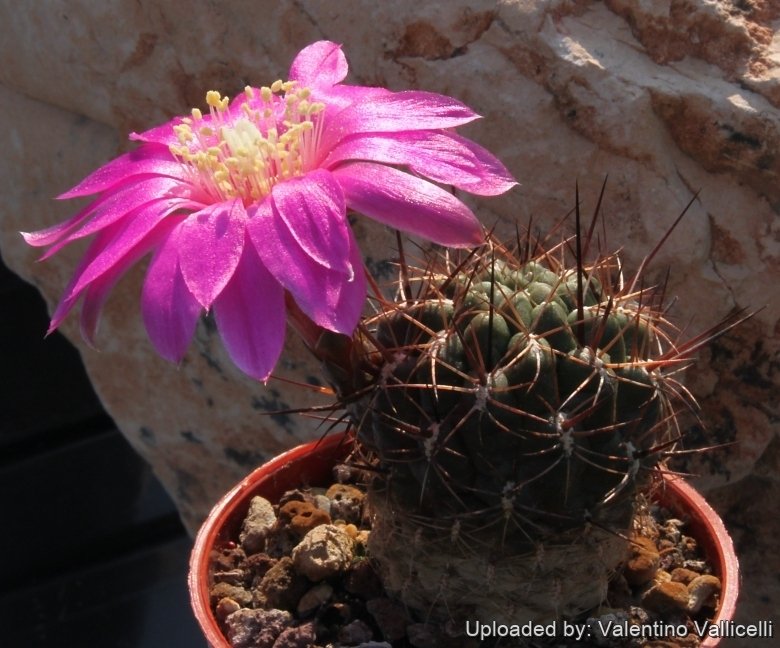
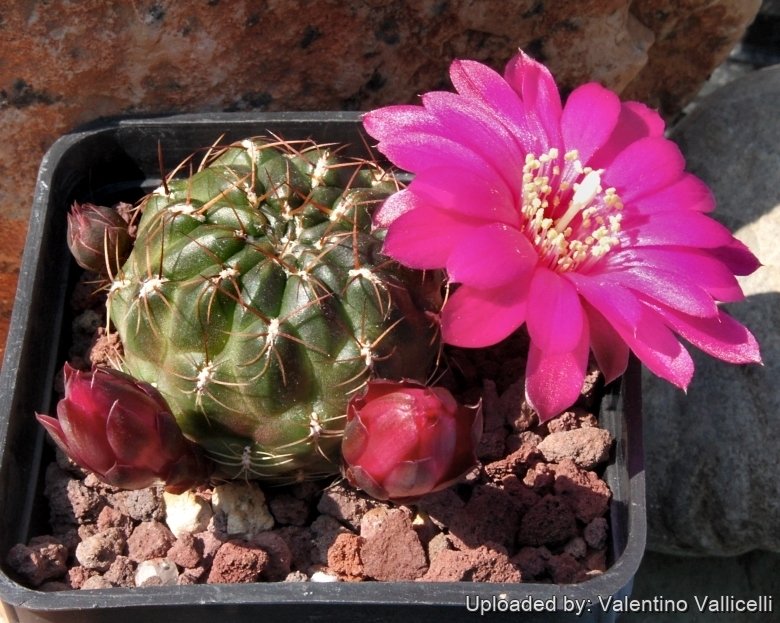
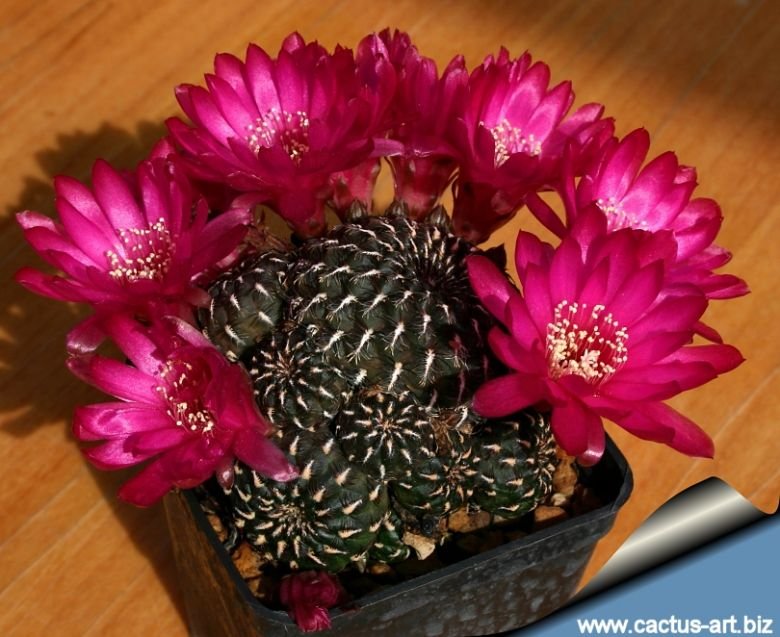
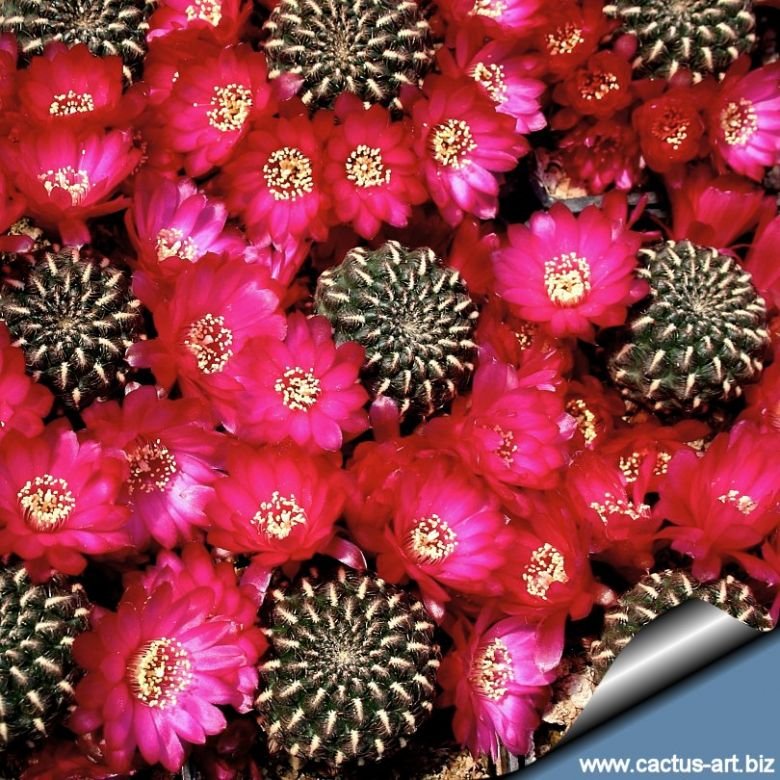
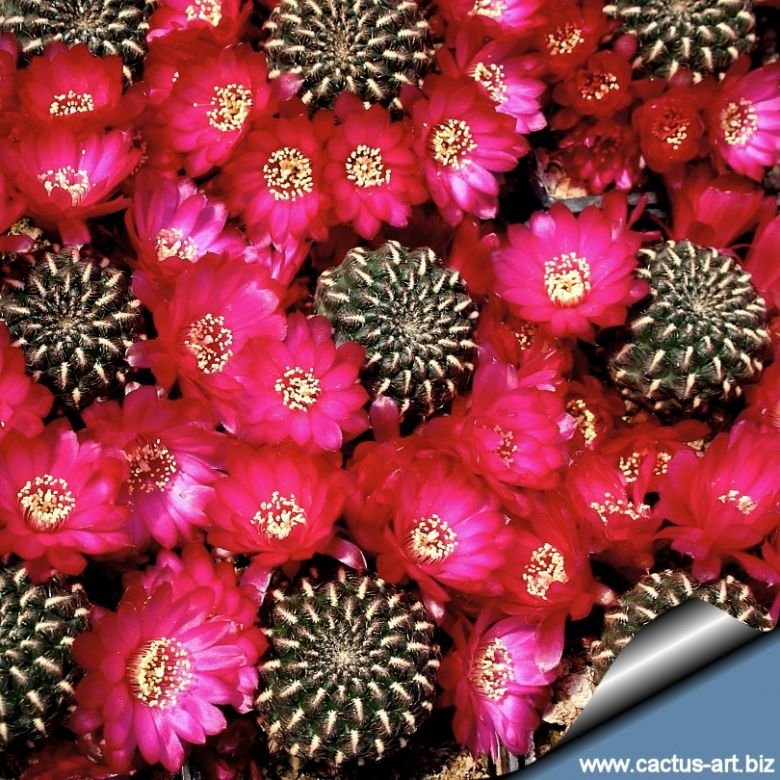
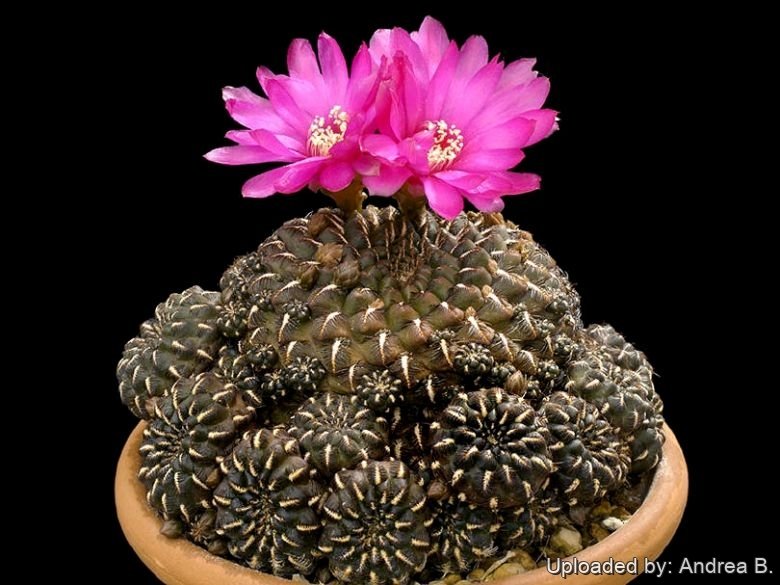
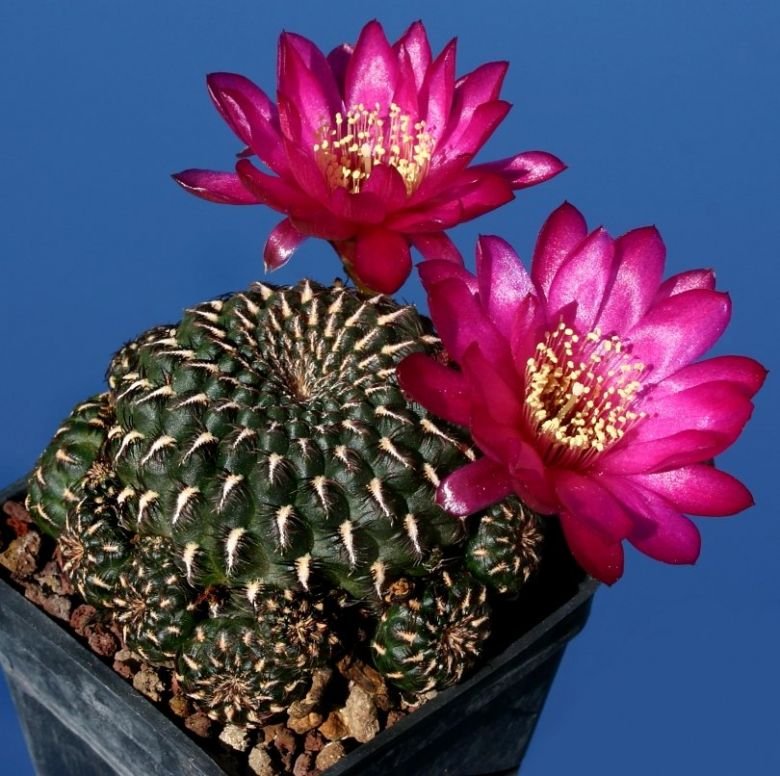
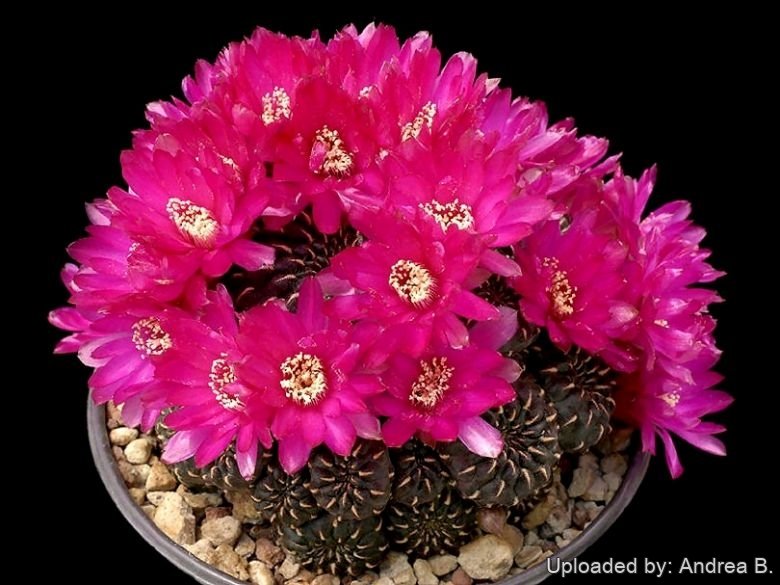
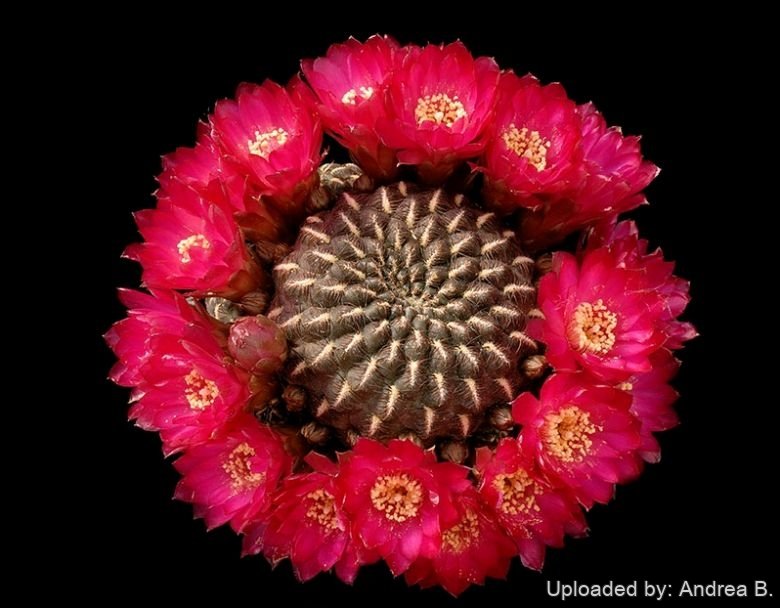
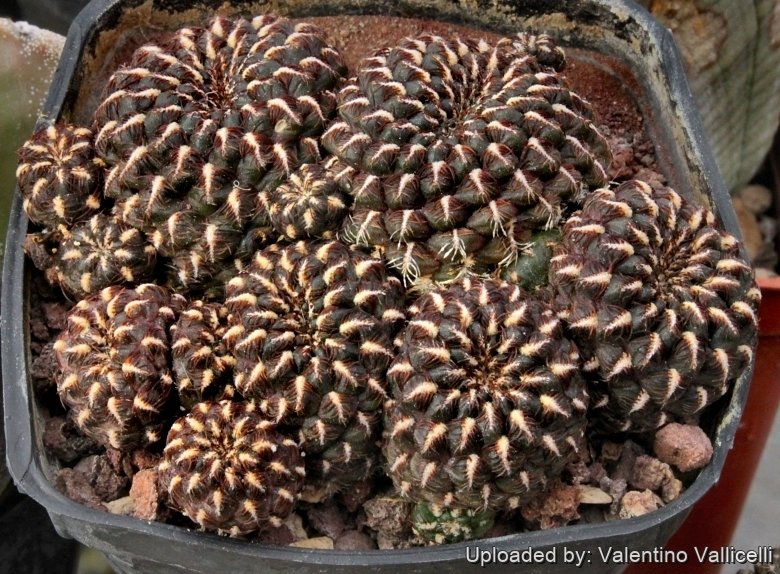
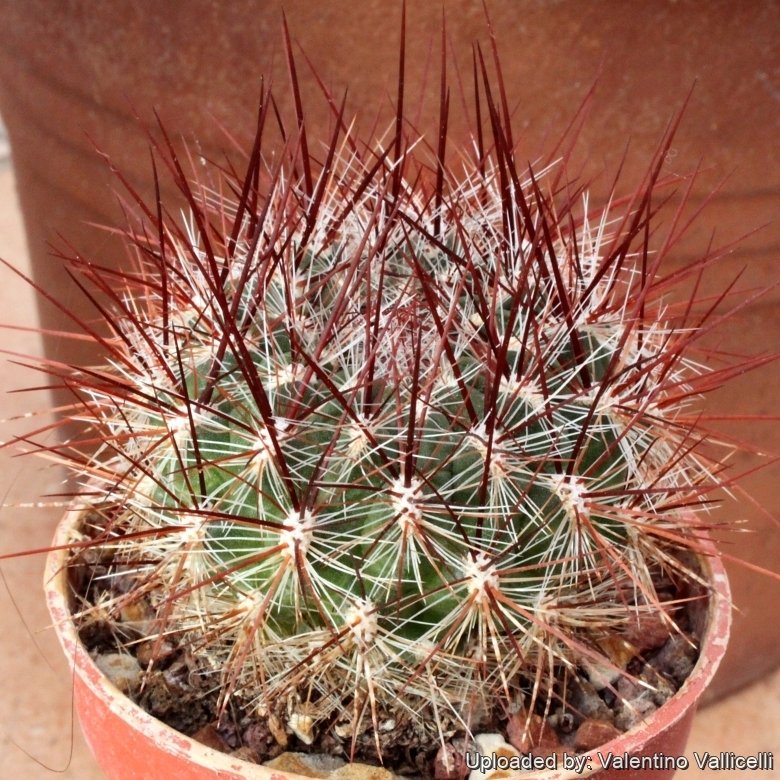
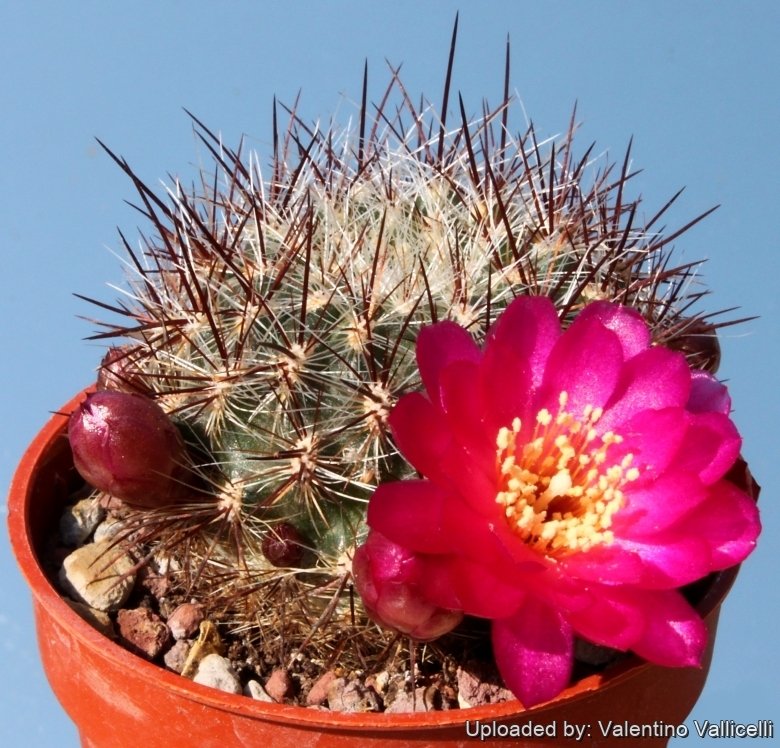
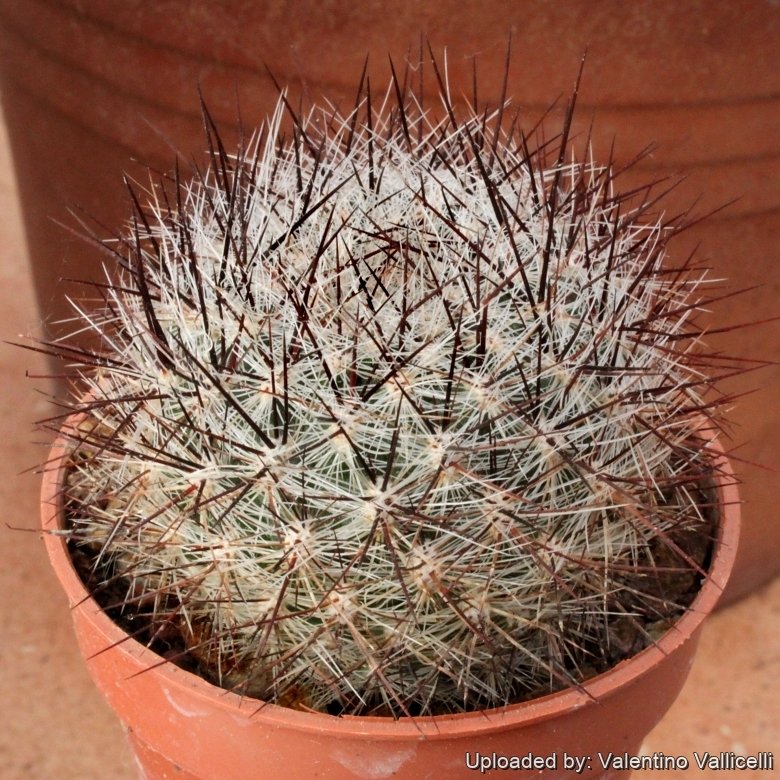
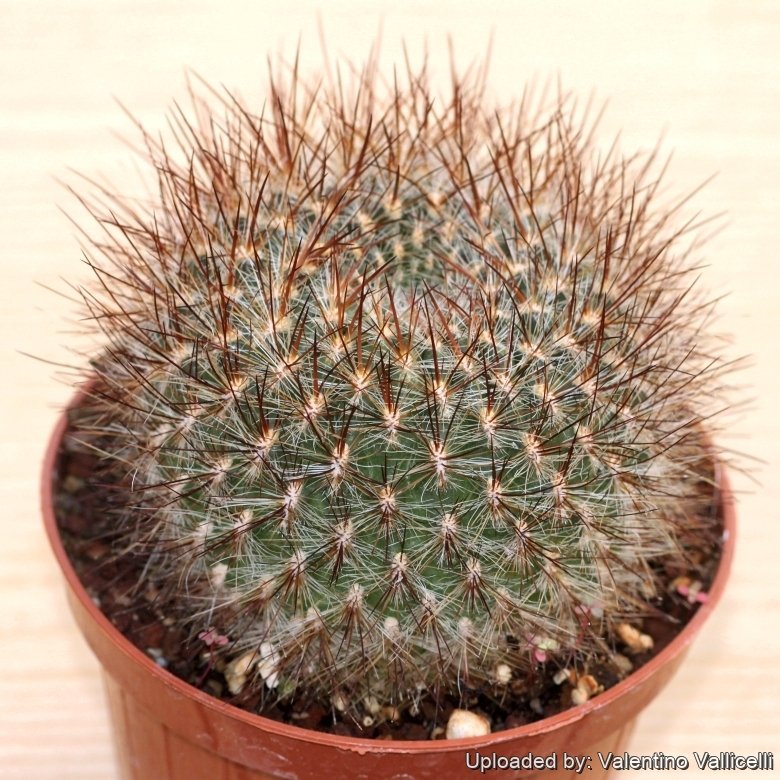
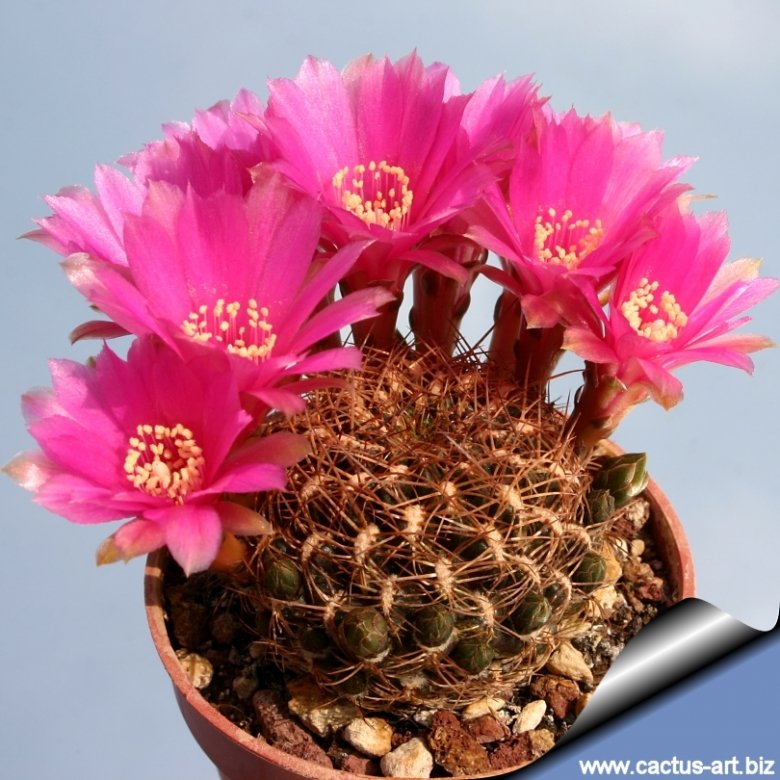
Rebutia steinbachii often listed under its old name of SulcoSN’>5220’ alt=‘5221’>Rebutia steinbachii#SN#5221’>Sulco[[Rebutia steinbachiiSN’ style=‘border:none;’> is a clumping plant (rarely solitary), readily forming, especially in cultivation, clumps of many heads. Plants are often dimorphic: short spined juvenile forms transform at maturity to strongly spined forms. Some of these juvenile forms, however, may persist without transformation to the mature form. However it is very variable due to it’s wide area of origin in Bolivia and spines ranges in colour from white, to yellow, red, brown or black. Three subspecies are recognized, the nominate form, subsp. tiraquensis (Cárdenas) D.R.Hunt and subsp. verticillacantha (F.Ritter) D.R.Hunt.
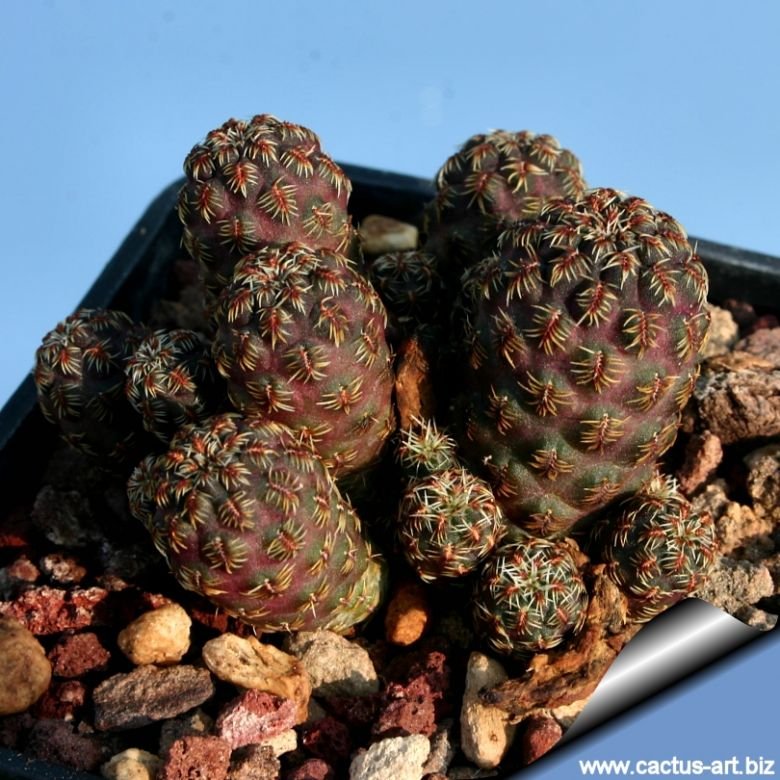
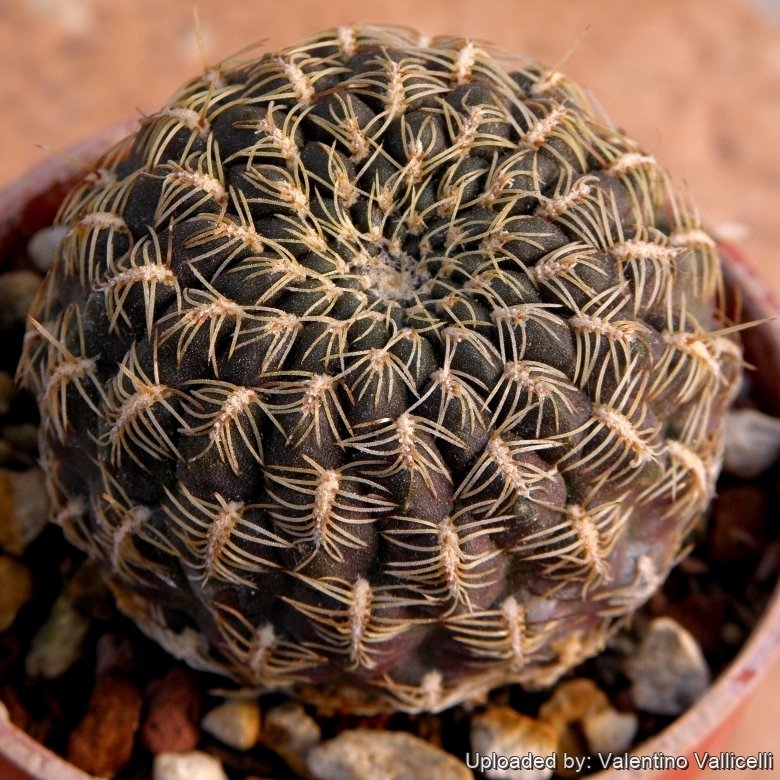
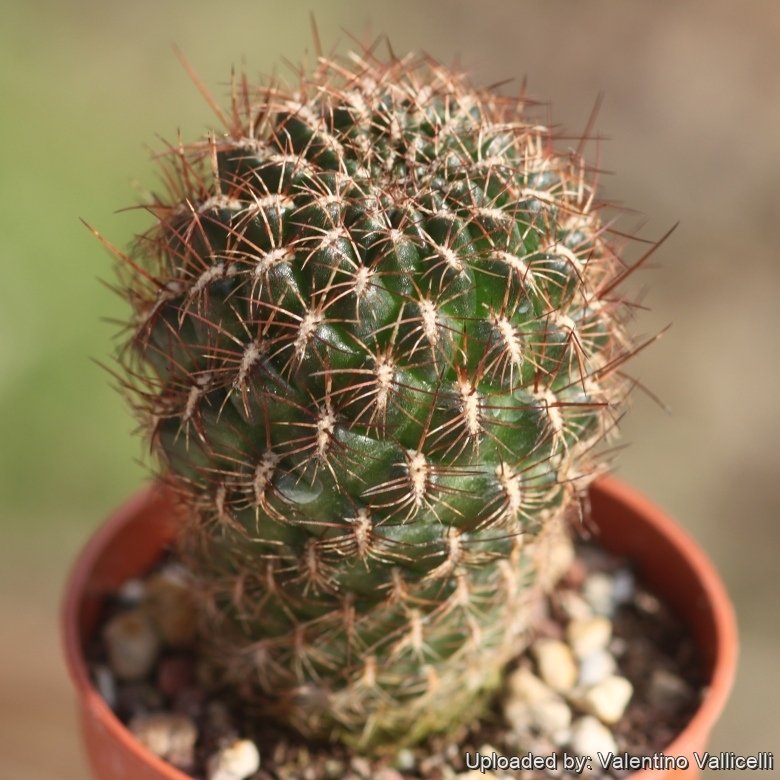
Stem: 24-40 mm tall, up to 50 mm wide, flattened globose, greysh-green to dark green sometime tinged red.
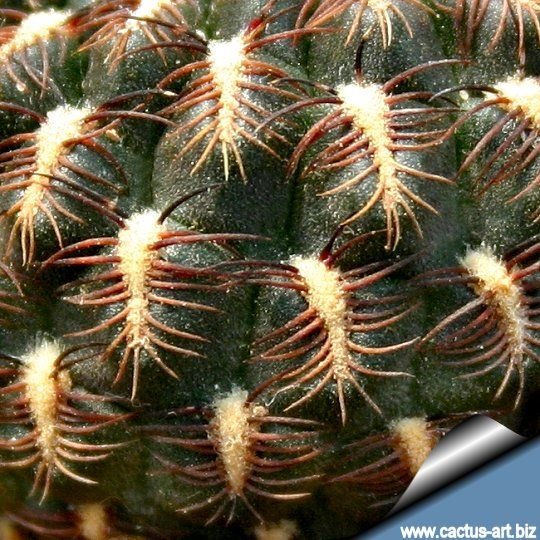
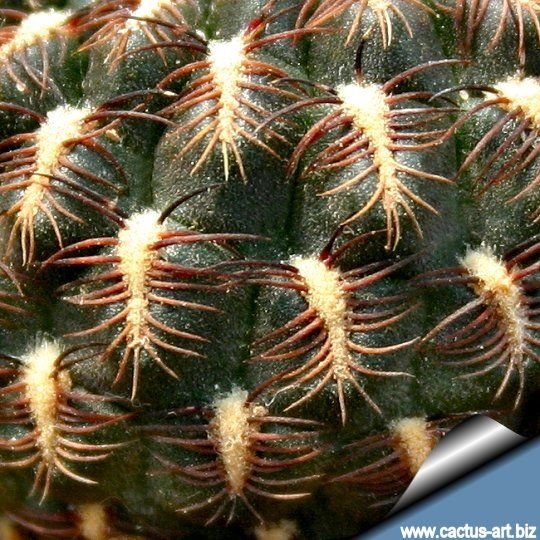
Ribs: Approx 13, spiralling, poorly distinguished, forming oblong rhomboidal grooved tubercles.
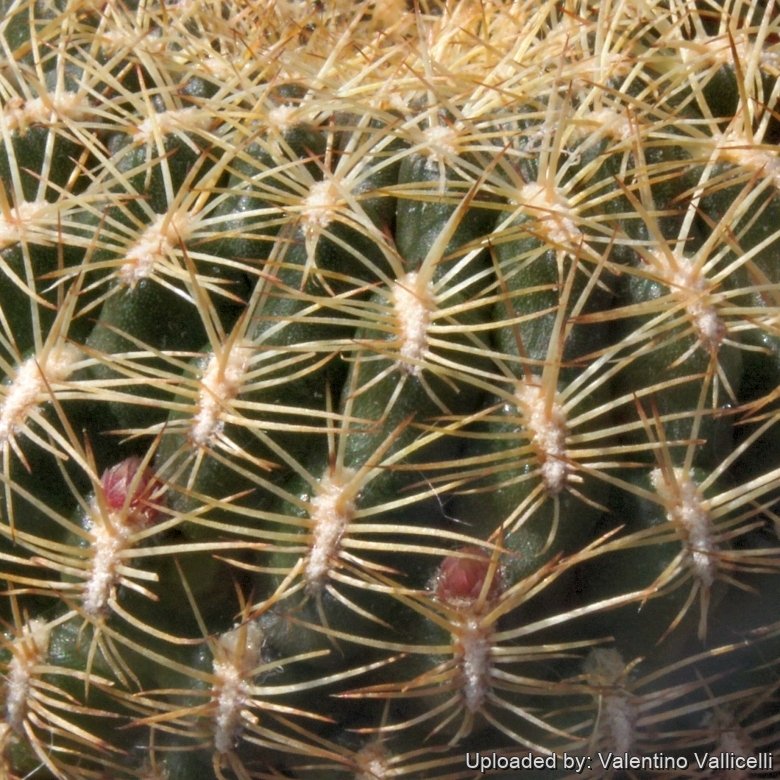
Areoles: Long narrow depressed with short grey felt (almost naked) 3 – 6 long, 1,5-2 mm large.
Radial spines: 9-12 (or more) about up to 20 mm long, acicular, addpressed against the body, ± pectinate to porrect, white, yellow, brown with darker tips or almost black, ± curved slow to develops, frequently absent on new areoles at plant apex.
Central spines: None or usually 1 to 3, 10-30 mm long, only slightly stouter of the same colour of the radials.
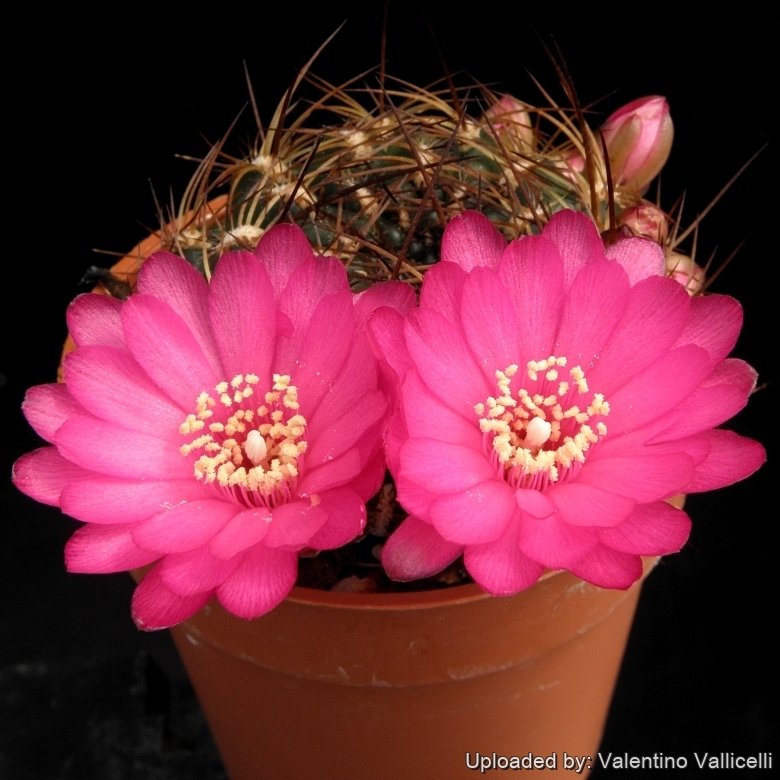
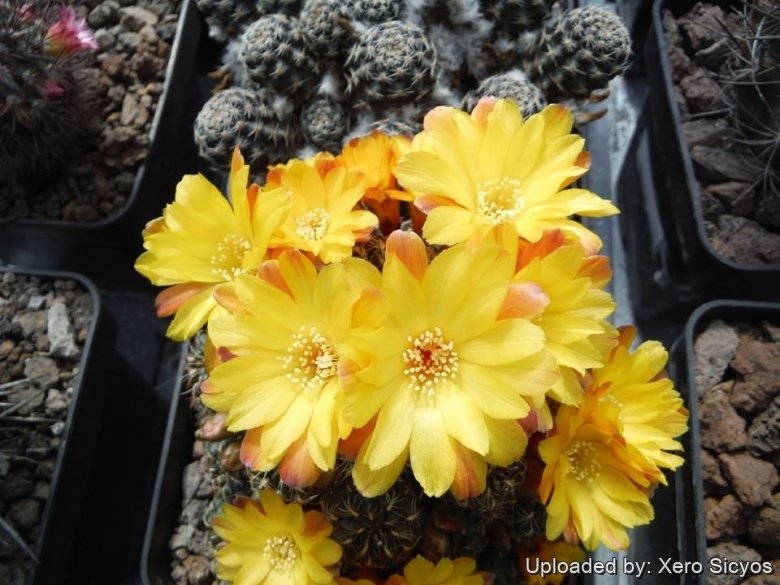
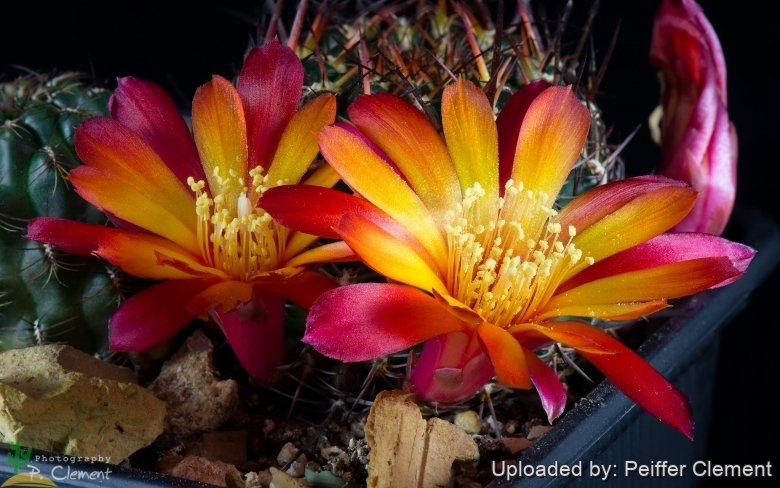
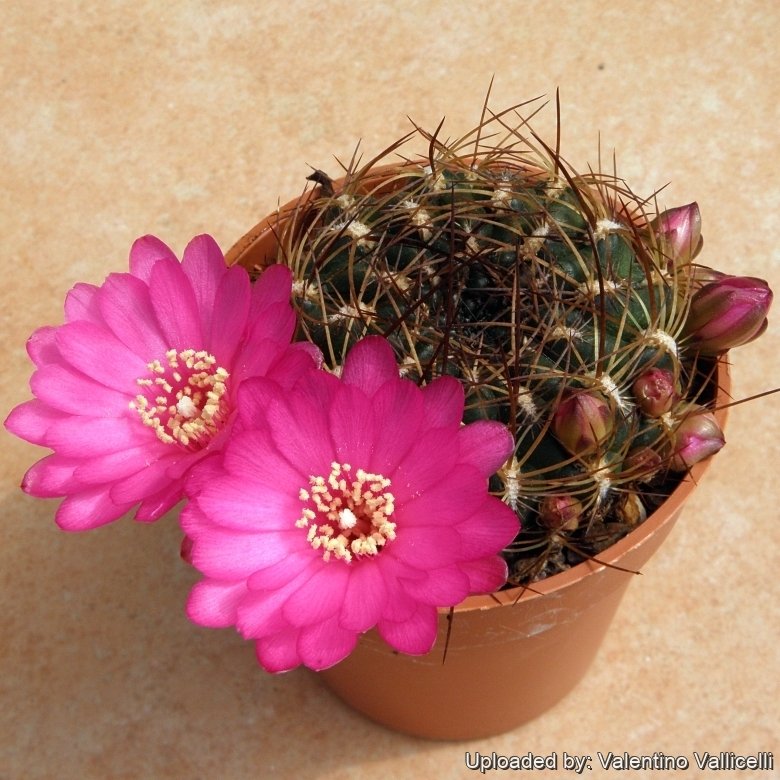
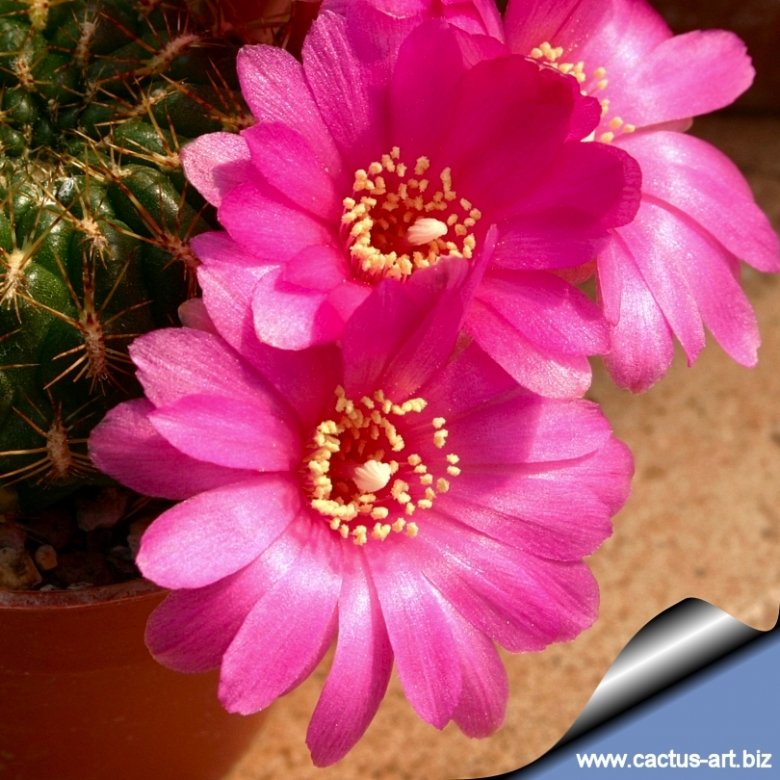
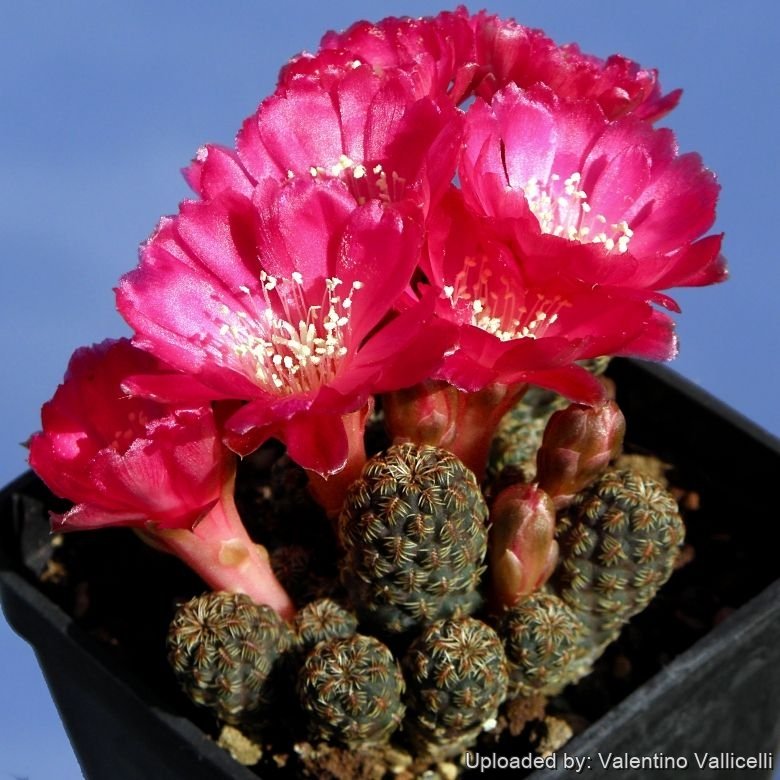
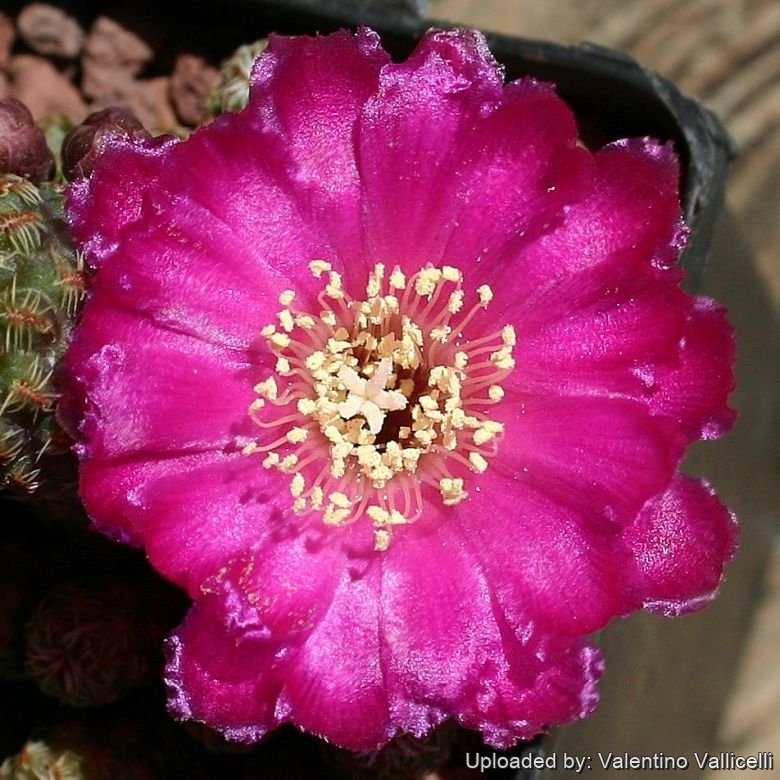
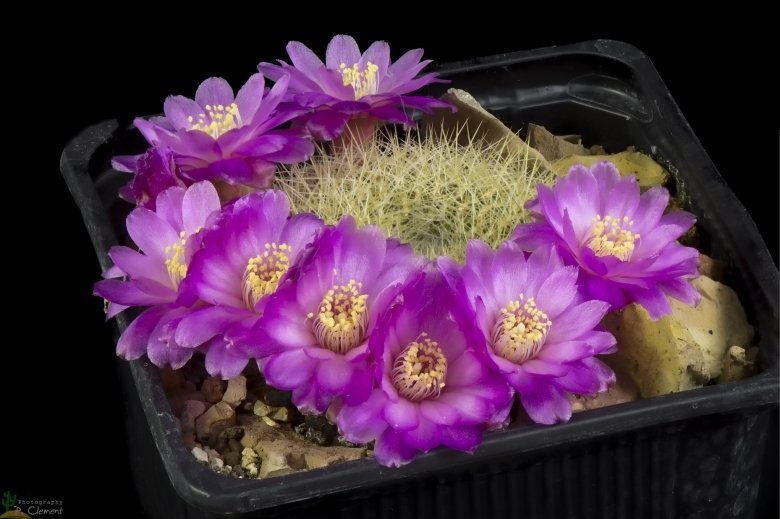
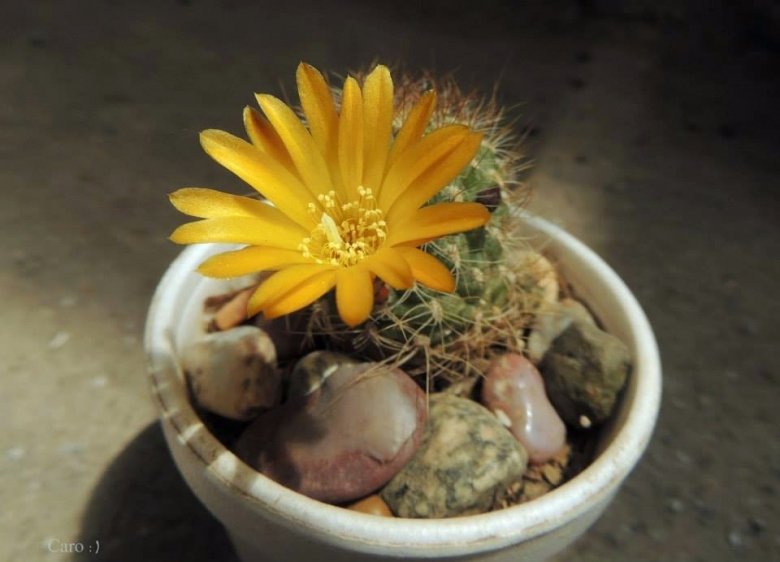
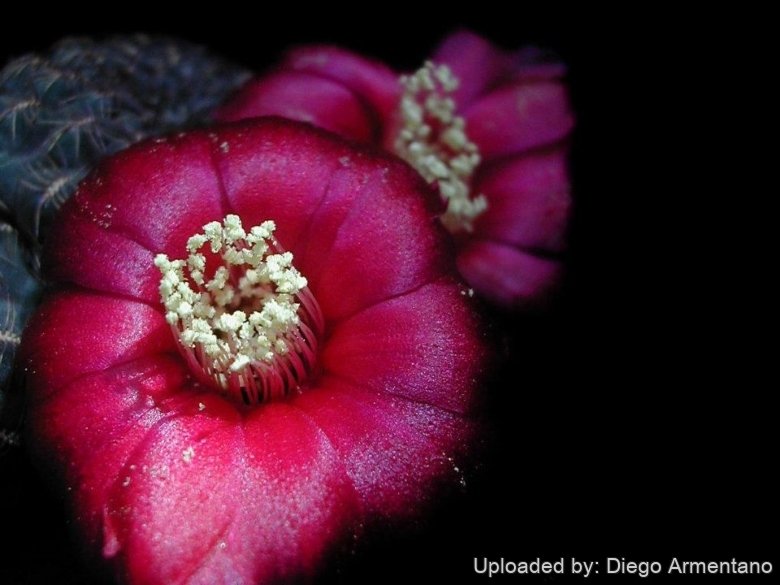
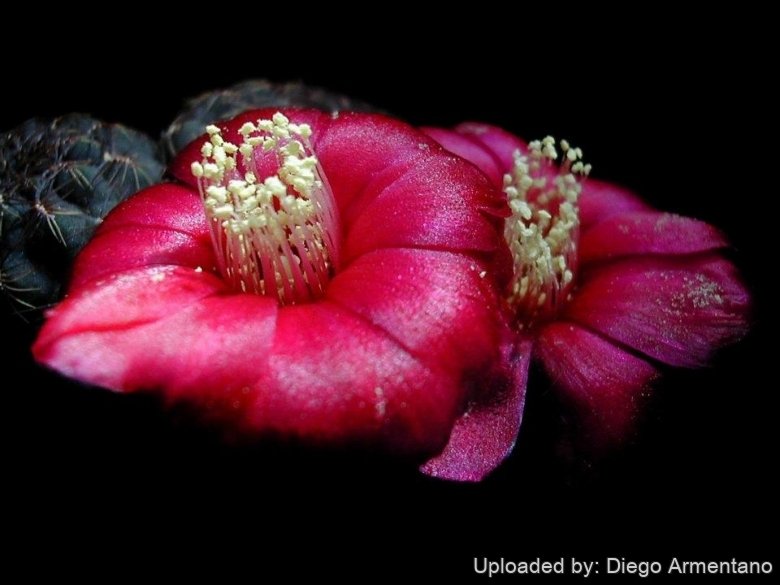
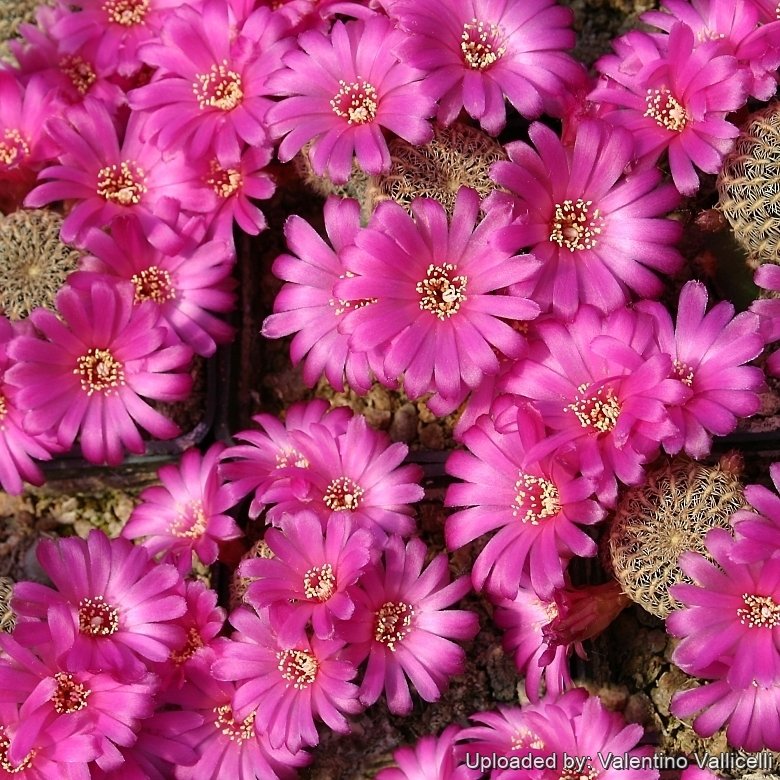
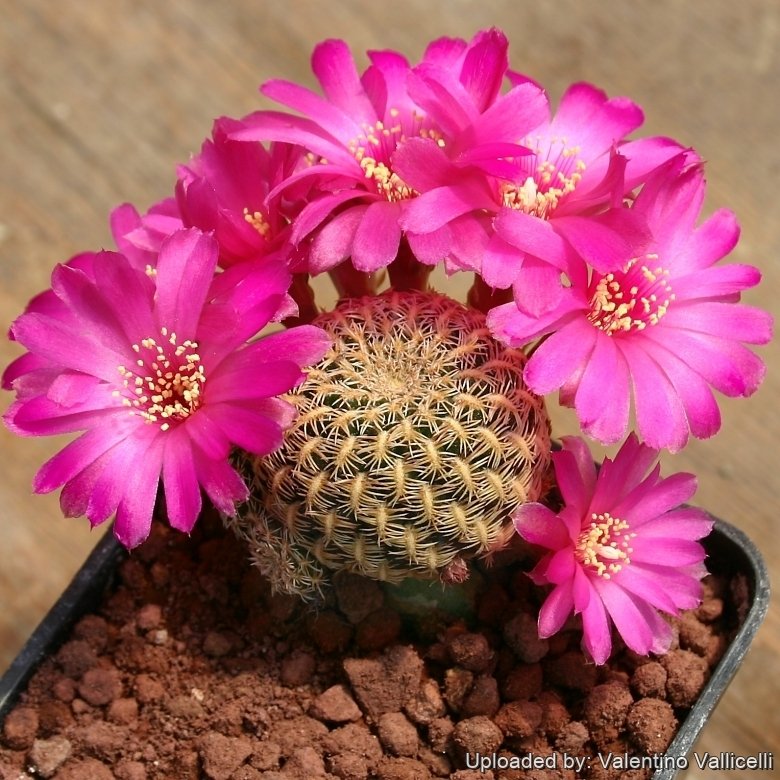
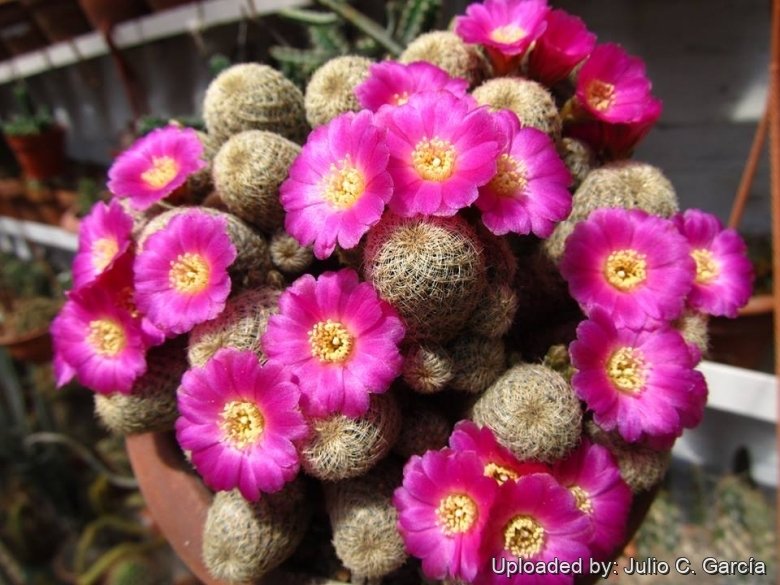
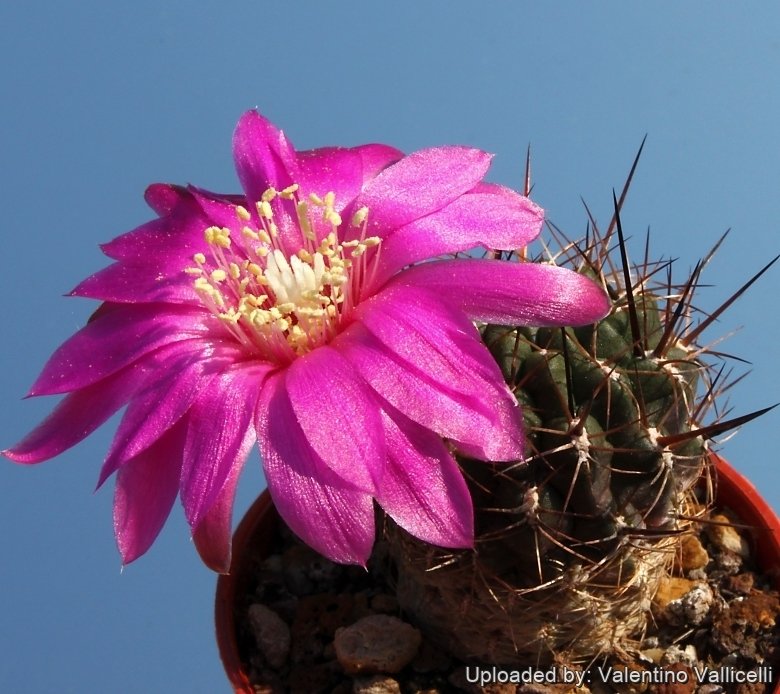
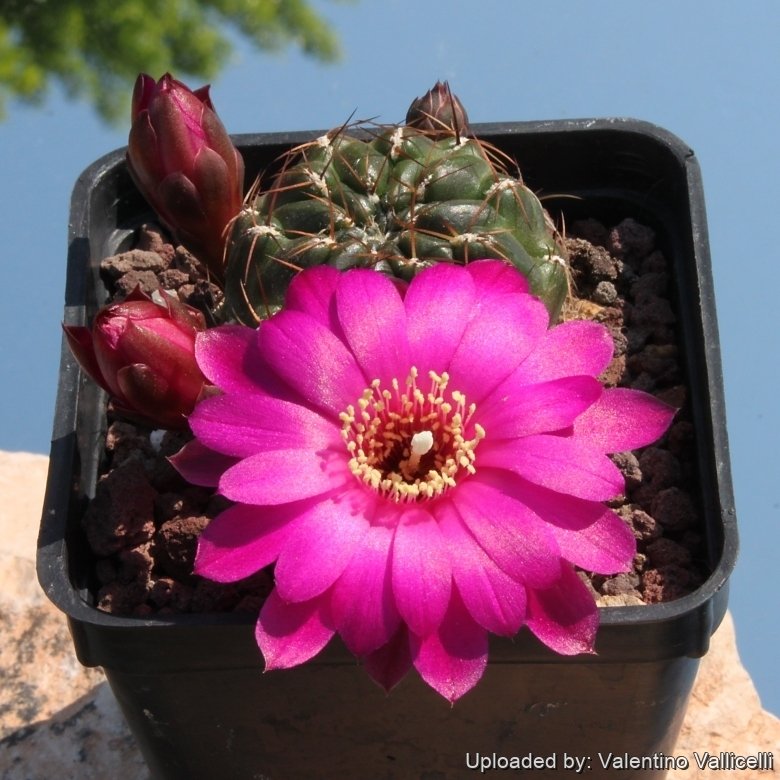
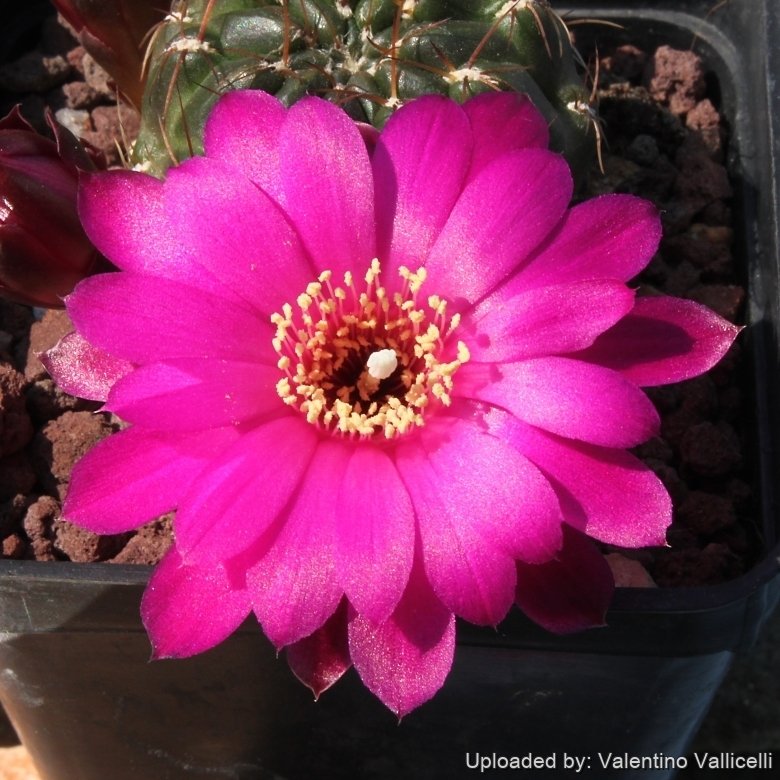
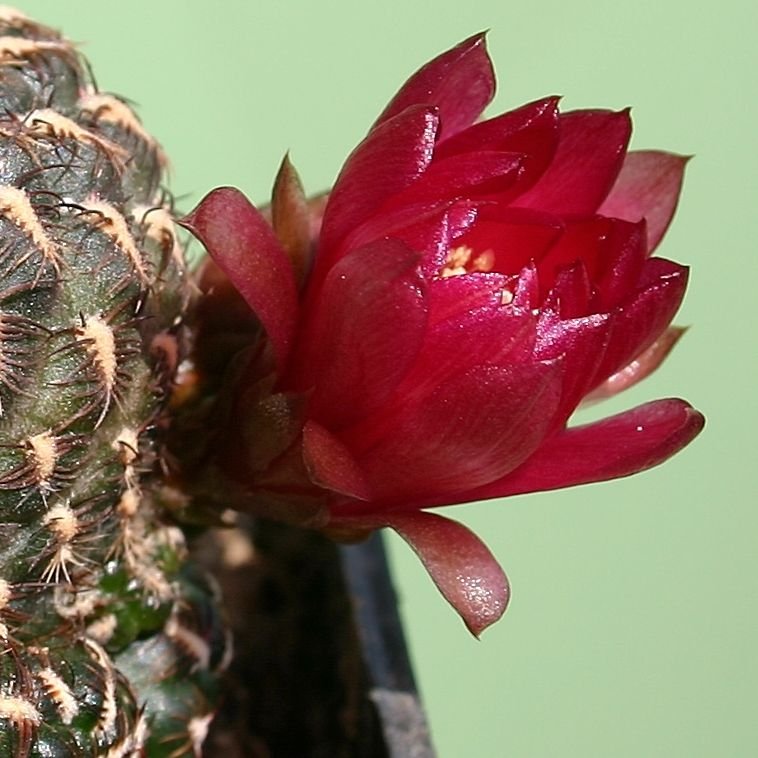
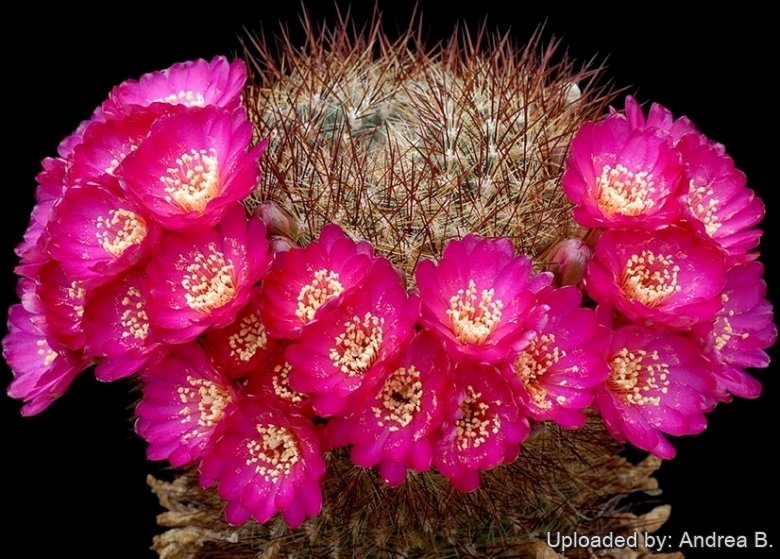
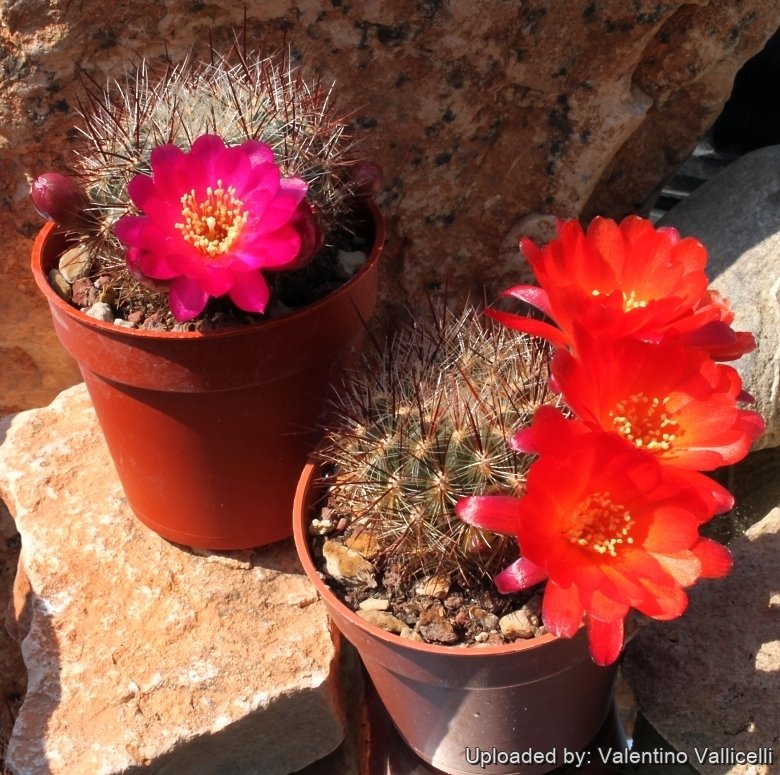
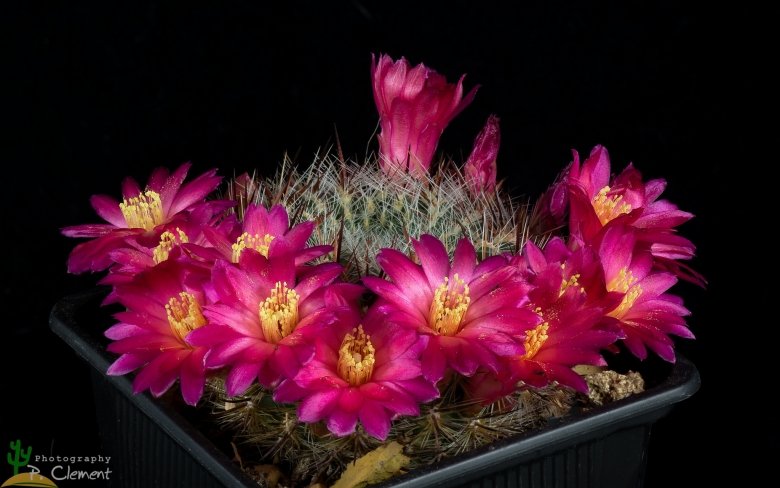
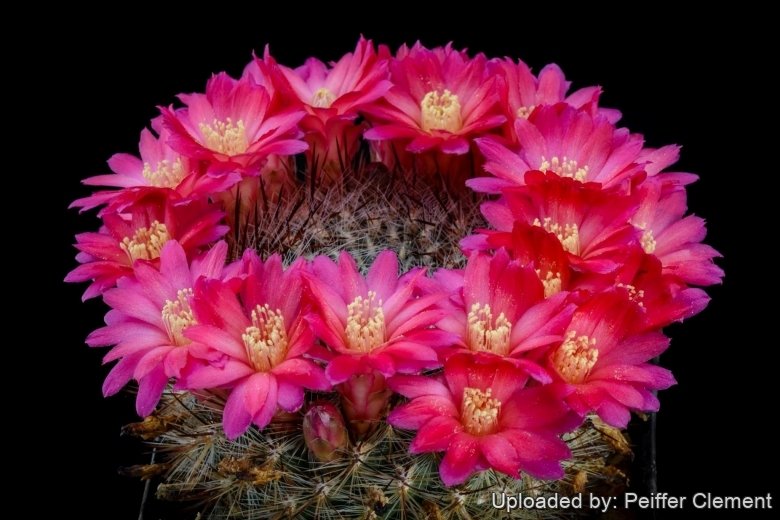
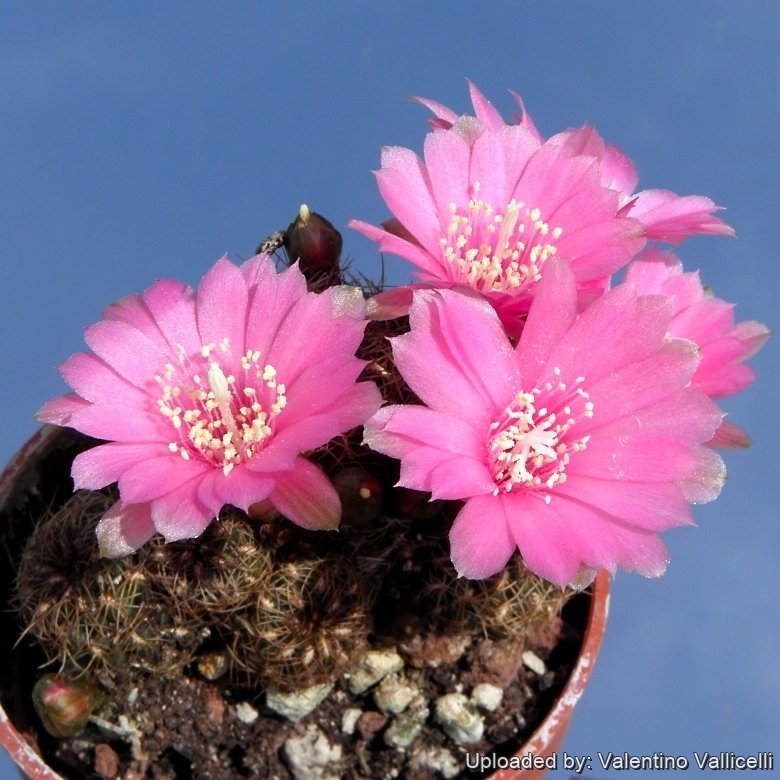
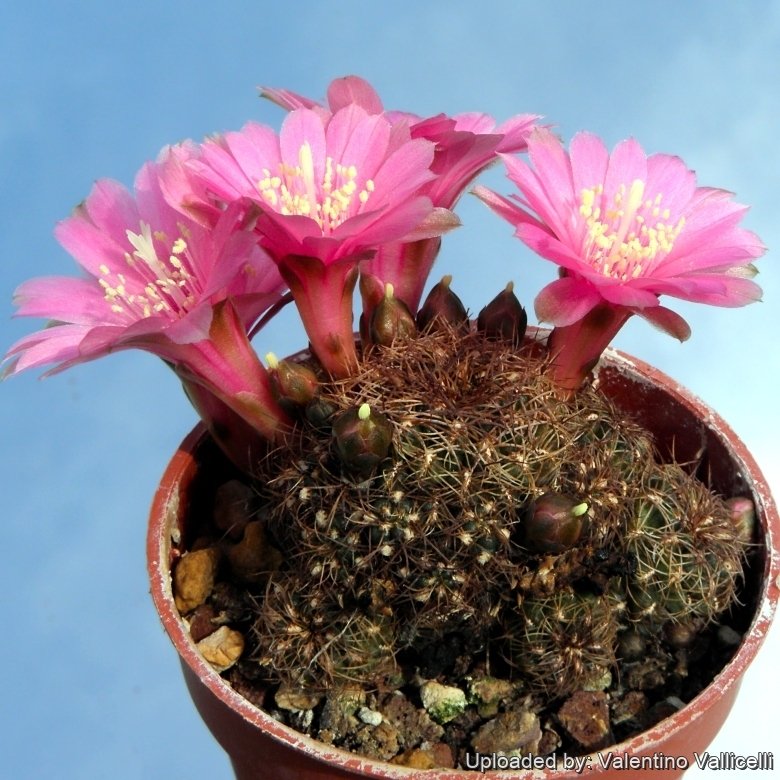
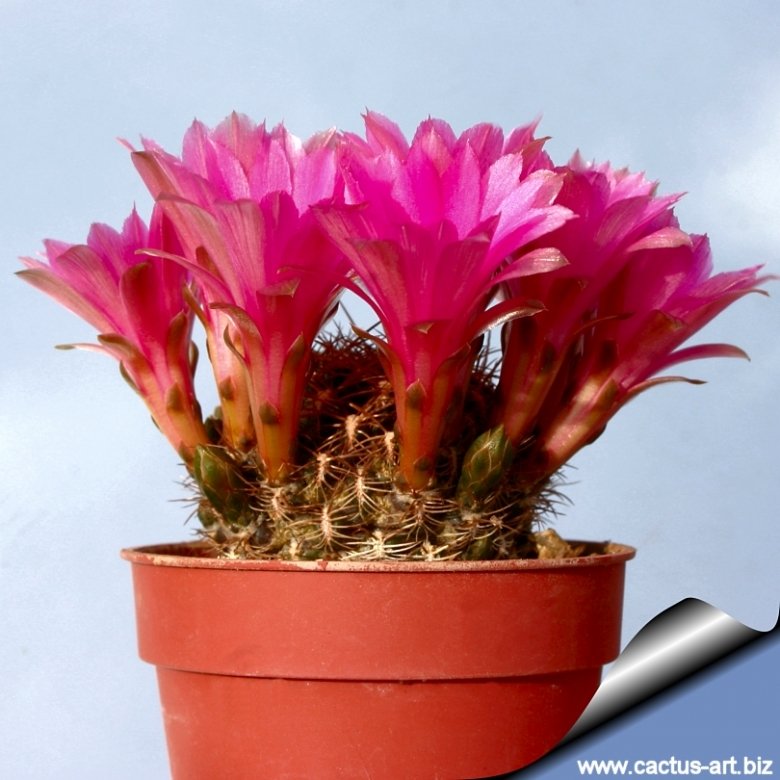
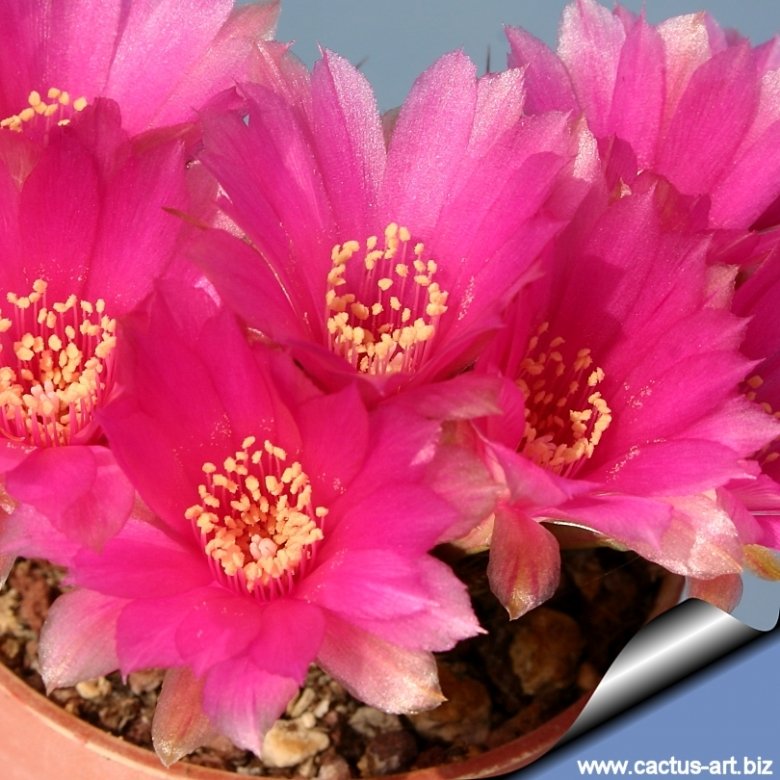
Flowers: Arising from monoflorous areoles, in lower lateral flower zone. Rarely more than 3,5 cm long and 4,5 in diameter, yellow, red, magenta, violet or orange often with white inner petals. Floral tube funnel-shaped, with broad naked scales.
Phenology: Blossoming time: Late spring.
Fruits: Small papery olive green to reddish brown at maturity.
Seeds: Black.
Origin and Habitat
North and east of Cochabamba in the Cordillera de Cochabamba, in southern Bolivia. Sulcorebutia is the type species of the genus Sulcorebutia. The first plants were collected near Colomi, along the route from Cochabamba to Chapare, by a Herr Steinbach.
Altitude range: 2900-3800 metres above sea level.
Habitat: Grows mainly on a flat, dry, stony area along the banks of the Rio Lopez, just before the moister zone of the tiraquensis populations.
Cultivation and Propagation
Rebutia steinbachii loves a very permeable, coarse mineral soil as well as to be strictly kept dry throughout the winter quiescent period since it is very sensitive to any moisture excesses, To prevent rottenness it is also advisable to surround its root neck by very rough sand or grit, this help a fast water drainage and an appropriate air circulation. The flowers appear in springtime after a “light” wintering. The spination and the growth are favourably influenced by a cultivation in a flat
container.
Watering Needs: Water moderately in the growing season, keep dry during the winter rest.
Frost Tolerance: Plants are quite frost hardy -5 (-10)° C, but for safe culture overwinter in a cool place (at 0/10°C) this is important for the flowers as well as for plants health. Without this cool winter period they normally wont get any buds.
Sun Exposure: Needs a full sun exposure (light shadow my be useful in the hottest summer days).
Propagation: Seed, cutting, grafting.
Notes
Sulcorebutia steinbachii is one of the most variable cactus species. The colour of the flower, the spines length, the body shape and pigmentation is extremely variable, even within a population. There are also many localized phenotypes capable of maintaining their separate identity, even though only a few kilometers apart and by former authors considered as separated species and varieties. They are nowadays considered just phenotypes of a highly polymorphic specie. These subpopulations are not only morphologically based but also geographically and can be grouped as follow:
Group 1a: Cochabamba to Chapare, northward and eastward to Tiraque
Sulcorebutia glomerispina
- S. tuberculato-chrysantha
- S. polymorpha
- S. kruegeri
- S. hoffmanniana
- S. glanduliflora Card. n.n.
- S. cochabambina
- S. steinbachii & vars. australis, gracilior, etc.
Group 1b: Province Tiraque to Epizana an eastward to Comarapa, 2,800 m-3.000 m.
Sulcorebutia tiraquensis & vars. longiseta
- S. spinosior & aglaia (bicolorispina)
- S. lepida
- S. krahnii
Group 2: Cerro Tunari-south and east of Cochabamba-Izata to Anzaldo, 3,400-3,900 m
Sulcorebutia verticillacantha
- S. tunariensis
- S. taratensis & var. minima
- S. mizquensis
- S. pojoniensis Rausch n.n.A
Group 3: West of Cochabamba-Ayopaya, 2,000-2,500 m
Sulcorebutia arenacea
- S. candiae
- S. menesesii & vars. kamiensis
- S. muschii
- S. glomeriseta
Group 4: Around Totora and southward toward Epizana, 2,600-3,000 m
Sulcorebutia oenantha
- S. totorensis
- S. pampagrandensis
Group 5: A limited area around Pasopaya and eastwards, 2,000 m
Sulcorebutia cardenasiana
- S. langeri
Bibliography
Major references and further lectures
-
James Cullen, Sabina G. Knees, H. Suzanne Cubey “The European Garden Flora Flowering Plants: A Manual for the Identification of Plants Cultivated in Europe, Both Out-of-Doors and Under Glass” Cambridge University Press, 11/Aug./2011
-
David Hunt, Nigel Taylor “The New Cactus Lexicon” DH Books, 2006
-
Edward F. Anderson “The Cactus Family” Timber Press, 2001
-
John Pilbeam “Sulcorebutia and Weingartia: A Collector’s Guide” Timber Press, 1985
-
Cyril Marsden, Herbert Spencer Jackson “Rebutia, Including Aylostera and Sulcorebutia” Macmillan, 1968
From llifle page Aylostera epizanaensis
Description
SulcoSN’>15211’ alt=‘5221’>Rebutia mizquensis#SN#5219’>Sulco[[Rebutia mizquensisSN’ style=‘border:none;’>, is a local or morphological form of the very variable Rebutia steinbachii . It is a choice solitary plant with dark green stems, white or brownish pectinated spines, pointing diagonally and downward. Flowers pink-violet or magenta. Rebutia steinbachii var. mizquensis is apparently a neotenic variety of the species in which juvenile spination is retained throughout the life of the plant, while most of the other varieties are dimorphic (short spined juvenile forms transform at maturity to strongly spined forms).
Habit: It is a low growing cactus, at first solitary, forming with time, especially in cultivation, clumps of many heads.
Stem: 24-40 mm tall, up to 50 mm wide, flattened globose, greysh-green to dark green sometime tinged red.
Ribs: Approx 13, spiralling, poorly distinguished, forming oblong rhomboidal grooved tubercles.
Areoles: Long narrow depressed with short grey felt (almost naked) 3-6 mm long, 1,5-2 mm large.
Radial spines: 9-12 (or more) about up to 20 mm long, fine, addpressed against the body, pectinate creamy to brownish, pointing diagonally and downward, ± curved slow to develops, frequently absent on new areoles at plant apex.
Central spines: None or rarely 1 to 3, only slightly stouter of the same colour of the radials.
Flowers: Arising from monoflorous areoles, in lower lateral flower zone. Rarely more than 3,5 cm long and 4,5 in diameter, pink, red or magenta often with paler inner petals. Floral tube funnel-shaped, with broad naked scales.
Blossoming time: Late spring.
Fruits: Small papery olive green to reddish brown at maturity.
Seeds: Black.
Origin and Habitat
Mizque amd adjacent areas, Cochabamba, Bolivia.
Altitude: 2400-3200 metres above sea level.
Cultivation and Propagation
Rebutia steinbachii var. mizquensis loves a very permeable, coarse mineral soil as well as to be strictly kept dry throughout the winter quiescent period since it is very sensitive to any moisture excesses, To prevent rottenness it is also advisable to surround its root neck by very rough sand or grit, this help a fast water drainage and an appropriate air circulation.
For its sensitive roots this species is frequently grafted to avoid root problems.
Watering Needs: Water moderately in the growing season, keep dry during the winter rest.
Frost Tolerance: Plants are and quite frost hardy -5 (-15)° C but prefeably overwinter in a cool place (at 0/10°C) this is important for the flowers as well as for plants health. Without this cool winter period they normally wont get any buds.
Sun Exposure: Needs a full sun exposure (light shadow my be useful in the hottest summer days)
Propagation: Seed, cutting, grafting.
Bibliography
Major references and further lectures
-
James Cullen, Sabina G. Knees, H. Suzanne Cubey “The European Garden Flora Flowering Plants: A Manual for the Identification of Plants Cultivated in Europe, Both Out-of-Doors and Under Glass” Cambridge University Press, 11/Aug./2011
-
David Hunt, Nigel Taylor “The New Cactus Lexicon” DH Books, 2006
-
Edward F. Anderson “The Cactus Family” Timber Press, 2001
-
Anderson E. F.: “The Cactus Family” Timber Press, Portland, Oregon, 2001
-
Ritter Fr.: “Kakteen in Südamerika” Spangenberg, 1980
-
John Pilbeam “Sulcorebutia and Weingartia: A Collector’s Guide” Timber Press, 1985
-
E Haustein “Der Kosmos Kakteenfuehrer (the Kosmos Cactus Guide)” Balogh Scientific Books 01 December 1998
-
Cullmann W., Götz E., Gröner G.”Kakteen: Kultur, Vermehrung und Pflege - Lexikon der Gattungen und Arten” Ulmer, Stuttgart, 1984
Source: Aylostera epizanaensis, LLIFLE - Encyclopedia of living forms, CC-BY-SA, retrieved 2026-10-25.
From llifle page Rebutia polymorpha
Description
This Sulcorebutia has been named polymorpha (which means “many forms”) for the variability of the plant in habitat. It is a clumping plant (rarely solitary) , readily forms clumps of many heads and are typical for Rebutia steinbachii.
Stem: 24-40 mm tall, up to 50 mm wide, flattened globose, dark green sometime tinged red.
Ribs: 12-26 poorly distinguished, forming oblong rhomboidal grooved tubercles.
Areoles: Long narrow with short grey felt (almost naked) 3 – 6 long, 1,5-2 mm large.
Radial spines: 9-14, about 10 mm long, addpressed against the body, white, yellow, brown with darker tips or almost black, ±curved slow to develops, frequently absent on new areoles at plant apex.
Central spines: None or 1 to 3 stouter 20-30 mm long.
Flowers: Up to 3,5 cm long and 4,5 in diameter, yellow or (usually) magenta , both colours occurring at random in habitat. Magenta flowers with yellow or white inner petals are also available. Floral tube funnel-shaped.
Phenology: Blossoming time: late spring.
Fruits: Olive green to reddish brown at maturity.
Origin and Habitat
Cochabamba department, Bolivia
Habitat: Grows mainly on a flat, dry, stony area along the banks of the Rio Lopez, just before the moister zone of the tiraquensis populations. Altitude 2950 – 3700 m.
Cultivation and Propagation
It loves a very permeable, coarse mineral soil as well as to be strictly kept dry throughout the winter quiescent period since it is very sensitive to any moisture excesses, To prevent rottenness it is also advisable to surround its root neck by very rough sand or grit, this help a fast water drainage and an appropriate air circulation. Plants are quite frost hardy -5 (-10)° C
Watering Needs: Water moderately in the growing season, keep dry during the winter rest.
Frost Tolerance: Overwinter in a cool place (at 0/10°C) this is important for the flowers as well as for plants health. Without this cool winter period they normally wont get any buds. Sun Exposure: Needs a full sun exposure ( light shadow my be useful in the hottest summer days)
Propagation: Seed, cutting, grafting
Bibliography
Major references and further lectures
-
James Cullen, Sabina G. Knees, H. Suzanne Cubey “The European Garden Flora Flowering Plants: A Manual for the Identification of Plants Cultivated in Europe, Both Out-of-Doors and Under Glass” Cambridge University Press, 11/Aug./2011
-
David Hunt, Nigel Taylor “The New Cactus Lexicon” DH Books, 2006 ISBN 0953813444, 9780953813445
-
Edward F. Anderson “The Cactus Family” Timber Press, 2001
-
John Pilbeam “Sulcorebutia and Weingartia: A Collector’s Guide” Timber Press, 1985
-
Cyril Marsden, Herbert Spencer Jackson “Rebutia, Including Aylostera and Sulcorebutia” Macmillan, 1968
Source: Rebutia polymorpha, LLIFLE - Encyclopedia of living forms, CC-BY-SA, retrieved 2026-10-25.
From llifle page Rebutia taratensis
Description
Rebutia taratensis best known as SulcoSN’>5225’ alt=‘5221’>Rebutia taratensis#SN#5226’>Sulco[[Rebutia taratensisSN’ style=‘border:none;’> is one of the innumerable local form of the very variable Rebutia steinbachii (= SulcoSN’>5220’ alt=‘5226’>Rebutia steinbachii#SN#5221’>Sulco[[Rebutia steinbachiiSN’ style=‘border:none;’>). It distinguishes for its small, free clustering bodies. The flowers are bright purple and the spination of well-grown specimens is pleasing. It is one of the tiniest Sulcorebutia. The var. minima has minuscule bodies which cluster like a mad, readily forming crowded cushions with hundred of heads.
Note: Rebutia taratensis is apparently a neotenic variety of the species in which juvenile spination is retained throughout the life of the plant, while many of the other varieties are dimorphic (short spined juvenile forms transform at maturity to strongly spined forms).
Habit: It is a clumping plant growing readily forming, especially in cultivation, clumps of hundred of heads from the base.
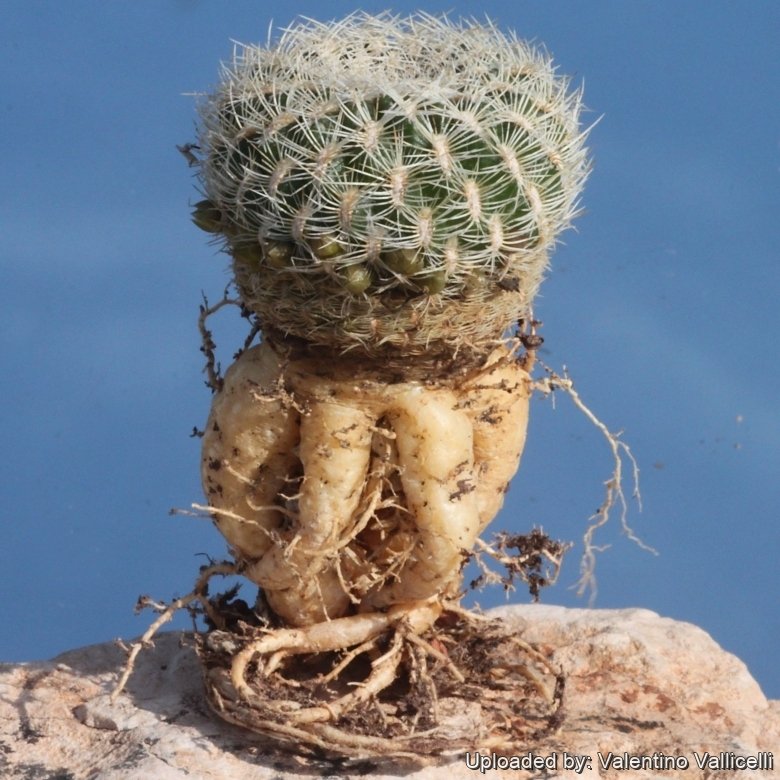
Roots: More or less thickened and carrot-like.
Stem: Single heads 15–30 mm wide, and 25-50 mm tall, globular, to clavate somehow apically depressed, very dark tanned green to dark magenta-green sometime tinged red, not completely hidden under the covering of spines.
Ribs: Few, spiralling, poorly distinguished, forming oblong rhomboid tubercles with well-defined grooves.
Areoles: Narrow 1-3 mm long, 0,5 mm large almost naked, depressed with short grey or brown felt.
Central spines: Absent.
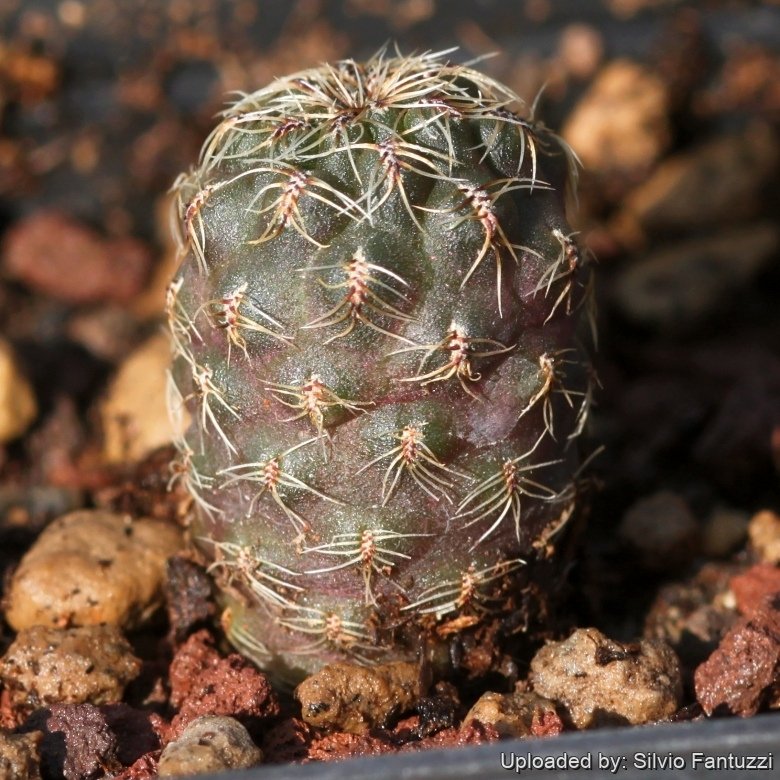
Radial spines: (6-)8-12(-14) about up to 3 mm long, acicular, adpressed against the body, thin, pectinate pointing sidewards and downwards less than 5 mm in length. Creamy-white, with darker brown base. These spines don’t obscure the stem but form a nice spiralling pattern.
Flowers: Numerous at the base of the plant, typically dark purple, with a silky sheen. Floral tube funnel-shaped, with broad naked scales
Blooming season: Spring (April - May) and remain open for up to five days.
Fruits: Small papery olive green to reddish brown at maturity.
Seeds: Black.
Origin and Habitat
Cochabamba (Tarata, Arani, Cliza, Sivingani, Mizque, Anzaldo, Sacabamba, Rio Caine and adjacent area) Bolivia.
Type Locality: Anzaldo, Cochabamba, Bolivia.
Altitude: 2000-3500 metres above sea level.
Cultivation and Propagation
Very difficult to find high quality plants of this species in cultivation, S. taratensis loves a very permeable, coarse mineral soil as well as to be strictly kept dry throughout the winter quiescent period since it is very sensitive to any moisture excesses, To prevent rottenness it is also advisable to surround its root neck by very rough sand or grit, this help a fast water drainage and an appropriate air circulation.
For its sensitive roots this species is frequently grafted to avoid root problems. Plants are quite frost hardy -5 (-10)° C. Water moderately in the growing season, keep dry during the winter rest. Overwinter in a cool place (at 0/10°C) this is important for the flowers as well as for plants health. Without this cool winter period they normally wont get any buds.
Sun Exposure: Needs a full sun exposure ( light shadow my be useful in the hottest summer days)
Propagation: Seed, cutting, grafting.
Notes
This plant is now considered by most authors a synonym of Sulcorebutia steinbachii but there is some confusion and others says that it is a smallish variant of Sulcorebutia rauschii with uniformly coloured flowers and fewer dark pectinated spines.
Source: Rebutia taratensis, LLIFLE - Encyclopedia of living forms, CC-BY-SA, retrieved 2026-10-25.
From llifle page Sulcorebutia cochabambina
Description
Sulcorebutia cochabambina is one of the innumerable local form of the very variable Rebutia steinbachii (= Sulcorebutia steinbachii). It is often referred as form of Sulcorebutia hoffmanniana with pinkish to dark magenta flowers (occasionally with yellow throat) dull green bodies, thin brown pectinate spines. It is barely distinguishable from Sulcorebutia clizensis with smaller reddish flowering. Rebutia cochabambina is apparently a neotenic variety of the species in which juvenile spination is retained throughout the life of the plant, while most of the other varieties are dimorphic (short spined juvenile forms transform at maturity to strongly spined forms).
Habit: It is a clumping plant, readily forming, especially in cultivation, clumps of many heads.
Root: Carrot-like.
Stem: 24-40 mm tall, up to 50 mm wide, flattened globose, dull gray-green sometime tinged red.
Ribs: Spiralling, poorly distinguished, forming oblong rhomboidal grooved tubercles.
Areoles: Long narrow depressed, dull white with short brownish-grey felt (almost bare) 3-6 mm long, 1,5-2 mm large.
Radial spines: Up to12 (or more) about up to 10 mm long, thin, acicular, addpressed and somewhat curved against the body, ± pectinate, dull creamy-yellow to light-brown.
Central spines: None .
Flowers: Arising from monoflorous areoles, in lower lateral flower zone. Rarely more than 3,5 cm long and 4,5 in diameter, mostly pinkish to dark magenta with a silky shine (occasionally with yellow throat). Floral tube funnel-shaped, with broad naked scales.
Blossoming time: Late spring.
Fruits: Small papery olive green to reddish brown at maturity.
Seeds: Black.
Origin and Habitat
Arani, Cochabamba, Bolivia. Altitude 3100 m.
Cultivation and Propagation
These mountainous plants have thick taproots and are susceptible to overwatering. They loves a very permeable, coarse mineral soil as well as to be strictly kept dry throughout the winter quiescent period since it is very sensitive to any moisture excesses, To prevent rottenness it is also advisable to surround its root neck by very rough sand or grit, this help a fast water drainage. They requires also an appropriate air circulation and are sometime grafted to avoid root problems. They need to be kept in a cool place during winter rest (at 0-10°C). This is important for the flowers ,as well as for their health. Without this cool winter period, they normally won’t get any buds. Grafted plants are very easy to grow, and are quite frost hardy (-5° C) if kept dry. Needs a full sun exposure ( light shadow my be useful in the hottest summer days)
Propagation: Seed, cutting, grafting
Source: Sulcorebutia cochabambina, LLIFLE - Encyclopedia of living forms, CC-BY-SA, retrieved 2026-10-25.
From llifle page Sulcorebutia minima
Description
SulcoSN’>5225’ alt=‘5226’>Rebutia taratensis#SN#5226’>Sulco[[Rebutia taratensisSN’ style=‘border:none;’> var. minima is one of the innumerable local form of the very variable Rebutia steinbachii (= SulcoSN’>5220’ alt=‘5221’>Rebutia steinbachii#SN#5221’>Sulco[[Rebutia steinbachiiSN’ style=‘border:none;’>). It distinguishes from standard taratensis for its thinner bodies (less than 2 cm in width) which cluster like a mad, readily forming crowded mounds or cushions with hundred of heads. The flowers are bright purple and the spination of well-grown specimens is pleasing. It is one of the tiniest Sulcorebutia.
Note: Rebutia taratensis var. minima is apparently a neotenic variety of the species in which juvenile spination is retained throughout the life of the plant, while many of the other varieties are dimorphic (short spined juvenile forms transform at maturity to strongly spined forms).
Habit: It is a clumping plant growing readily forming, especially in cultivation, clumps of h heads from the base.
Roots: More or less thickened and carrot-like.
Stem: Single heads minuscule 5–20 mm wide, and 25-50 mm tall, globular, to clavate somehow apically depressed, very dark tanned green to dark magenta-green sometime tinged red, not completely hidden under the covering of spines.
Ribs: Few, spiralling, poorly distinguished, forming oblong rhomboid tubercles with well-defined grooves.
Areoles: Narrow 1-3 mm long, 0,5 mm large almost naked, depressed with short grey or brown felt.
Central spines: Absent.
Radial spines: (6-)8-12(-14) about up to 3 mm long, acicular, adpressed against the body, thin, pectinate pointing sidewards and downwards less than 5 mm in length. Creamy-white, with darker brown base. These spines don’t obscure the stem but form a nice spiralling pattern.
Flowers: Numerous at the base of the plant, typically dark purple, with a silky sheen. Floral tube funnel-shaped, with broad naked scales.
Blooming season: Spring (April - May) and remain open for up to five days.
Fruits: Small papery olive green to reddish brown at maturity.
Seeds: Black.
Origin and Habitat
Cochabamba, Cochabamba, Bolivia
Cultivation and Propagation
Very difficult to find high quality plants of this species in cultivation, S. taratensis “minima” loves a very permeable, coarse mineral soil as well as to be strictly kept dry throughout the winter quiescent period since it is very sensitive to any moisture excesses, To prevent rottenness it is also advisable to surround its root neck by very rough sand or grit, this help a fast water drainage and an appropriate air circulation.
For its sensitive roots this species is frequently grafted to avoid root problems. Plants are quite frost hardy -5 (-10)° C. Water moderately in the growing season, keep dry during the winter rest. Overwinter in a cool place (at 0/10°C) this is important for the flowers as well as for plants health. Without this cool winter period they normally wont get any buds.
Sun Exposure: Needs a full sun exposure ( light shadow my be useful in the hottest summer days)
Propagation: Seed, cutting, grafting.
Source: Sulcorebutia minima, LLIFLE - Encyclopedia of living forms, CC-BY-SA, retrieved 2026-10-25.
From llifle page Sulcorebutia oenantha var. pampagrandensis
Description
Rebutia steinbachii var. pampagrandensis best known as Sulcorebutia pampagrandensis is one of the innumerable local form of the very variable Rebutia steinbachii (= Sulcorebutia steinbachii) that distinguishes for its grey-green body, long narrow yellowish areoles and yellowish pectinate spines. The blooms are mauve.
Note: Rebutia steinbachii var. pampagrandensis is apparently a neotenic variety of the species in which juvenile spination is retained throughout the life of the plant, while many of the other varieties are dimorphic (short spined juvenile forms transform at maturity to strongly spined forms).
Habit: It is solitary or few branched, but readily forming, clusters or cushions in cultivation.
Root: Carrot-like.
Stem: Single heads 30–50 mm wide, flattened-globose or globose and somehow apically depressed, grey-green, lighter than type, almost hidden under the covering of spines..
Ribs: 12-26, spiralling, forming rhomboid tubercles.
Tubercles: Conical conspicuous.
Areoles: White or yellowish, long, narrow 3-6 long, 1,5-2 mm large.
Spines: About 20-25 creamy-white or yellowish (sometime brownish to almost black.) pectinate, addpressed to slightly spreading and somewhat curved against the body.
Central spines: Absent or occasionally one.
Flowers: Rarely more than 3,5 cm long and 4,5 in diameter, mauve to burgundy red with a silky sheen (occasionally yellow with reddish tones on the outside), numerous in a ring at the base of the plant.
Blooming season: Spring (April - May) and remain open for up to five days.
Origin and Habitat
Cochabamba, Bolivia (reported localities: Epizana, Mizque ,Aiquile, South of Totora)
Type Locality: Rancho Pampa Grande, Totora, Cochabamba
Altitude: 2600-2700
Cultivation and Propagation
It loves a very permeable, coarse mineral soil as well as to be strictly kept dry throughout the winter quiescent period since it is very sensitive to any moisture excesses, To prevent rottenness it is also advisable to surround its root neck by very rough sand or grit, this help a fast water drainage and an appropriate air circulation. Plants are quite frost hardy -5 (-10)° C
Watering Needs: Water moderately in the growing season, keep dry during the winter rest
Frost Tolerance: Overwinter in a cool place (at 0/10°C) this is important for the flowers as well as for plants health. Without this cool winter period they normally wont get any buds.
Sun Exposure: Needs a full sun exposure ( light shadow my be useful in the hottest summer days)
Propagation: Seed, cutting, grafting
Source: Sulcorebutia oenantha var. pampagrandensis, LLIFLE - Encyclopedia of living forms, CC-BY-SA, retrieved 2026-10-25.
From llifle page Sulcorebutia steinbachii var. krahnii
Description
Sulcorebutia krahnii is a local or morphological form of the widespread and variable Rebutia steinbachii. It has bright yellow flowers that appear rarely in a closed crown. The colour and the thickness of the spination are variable with yellow and brown as predominant colours and occasionally extremely dark. However the distinguishing characteristics of this taxon, appear to fall within the natural variation of Rebutia steinbachii and the name Sulcorebutia krahnii is not accepted by some botanists that treat it as synonym, but it still has a value for a collector because they identify plants with particular characters.
Stem: Solitary, flattened-spherical, with concave apex, dark green to dull olive-green, up to 10 cm tall and 7 cm in diameter.
Ribs: about 32, with conical tubercles in spirals.
Aeoles: Rounded to oval 3 to 4 mm long, 2 to 3mm wide.
Root: Main root thin (up to 7 cm long) highly branched, but in larger plants the main root is barely recognizable.
Spines: Not easily distinguishable as radial and central.
Central spines: 3-7 central spines, up to 12 mm long, brown to brownish black.
Radial spines: about 24 soft, bristle-like, from white to brown and black, up to 10 mm long.
Flowers: Buds brownish, mostly born in the old areoles on the side of the stems, rarely on older areoles near the base of the plant. Flowers yellow with white throat, 2.5 to 3.5 cm across, scentless, sometimes with fruity, mouldy or musty odours, also smelling like lemon balm (Melissa) or jasmine. Outer tepals scaly, yellow with darker brownish red tips, inner tepals yellow with a clear white-yellow base. Carpel and tube with greenish or reddish yellow, apiculate scales. Stamens yellow or yellowish. Pistil white to yellowish with 5-6 papillose, whitish or yellowish stigma-lobes.
Fruit: Olive-green or brownish, up to 5 mm in diameter, with scale scales of the same colour. Lower scales with or without few white hairs.
Seeds: Oblong-globose 1.2 to 1.3 mm long and 1.1 to 1.2 mm wide, dark brown.
Origin and Habitat
Cerro Tukiphalla (North-West of Comarapa), province of Caballero, Santa Cruz, Bolivia
Altitude range: 1900-2700 metres above sea level.
Habitat and ecology: This species grows in forest clearings, between herbs and selaginellas, on rocky outcrops and rock fissures with some humus in relatively wet inter-Andean valleys, with almost permanent fog. Therefore this area (even in the dry season), is much green than elsewhere in Sulcorebutias habitats. Some plants (especially low bushes) are very large, up to 150 cm wide. In the yellow-brown sand the yellow-brown spined plants appears almost camouflaged. The same area support endemic succulents and xerophyte plants such as Parodia comarapana, Samaipaticereus corroanus and the orchid Epidendrum ibaguense.
Cultivation and Propagation
Sulcorebutia krahnii loves a permeable, coarse mineral soil as well as to be strictly kept dry throughout the winter quiescent period since it is very sensitive to any moisture excesses, To prevent rottenness it is also advisable to surround its root neck by very rough sand or grit, this help a fast water drainage and an appropriate air circulation. The flowers appear in springtime after a “light” wintering. The spination and the growth are favourably influenced by a cultivation in a flat
container.
Watering Needs: Water moderately in the growing season, keep dry during the winter rest.
Frost Tolerance: Plants are quite frost hardy -5 (-10)° C, but for safe culture overwinter in a cool place (at 0/10°C) this is important for the flowers as well as for plants health. Without this cool winter period they normally wont get any buds.
Sun Exposure: Needs a full sun exposure (light shadow my be useful in the hottest summer days).
Propagation: Seed, cutting, grafting.
Bibliography
Major references and further lectures
-
Wolfgang Krahn “Sulcorebutia krahnii Rausch” Succulenta Nederland 50 : 1 (1971) (p.2-3)
-
Walter Rausch: “Neue Arten der Gattung Sulcorebutia Backeb. – Sulcorebutia krahnii Rausch spec. nov.” – Kakteen und andere Sukkulenten 21 (6): 104, 1970
Source: Sulcorebutia steinbachii var. krahnii, LLIFLE - Encyclopedia of living forms, CC-BY-SA, retrieved 2026-10-25.
From llifle page Sulcorebutia steinbachii subs. markusii
Description
Although SulcoSN’>5220’ alt=‘5257’>Rebutia steinbachii#SN#5221’>Sulco[[Rebutia steinbachiiSN’ style=‘border:none;’> ssp.markusii has been considered up to now to be a good species, because of the findings of the last ten years this taxon has been identified by Gertel et de Vries (2004) as belonging to Rebutia steinbachii, but other authorities consider it a synonym of Rebutia mentosa ( E. Anderson 2001, D.R.Hunt 2006).
Habit: Described as solitary, this species reluctantly clusters in cultivation after a few years, but is slow-growing, and this and its low-growing habit suggest perhaps a harsh time in the wild.
Stems: Depressed - globose, about 3 or 4 cm tall, and to 6 cm wide, dark green to brownish violet, with from 10 to 17 ribs, spiralling. Tubercles 5 to 8 mm long.
Root: Thick napiforme c. 16 cm long, connected to the body by a narrow neck.
Areoles: Elongated 3 to 4 mm long and 1 to 1.5 mm wide with short whitish felt.
Central spines: 0 to 1 (rare in cultivated plants), 4 to 8 mm long, brownish grey to black, usually erect.
Radial spines: 8 to 12 thin, slightly curved, appressed, 3 to 5 mm long, whitish, ash-grey to brownish-black, base thickened dark-brownish, sometimes with paler tips.
Flowers: Buds dark to brownish green, growing from around the stem base. Flowers short funnel-shaped, completely open, red to purple, 40 mm wide and long, scentless or slightly fruity or mouldy. Outer perianth segments red or violet, some-times olive green with a brownish base. Inner perianth segments dark reddish violet, carmine purple sometime with a paler base. Stamens yellowish, reddish violet in the base. Pistil yellowish-green in the base, with 6 yellow papillose stigma lobes.
Fruits: Reddish-brown 6 mm in diameter, covered with brownish or greenish scales, the lower scales with fine white hairs, sometimes barely visible.
Seeds: 1.4 to 1.5 mm long and 1.2 to 1.4 mm wide.
Origin and Habitat
Sulcorebutia steinbachii ssp. markusii had been reported from Bolivia, Department Cochabamba, province of Mizque, from Vila Vila, north of the town Villa Vizcarra. The distribution area of subs. markusii is adjoining that of the subspecies verticillacantha, steinbachii and krugerae to the south and south-east.
Altitude range: Arund 2400-3500 metres above sea level.
Cultivation and Propagation
It loves a very permeable, coarse mineral soil as well as to be strictly kept dry throughout the winter quiescent period since it is very sensitive to any moisture excesses, To prevent rottenness it is also advisable to surround its root neck by very rough sand or grit, this help a fast water drainage and an appropriate air circulation. Plants are quite frost hardy -5 (-10)° C
Watering Needs: Water moderately in the growing season, keep dry during the winter rest.
Frost Tolerance: Overwinter in a cool place (at 0/10°C) this is important for the flowers as well as for plants health. Without this cool winter period they normally wont get any buds.
Sun Exposure: Needs a full sun exposure (light shadow my be useful in the hottest summer days).
Propagation: Seed, cutting, grafting.
Bibliography
Major references and further lectures
-
Günther Fritz, Willi Gertel & Johan de Vries “The complex of sulcorebutia steinbachii (Werdermann) Backeberg” CACTUS & Co. 3 (8) 2004
-
David Hunt, Nigel Taylor “The New Cactus Lexicon” DH Books, 2006
-
Edward F. Anderson “The Cactus Family” Timber Press, 2001
-
John Pilbeam “Sulcorebutia and Weingartia: A Collector’s Guide” Timber Press, 1985
-
Curt Backeberg “Cactus Lexicon” Sterling Publishing Company, Incorporated, 1978
-
Karl-Heinz Brinkmann, “Die Gattung Sulcorebutia” 1976
-
Rausch, Walter “Neue Arten der Gattung Sulcorebutia Backeb. – Sulcorebutia markusii Rausch spec. nov.” Kakteen und andere Sukkulenten 21 (6): 103-104, 1970
-
“Rebutia, Aylostera y Weingartia - Blog dedicado a Rebutia, Aylostera, Mediolobivia, Weingartia, Sulcorebutia y otros cactus.” Retrieved 08 April 2016 from <http://good-rebutia.blogspot.it/2012/08/rebutia-steinbachii-werdermann-1931-ssp.html\>
Source: Sulcorebutia steinbachii subs. markusii, LLIFLE - Encyclopedia of living forms, CC-BY-SA, retrieved 2026-10-25.
From llifle page Sulcorebutia steinbachii subvar. augustinii
Description
Sulcorebutia augustinii is one of the innumerable local form of the very variable Rebutia steinbachii (= SulcoSN’>5220’ alt=‘5221’>Rebutia steinbachii#SN#5221’>Sulco[[Rebutia steinbachiiSN’ style=‘border:none;’>) characterized by mini stems almost hidden under the dense covering of tiny amber and pectinate spines. Rings of light purple flowers brighten up the plant in spring.
Note: Rebutia steinbachii subv. augustinii is apparently a neotenic variety of the species in which juvenile spination is retained throughout the life of the plant, while many of the other varieties are dimorphic (short spined juvenile forms transform at maturity to strongly spined forms).
Habit: It is a clumping plant, readily forming, especially in cultivation, dense clumps or cushion of many heads and flat to the ground.
Roots: Mostly non-succulent, fibrous roots. More than 90% of the plant is concentrated in the stem.
Stem: Single heads 30–40 mm wide (but often smaller), globular, flattened and somehow apically depressed, grey-green, almost hidden under the covering of spines.
Ribs: 12-26, spiralling, forming oblong rhomboid tubercles with well-defined grooves.
Tubercles: Conical conspicuous.
Areoles: White or yellowish, long, narrow 3-6 long, 1,5-2 mm large.
Spines: Tiny Amber coloured and pectinate, often more than 20. These spines obscure the stem giving the plant a straw-yellow to reddish-brown appearance.
Flowers: Bright pink to light purple, numerous in a ring at the base of the plant.
Blooming season: Spring (April - May) and remain open for up to five days.
Origin and Habitat
Pasorapa (Villa Redención Pampa Zudañez) Cochabamba, Bolivia.
Cultivation and Propagation
These mountainous plants have thick taproots and are susceptible to overwatering. They loves a very permeable, coarse mineral soil as well as to be strictly kept dry throughout the winter quiescent period since it is very sensitive to any moisture excesses, To prevent rottenness it is also advisable to surround its root neck by very rough sand or grit, this help a fast water drainage. They requires also an appropriate air circulation and are sometime grafted to avoid root problems. They need to be kept in a cool place during winter rest (at 0-10°C). This is important for the flowers, as well as for their health. Without this cool winter period, they normally won’t get any buds.
Grafted plants are very easy to grow. Needs a full sun exposure ( light shadow my be useful in the hottest summer days).
Propagation: Seed, cutting, grafting
Source: Sulcorebutia steinbachii subvar. augustinii, LLIFLE - Encyclopedia of living forms, CC-BY-SA, retrieved 2026-10-25.
From llifle page Sulcorebutia steinbachii subs. verticillacantha
Description
Rebutia steinbachii subs. verticillacantha best known as Sulcorebutia verticillacantha is one of the innumerable local form of the very variable Rebutia steinbachii (= Sulcorebutia steinbachii) with 13-21 spiraling ribs, no central spines, and 12-14 pectinated radials. Rings of light purple flowers with a contrasting yellow-orange throat brighten up the plant in spring. In its habitat it is a very variable species.
Note: Rebutia steinbachii subs. verticillacantha is apparently a neotenic variety of the species in which juvenile spination is retained throughout the life of the plant, while many of the other varieties are dimorphic (short spined juvenile forms transform at maturity to strongly spined forms).
Habit: It is a clumping plant growing flat to the ground and readily forming, especially in cultivation, clumps of many heads from the base.
Roots: Non-succulent, fibrous, or more or less thickened and carrot-like.
Stem: Single heads 25–35 mm wide, and up to 35 mm tall, globular, flattened and somehow apically depressed, grey-green to dark olive green sometime tinged red, not completely hidden under the covering of spines.
Ribs: About 17, spiralling, poorly distinguished, forming oblong rhomboid tubercles with well-defined grooves.
Areoles: White or yellowish, long, narrow 3-6 long, 1,5 mm large.
Central spines: Absent.
Radial spiens: (6-)8-12(-14) tiny, thin, pectinate pointing sidewards and downwards up to 5 mm in length. Creamy-white, yellowish or amber, brow at the base. These spines don’t obscure the stem but form a nice spiralling pattern on the stem..
Flowers: Typically yellow with orange petals tip, or light purple with a contrasting yellow-orange troat, but also pure yellow, orange, red or violet or bicoloured, numerous in a ring at the base of the plant.
Blooming season: Spring (April - May) and remain open for up to five days.
Origin and Habitat
Arque and adjacent areas, Cochabamba department, Bolivia.
Altitude: 2900-3900 metres above sea level.
Habitat: It grows on hill sides on rocky outcrop.
Cultivation and Propagation
Sulcorebutias are summer grower species easy to cultivate, more cold tolerant than most. These mountainous plants have thick taproots and are susceptible to overwatering. They requires also an appropriate air circulation and are sometime grafted to avoid root problems.
Growth rate: It is a relatively rapidly growing and easily flowering species that will make clumps given the best conditions.
Soils: It likes very coarse mineral cactus mix soil, but can become too elongated if compost is too rich.
Repotting: Use pot with good drainage.
Watering: Water moderately from Spring to Autumn, but do not overwater (Rot prone), it must be strictly kept dry throughout the winter quiescent period since it is very sensitive to any moisture excesses keep dry in winter.
Fertilization: Feed with a high potassium fertilizer in summer.
Hardiness: They need to be kept in a cool place during winter rest and are somewhat resistant to frost if kept on the dry side prior to, and during, cold weather (due to the altitude they are hardy to -7 C ° C, or less for short periods). The cold is important for the flowers, as well as for their health. Without this cool winter period, they normally won’t get any buds.
Exposition: Requires full sun or light shade and careful watering to keep plant compact with strong coloured spines. Tends to bronze in strong light, which encourages flowering and heavy spine production. Light shadow my be useful in the hottest summer days.
Uses: It is an excellent plant for container growing. It always looks good and stays small. It look fine in a cold greenhouse and frame or outdoor in a rockery.
Pests & diseases: It may be attractive to a variety of insects, but plants in good condition should be nearly pest-free, particularly if they are grown in a mineral potting-mix, with good exposure and ventilation. Nonetheless, there are several pests to watch for:
- Red spiders: Red spiders may be effectively rubbed up by watering the infested plants from above.
- Mealy bugs: Mealy bugs occasionally develop aerial into the new growth among the wool with disfiguring results, but the worst types develop underground on the roots and are invisible except by their effects.
- Sciara Flies: Sciara flies are one of the major problems for seedlings. It is a good practice to mulch your seedlings with a layer of grit, which will strongly discourage the flies.
- Scales: Scales are rarely a problem.
It is wise to treat your whole collection with a systemic insecticide twice a year in spring and autumn.
- Rot: Rot is only a minor problem with cacti if the plants are watered and “aired” correctly. If they are not, fungicides won’t help all that much. To prevent rottenness it is also advisable to surround its root neck by very rough sand or grit, this help a fast water drainage.
Propagation: Seed, cutting, grafting. Seeds germinate in 7-14 days at 21-27° C in spring, remove gradually the glass cover as soon the plants will be well rooted (ca 1-2 weeks) and keep ventilated, no full sun for young plants!
Source: Sulcorebutia steinbachii subs. verticillacantha, LLIFLE - Encyclopedia of living forms, CC-BY-SA, retrieved 2026-10-25.
From llifle page Weingartia backebergiana
Description
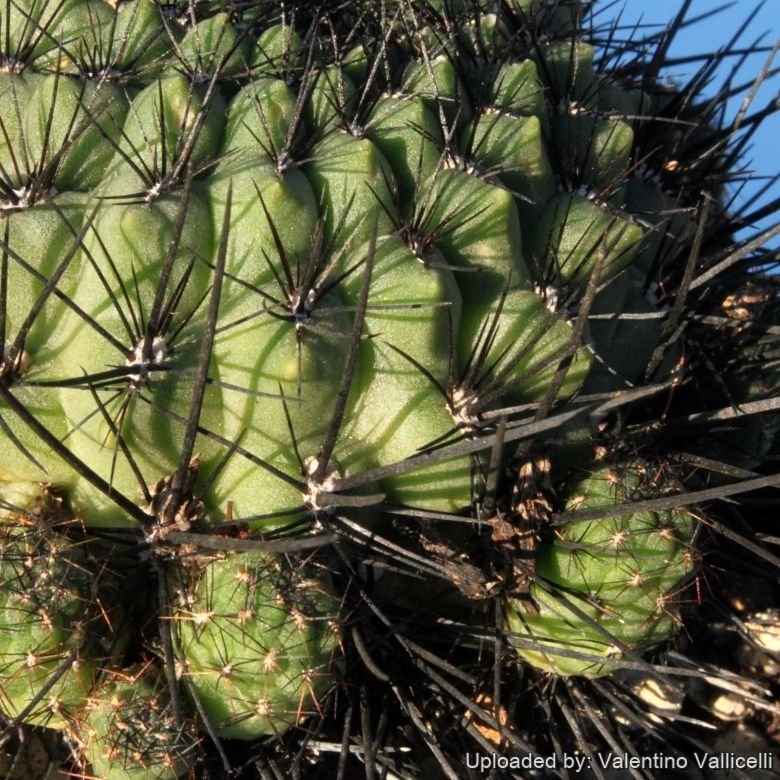
SulcoSN’>5220’ alt=‘5221’>Rebutia steinbachii#SN#5221’>Sulco[[Rebutia steinbachiiSN’ style=‘border:none;’> var. horrida is one of the innumerable local form of the very variable Rebutia steinbachii (= SulcoSN’>5220’ alt=‘5221’>Rebutia steinbachii#SN#5221’>Sulco[[Rebutia steinbachiiSN’ style=‘border:none;’>) that distinguishes for its strong dark brown protruding spines and very dark bodies.
Habit: It is a clustering species (rarely solitary) readily forming, especially in cultivation, clusters or cushions up to 30 cm (or more) in diameter.
Root: Carrot-like.
Stem: Single heads 30–50 mm (or more) wide, flattened-globose or globose and somehow apically depressed, very dark tanned green or bluish-black.
Ribs: 12-26 , spiralling, forming oblong rhomboid tubercles with well-defined grooves.
Tubercles: Conical conspicuous.
Areoles: White, narrow 3-6 long, 1,5-2 mm large.
Spines: Strong, protruding, dark brown and then brown.
Central spines: 1-2 firm, often very long, vertical and noticeably stronger than the radials.
Flowers: Rarely more than 3,5 cm long and 4,5 in diameter, mauve to dark magenta with a silky sheen (occasionally yellow with reddish tones on the outside), numerous in a ring at the base of the plant.
Blooming season: Spring (April - May) and remain open for up to five days.
Origin and Habitat
Vacas, Cochabamba, Bolivia.
Altitude: 3400 meters above sea level.
Source: Weingartia backebergiana, LLIFLE - Encyclopedia of living forms, CC-BY-SA, retrieved 2026-10-25.
From llifle page Sulcorebutia heinzii
Description
Sulcorebutia heinzii is one of the innumerable local form of the very variable Rebutia steinbachii (= SulcoSN’>5220’ alt=‘5221’>Rebutia steinbachii#SN#5221’>Sulco[[Rebutia steinbachiiSN’ style=‘border:none;’>). Its has very dark tanned green or almost black stems that contrast nicely with the white, narrow areoles, the spines are short, pectinated, at first reddish and then brown. This is a very distinctive cactus, even without flowers. It is barely distinguishable from Sulcorebutia clizensis with smaller reddish flowering. Rebutia steinbachii subs. heinzii is apparently a neotenic variety of the species in which juvenile spination is retained throughout the life of the plant, while most of the other varieties are dimorphic (short spined juvenile forms transform at maturity to strongly spined forms).
Habit: It is a clustering species (rarely solitary) readily forming, especially in cultivation, clusters or cushions.
Root: Carrot-like.
Stem: Single heads 30–50 mm wide, Flattened and somehow apically depressed, very dark tanned green, dark magenta-green or almost black, often nearly buried with only the summit visible above ground.
Ribs: 12-26, spiralling, forming oblong rhomboid tubercles with well-defined grooves.
Areoles: White, narrow. 3-6 long, 1,5-2 mm large.
Spines: Short, pectinated, at first reddish and then brown.
Flowers: Rarely more than 3,5 cm long and 4,5 in diameter, dark magenta with a silky sheen, numerous in a ring at the base of the plant.
Blooming season: Spring (April-May) and remain open for up to five days.
Origin and Habitat
Siles, (Road Totora-Omereque km 23, above pump station, 2800 m) Cochabamba, Bolivia
Cultivation and Propagation
These mountainous plants have thick taproots and are susceptible to overwatering. They loves a very permeable, coarse mineral soil as well as to be strictly kept dry throughout the winter quiescent period since it is very sensitive to any moisture excesses, To prevent rottenness it is also advisable to surround its root neck by very rough sand or grit, this help a fast water drainage. They requires also an appropriate air circulation and are sometime grafted to avoid root problems. They need to be kept in a cool place during winter rest (at 0-10°C). This is important for the flowers ,as well as for their health. Without this cool winter period, they normally won’t get any buds.
Grafted plants are very easy to grow, and are quite frost hardy (-5° C) if kept dry. Needs a full sun exposure ( light shadow my be useful in the hottest summer days).
Propagation: Seed, cutting, grafting.
Notes
Sulcorebutia heinzii is a recent name for a very choice Sulcorebutia collected by Heinz Swoboda and only named nearly 20 years later (this plant is, in fact Sulcorebutia sp. HS 151 )
Source: Sulcorebutia heinzii, LLIFLE - Encyclopedia of living forms, CC-BY-SA, retrieved 2026-10-25.
From llifle page Sulcorebutia steinbachii f. bicolorispina
Description
SulcoSN’>SN|12098’ alt=‘5221’>Rebutia tiraquensis#SN#11512’>Sulco[[Rebutia tiraquensisSN’ style=‘border:none;’> is one of the innumerable local form of the very variable Rebutia steinbachii (= SulcoSN’>5220’ alt=‘11512’>Rebutia steinbachii#SN#5221’>Sulco[[Rebutia steinbachiiSN’ style=‘border:none;’>). Its stems are almost completely concealed by fine silvery white and dark-reddish or mahogany coloured spines.
Habit: It is a clustering species (rarely solitary) readily forming, especially in cultivation, clumps of many heads.
Root: Mostly non-succulent, fibrous roots.
Stem: Soft globular, flattened and somehow apically depressed, greysh-green to dark green sometime very dark magenta-green.
Ribs: 12-26, spiralling, forming oblong rhomboid tubercles with well-defined grooves.
Areoles: Elongated with short grey felt (almost naked) 3-6 long, 1,5-2 mm large.
Spines: Erect, thin, bristle-like and flexible, bicoloured silvery white and dark-reddish or mahogany with darker tips.
Flowers: Rarely more than 3,5 cm long and 4,5 in diameter. Bright pink to light purple, numerous in a ring at the base of the plant.
Blooming season: April-May and remain open for up to five days.
Origin and Habitat
North and east of Cochabamba in the Cordillera de Cochabamba, in southern Bolivia.
Habitat: Grows mainly on a flat, dry, stony areas.
Cultivation and Propagation
This species loves a very permeable, coarse mineral soil as well as to be strictly kept dry throughout the winter quiescent period since it is very sensitive to any moisture excesses, To prevent rottenness it is also advisable to surround its root neck by very rough sand or grit, this help a fast water drainage and an appropriate air circulation.
Watering Needs: Water moderately in the growing season, keep dry during the winter rest.
Frost Tolerance: Plants are quite frost hardy -5 (-10)° C. Overwinter in a cool place (at 0/10°C) this is important for the flowers as well as for plants health. Without this cool winter period they normally wont get any buds.
Sun Exposure: Needs a full sun exposure ( light shadow my be useful in the hottest summer days).
Propagation: Seed, cutting, grafting.
Notes
Sulcorebutia steinbachii is one of the most variable cactus species. The colour of the flower, the spines length, the body shape and pigmentation is extremely variable, even within a population. There are also many localized phenotypes capable of maintaining their separate identity, even though only a few kilometers apart and by former authors considered as separated species and varieties. They are nowadays considered just phenotypes of a highly polymorphic specie. These subpopulations are not only morphologically based but also geographically and can be grouped as follow:
Group 1a: Cochabamba to Chapare, northward and eastward to Tiraque
* Sulcorebutia glomerispina
* S. tuberculato-chrysantha
* S. polymorphaS. kruegeri
* S. hoffmannianaS. glanduliflora Card. n.n.
* S. cochabambina
* S. steinbachii & vars. australis, gracilior, etc.A
Group 1b: Province Tiraque to Epizana an eastward to Comarapa, 2,800 m-3.000 m.
* Sulcorebutia tiraquensis & vars. longiseta
* S. spinosior & aglaia (bicolorispina)
* S. lepida
* S. krahnii
Group 2: Cerro Tunari-south and east of Cochabamba-Izata to Anzaldo, 3,400-3,900 m
* Sulcorebutia verticillacantha
* S. tunariensis
* S. taratensis & var. minima
* S. mizquensis
* S. pojoniensis Rausch n.n.A
Group 3: West of Cochabamba-Ayopaya, 2,000-2,500 m
* Sulcorebutia arenacea
* S. candiae
* S. menesesii & vars. kamiensis
* S. muschii
* S. glomeriseta
Group 4: Around Totora and southward toward Epizana, 2,600-3,000 m
* Sulcorebutia oenantha
* S. totorensis
* S. pampagrandensis
Group 5: A limited area around Pasopaya and eastwards, 2,000 m
* Sulcorebutia cardenasiana
* S. langeri
Source: Sulcorebutia steinbachii f. bicolorispina, LLIFLE - Encyclopedia of living forms, CC-BY-SA, retrieved 2026-10-25.
From llifle page Sulcorebutia augustinii f. cristata
Description
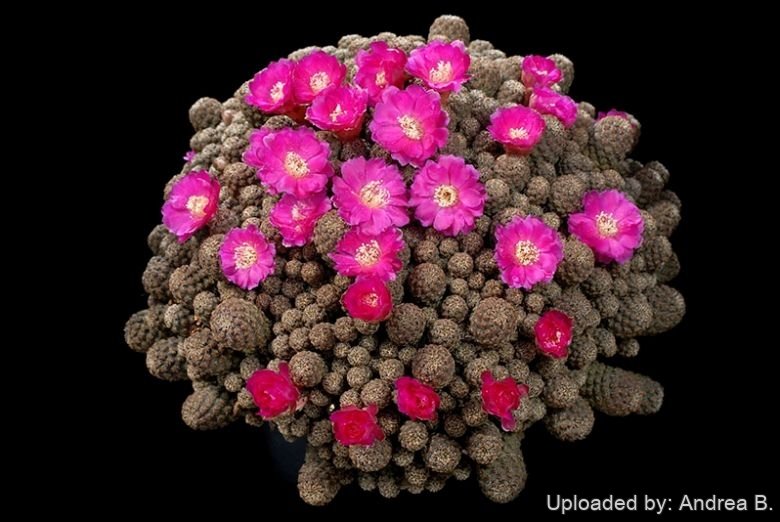
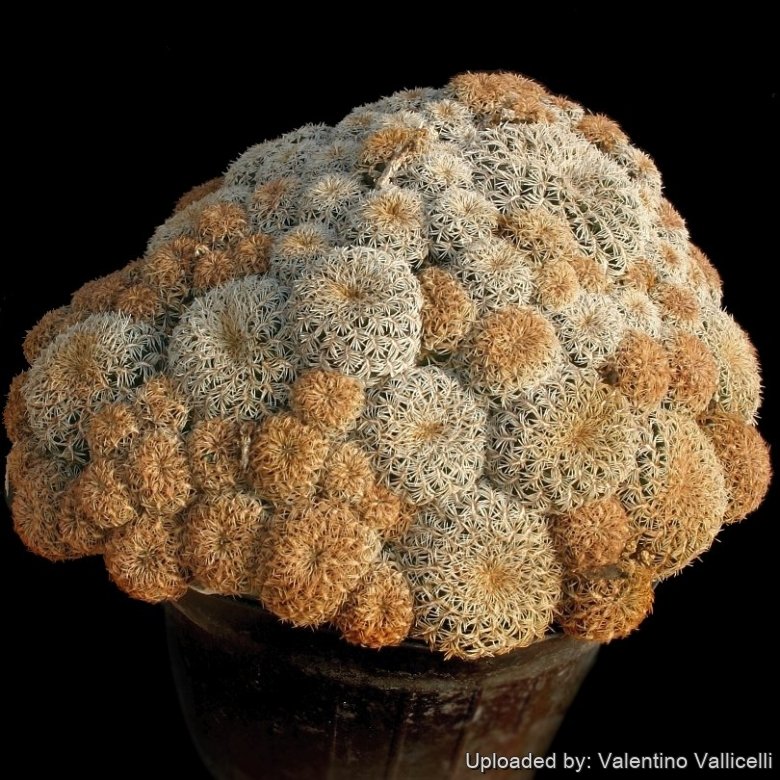
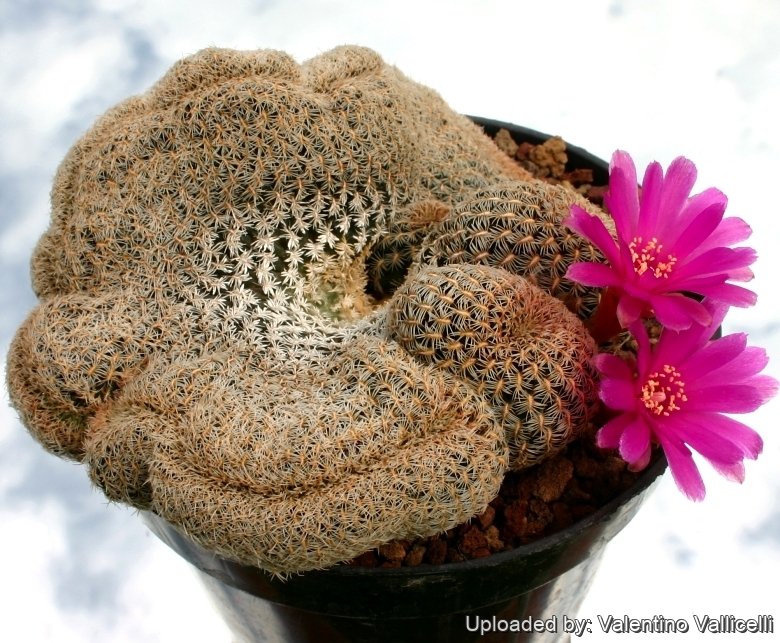
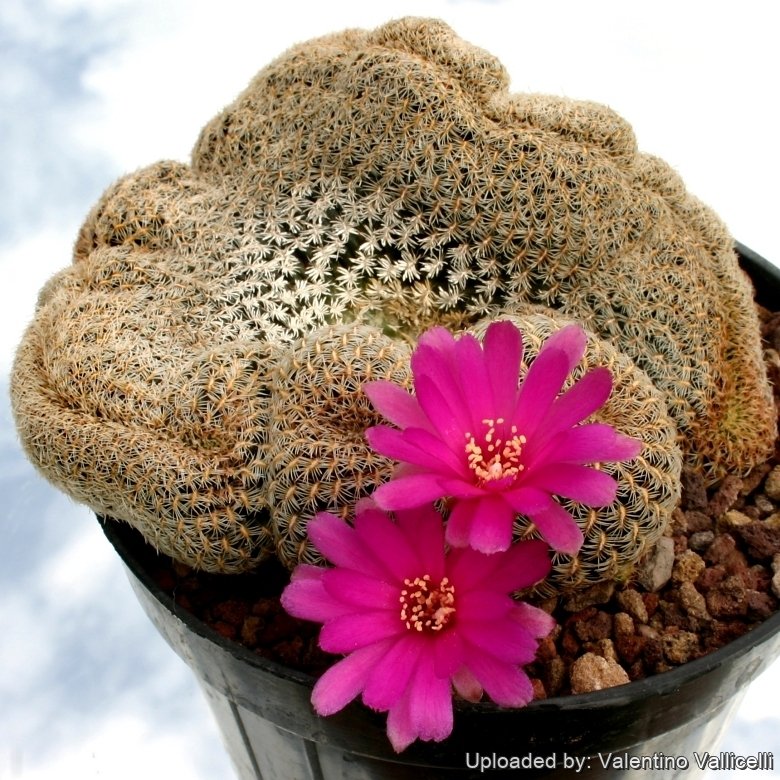
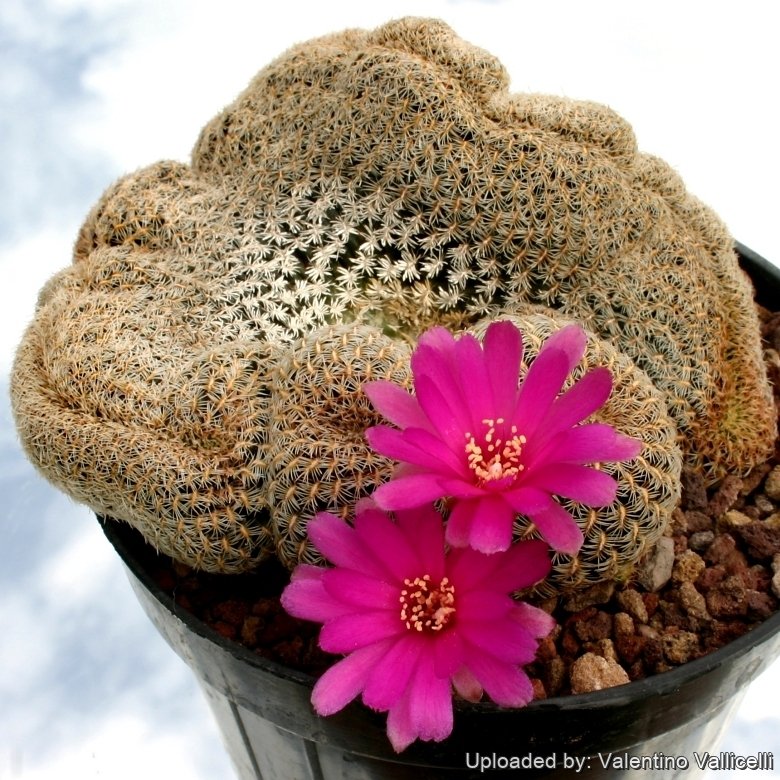
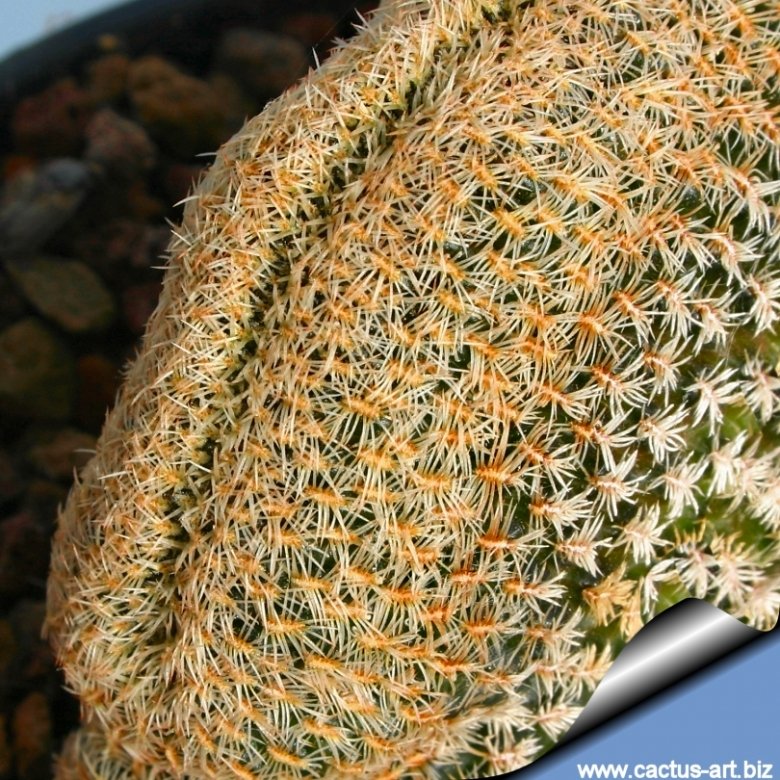
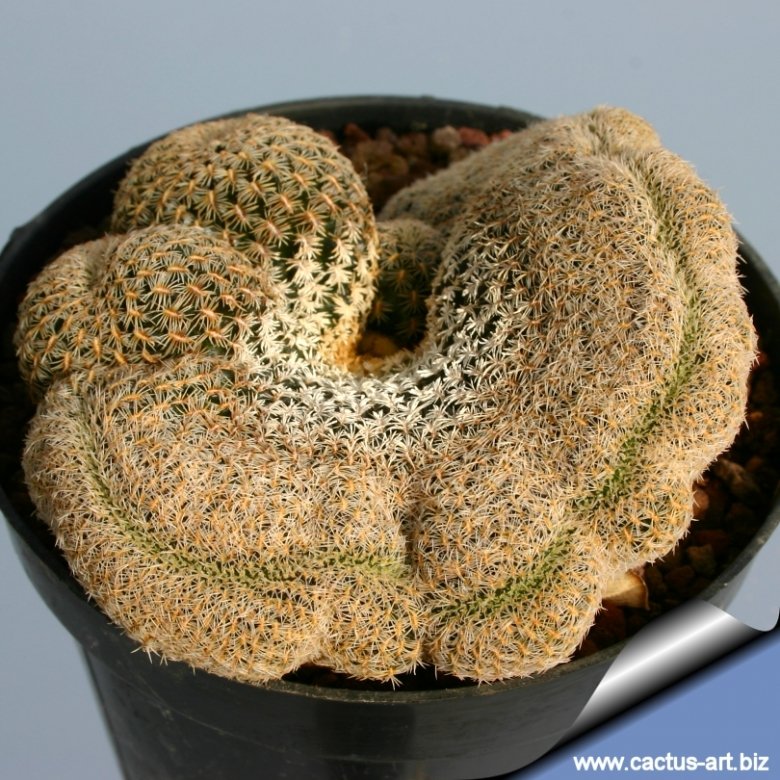
Sulcorebutia augustinii (Rebutia) is one of the best Sulcos recently introduced, that forms a dense clump of mini stems, the crested form is very nice and forms large brain-like mound.
Stem: Grey-green to very dark and flat to the ground.
Spines: Tiny Amber pectinate.
Flowers: Very nice magenta pink, in late April.
Cultivation and Propagation
These mountainous plants have thick taproots and are susceptible to overwatering. They loves a very permeable, coarse mineral soil as well as to be strictly kept dry throughout the winter quiescent period since it is very sensitive to any moisture excesses, To prevent rottenness it is also advisable to surround its root neck by very rough sand or grit, this help a fast water drainage. They requires also an appropriate air circulation and are sometime grafted to avoid root problems. They need to be kept in a cool place during winter rest (at 0-10°C). This is important for the flowers ,as well as for their health. Without this cool winter period, they normally won’t get any buds.
Grafted plants are very easy to grow, and are quite frost hardy (-5° C) if kept dry. Needs a full sun exposure ( light shadow my be useful in the hottest summer days)
Propagation: Cutting, grafting
Source: Sulcorebutia augustinii f. cristata, LLIFLE - Encyclopedia of living forms, CC-BY-SA, retrieved 2026-10-25.
From llifle page Rebutia cochabambina var. clizensis
Description
Sulcorebutia clizensis is one of the innumerable local form of the very variable Rebutia steinbachii (= SulcoSN’>5220’ alt=‘5221’>Rebutia steinbachii#SN#5221’>Sulco[[Rebutia steinbachiiSN’ style=‘border:none;’>). It is often referred as form of Sulcorebutia hoffmanniana with dark green bodies, protruding brown spines and reddish flowers, barely distinguishable from Sulcorebutia cochabambina.
Habit: It is a clumping plant, readily forming, especially in cultivation, clumps of many heads.
Stem: 24-40 mm tall, up to 50 mm wide, flattened globose, dark green sometime tinged red.
Ribs: Spiralling, poorly distinguished, forming oblong rhomboidal grooved tubercles.
Areoles: Long narrow depressed, dark, with short brownish-grey felt 3-6 mm long, 1,5-2 mm large.
Radial spines: Up to12 (or more) about up to 20 mm long, acicular, addpressed to slightly speading and somewhat curved against the body, ± pectinate, dull creamy-yellow to light-brown.
Central spines: None .
Flowers: Arising from monoflorous areoles, in lower lateral flower zone. Rarely more than 3,5 cm long and 4,5 in diameter, mostly reddish with a silky sheen (or to pinkish). Floral tube funnel-shaped, with broad naked scales.
Blossoming time: Late spring.
Fruits: Small papery olive green to reddish brown at maturity.
Seeds: Black.
Origin and Habitat
Cliza (Cochabamba, Cochabamba 34 km SE)
Source: Rebutia cochabambina var. clizensis, LLIFLE - Encyclopedia of living forms, CC-BY-SA, retrieved 2026-10-25.
From llifle page Sulcorebutia seinoiana
Description
Sulcorebutia seinoiana is a nomen nudum (undescribed name) used by Vasquez (seeds collector and succulent traders) to indicate one of the innumerable local form of the very variable Rebutia steinbachii (= Sulcorebutia steinbachii). It is often referred as form of Sulcorebutia hoffmanniana with pinkish to dark magenta flowers with yellow throat and dull green bodies, thin brown pectinate spines. It is barely distinguishable from Sulcorebutia clizensis with smaller reddish flowering. Rebutia seinoiana is apparently a neotenic variety of the species in which juvenile spination is retained throughout the life of the plant, while most of the other varieties are dimorphic (short spined juvenile forms transform at maturity to strongly spined forms).
Habit: It is a clumping plant, readily forming, especially in cultivation, clumps of many heads.
Root: Carrot-like.
Stem: 24-40 mm tall, up to 50 mm wide, flattened globose, dull grey-green sometime tinged red.
Ribs: Spiralling, poorly distinguished, forming oblong rhomboidal grooved tubercles.
Areoles: Long narrow depressed, dull white with short brownish-grey felt (almost bare) 3-6 mm long, 1,5-2 mm large.
Radial spines: Up to 12 (or more) about up to 10 mm long, thin, acicular, addpressed and somewhat curved against the body, ± pectinate, dull creamy-yellow to light-brown.
Central spines: None .
Flowers: Arising from monoflorous areoles, in lower lateral flower zone. Rarely more than 3,5 cm long and 4,5 in diameter, mostly pinkish to dark magenta with a silky shine and with yellow throat). Floral tube funnel-shaped, with broad naked scales.
Blossoming time: Late spring.
Fruits: Small papery olive green to reddish brown at maturity.
Seeds: Black.
Source: Sulcorebutia seinoiana, LLIFLE - Encyclopedia of living forms, CC-BY-SA, retrieved 2026-10-25.
From llifle page Sulcorebutia steinbachii f. cristata
Description
Rebutia steinbachii often listed under its old name of SulcoSN’>5220’ alt=‘5221’>Rebutia steinbachii#SN#5221’>Sulco[[Rebutia steinbachiiSN’ style=‘border:none;’> is a clumping plant (rarely solitary), readily forming, especially in cultivation, clumps of many heads. Plants are often dimorphic: short spined juvenile forms transform at maturity to strongly spined forms. Some of these juvenile forms, however, may persist without transformation to the mature form. However it is very variable due to it’s wide area of origin in Bolivia and spines ranges in colour from white, to yellow, red, brown or black. There are several different subspecies and cultivars.
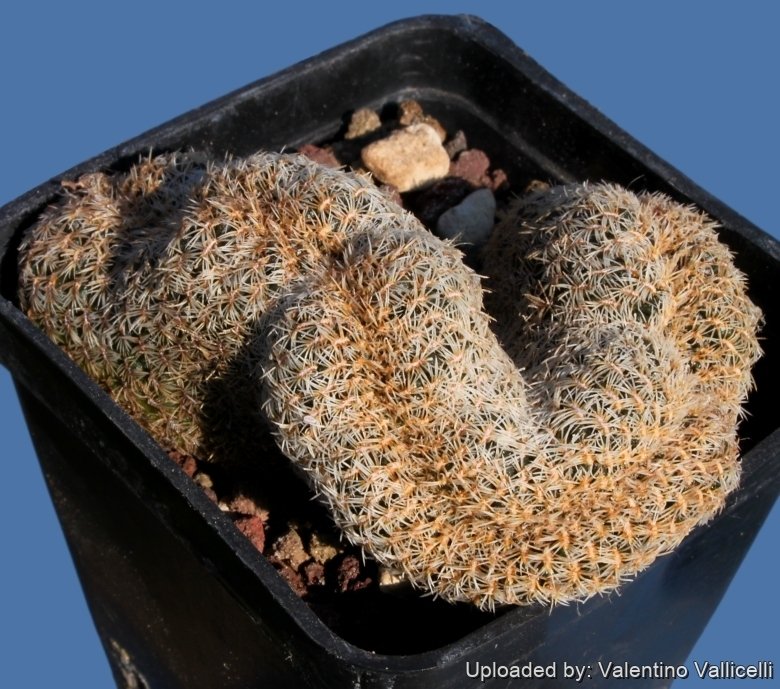
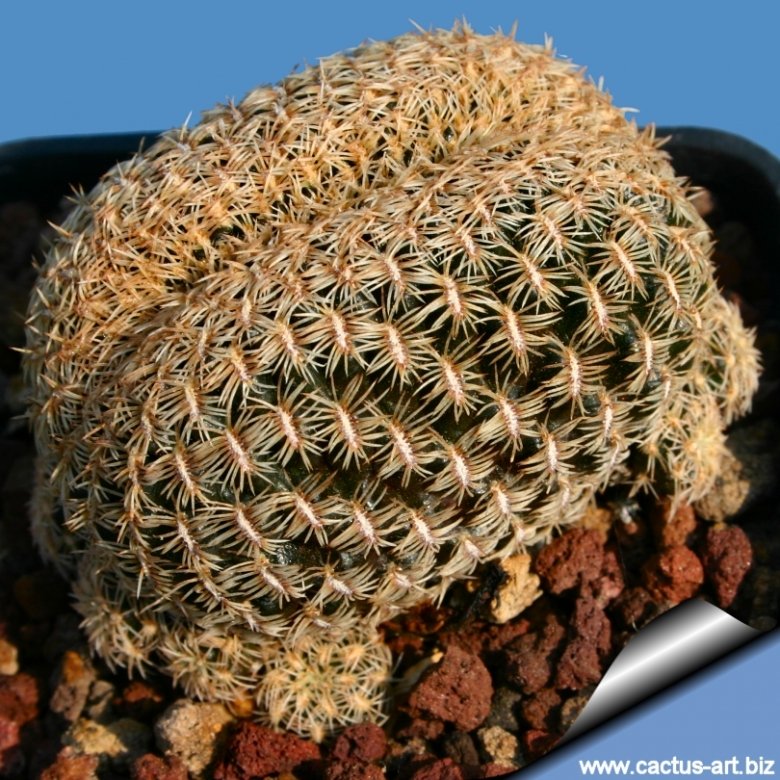
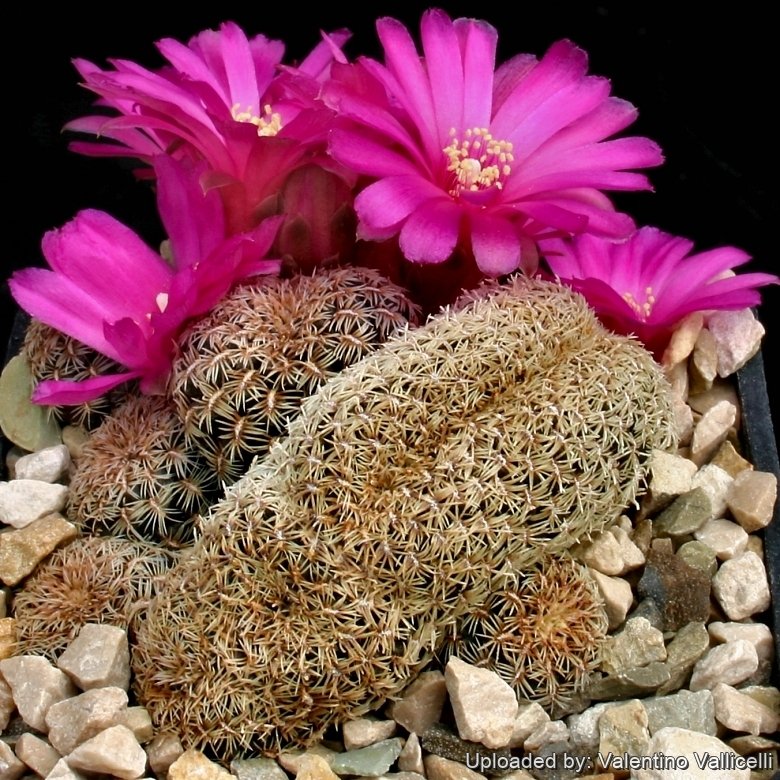
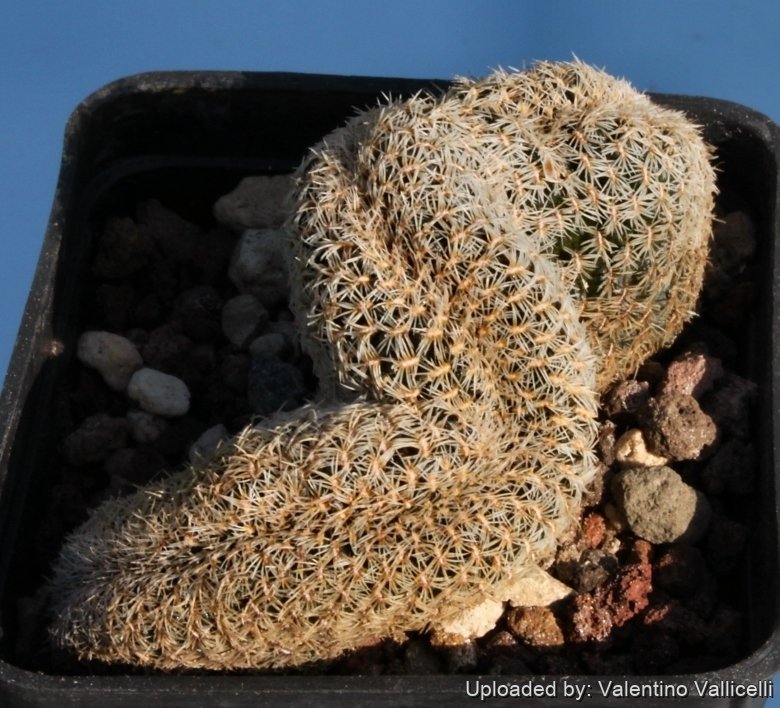
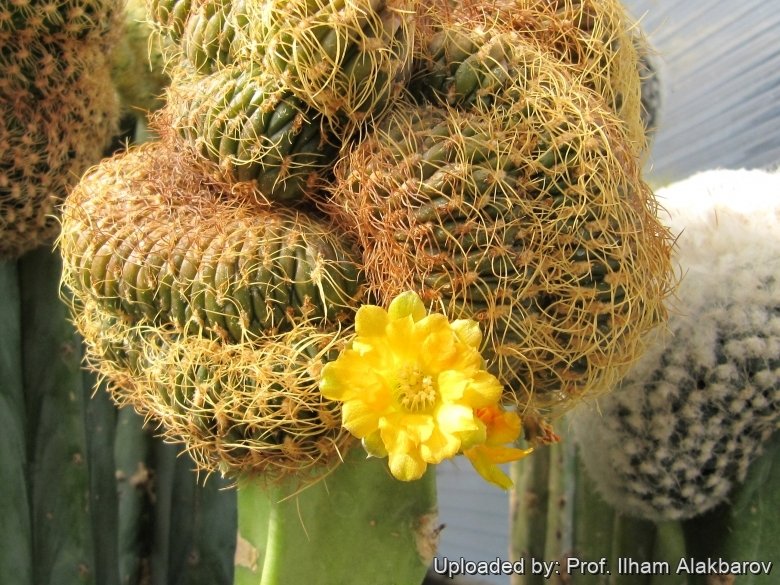
Crested form: The crested form (Rebutia steinbachii f. cristata) is very rare and sought after by collectors, for its unique features. It is a small low growing crested cactus that will slowly forms tangled groups up to 30 cm (or more ) in diameter with age. The plant tends to grow seated in substrate, but in cultivation it is almost always seen grafted on columnar cacti. There are several crested clones often very different one to each other.
Stem: Greysh-green to dark green sometime tinged red.
Ribs: Poorly distinguished, forming oblong rhomboidal grooved tubercles.
Areoles: Long narrow depressed with short grey felt (almost naked) 3 – 6 long, 1,5-2 mm large.
Radial spines: 9-12 (or more) about up to 20 mm long, acicular, addpressed against the body, ± pectinate to porrect, white, yellow, brown with darker tips or almost black, ± curved slow to develops, frequently absent on new areoles at plant apex.
Central spines: None or usually 1 to 3, 10-30 mm long, only slightly stouter of the same colour of the radials.
Flowers: Arising from monoflorous areoles, in lower lateral flower zone. Rarely more than 3,5 cm long and 4,5 in diameter, yellow, red, magenta or orange with white inner petals. Floral tube funnel-shaped, with broad naked scales.
Phenology: Blossoming time late spring.
Fruits: Small papery olive green to reddish brown at maturity.
Seeds: Black.
Origin and Habitat
Garden origin (Nursery produced cultivar)
Cultivation and Propagation
It loves a very permeable, coarse mineral soil as well as to be strictly kept dry throughout the winter quiescent period since it is very sensitive to any moisture excesses, to prevent rottenness it is also advisable to surround its root neck by very rough sand or grit, this help a fast water drainage and an appropriate air circulation.
Watering Needs: Water moderately in the growing season, keep dry during the winter rest.
Frost Tolerance: Plants are quite frost hardy -5 (-10)° C, but for safe cultivation overwinter in a cool place (at 0/10°C) this is important for the flowers as well as for plants health. Without this cool winter period they normally wont get any buds.
Sun Exposure: Needs a full sun exposure ( light shadow my be useful in the hottest summer days).
Propagation: Cutting, grafting.
Source: Sulcorebutia steinbachii f. cristata, LLIFLE - Encyclopedia of living forms, CC-BY-SA, retrieved 2026-10-25.
Cultivars and forms (4)
Forms (1)
Other names (1)
Gallery