Publication: Cactus (Paris) no. 38: 250. 1953
Description
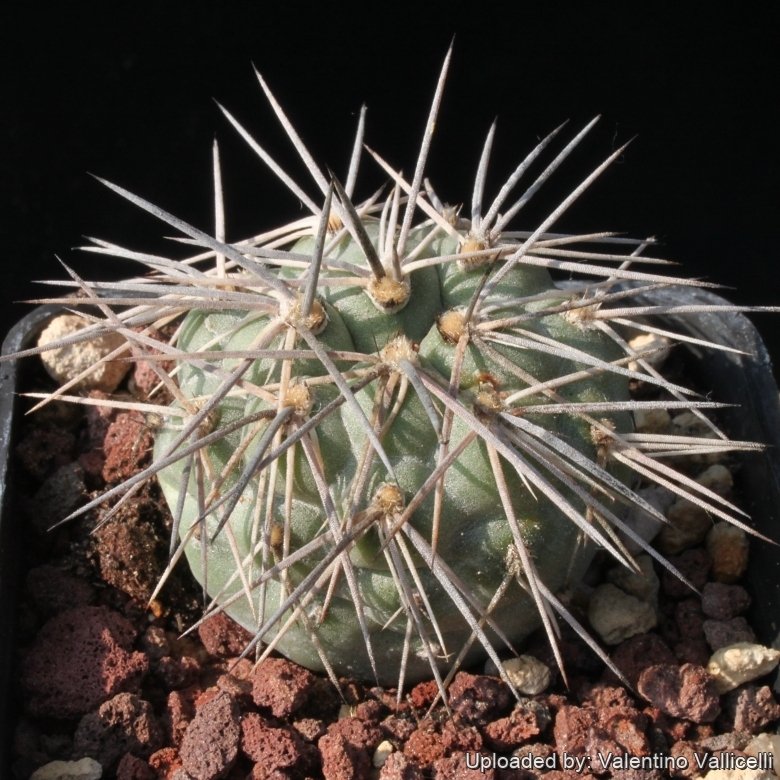
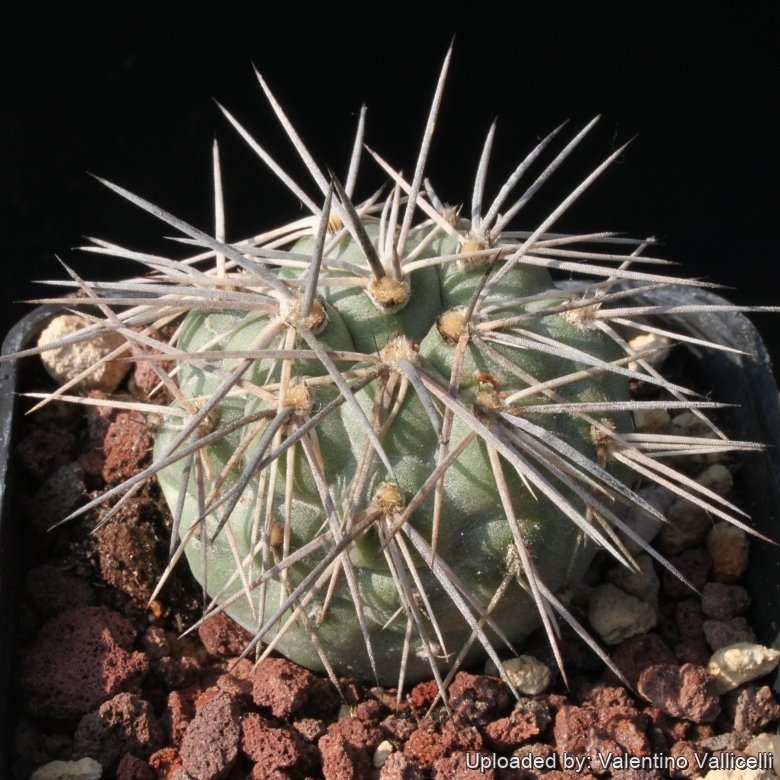
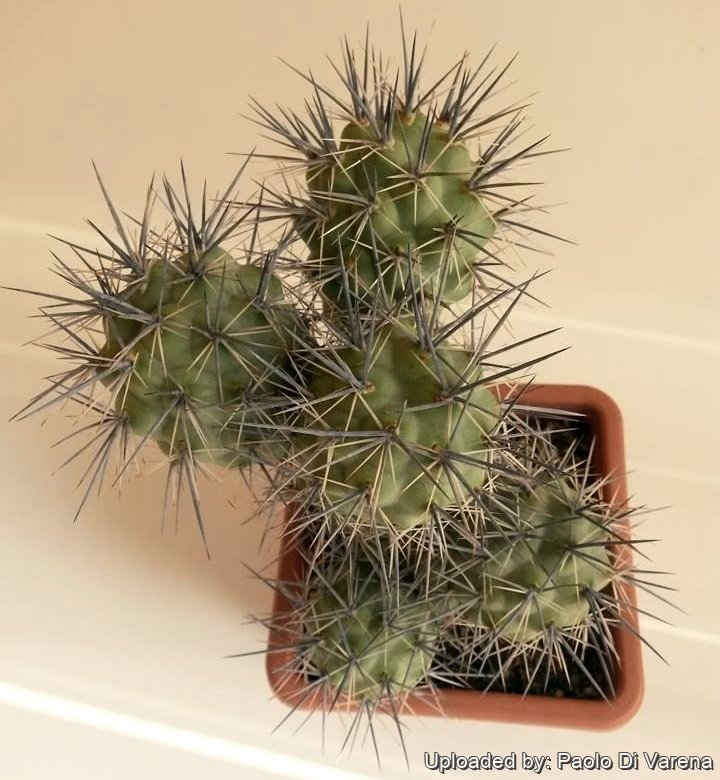
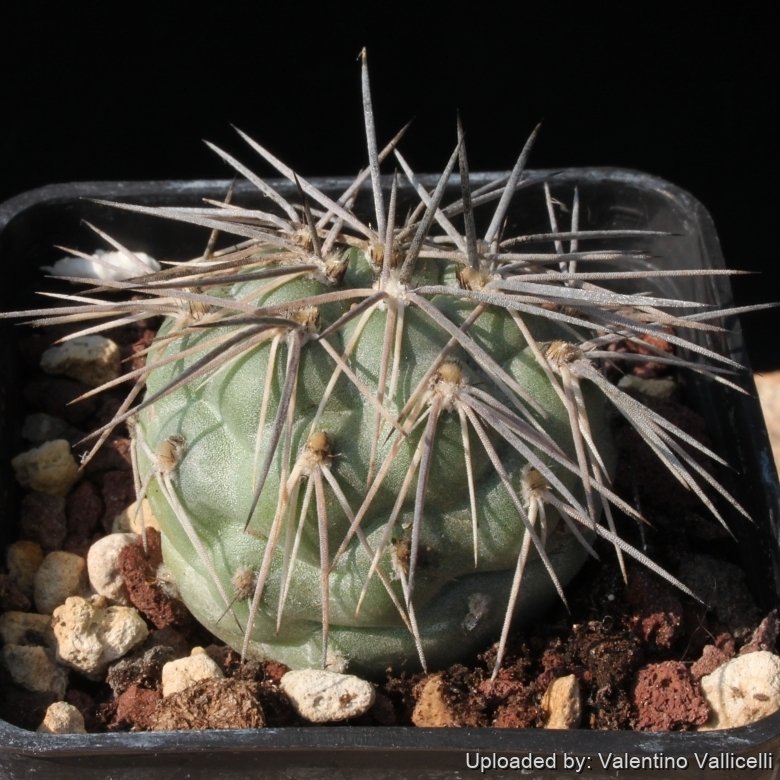
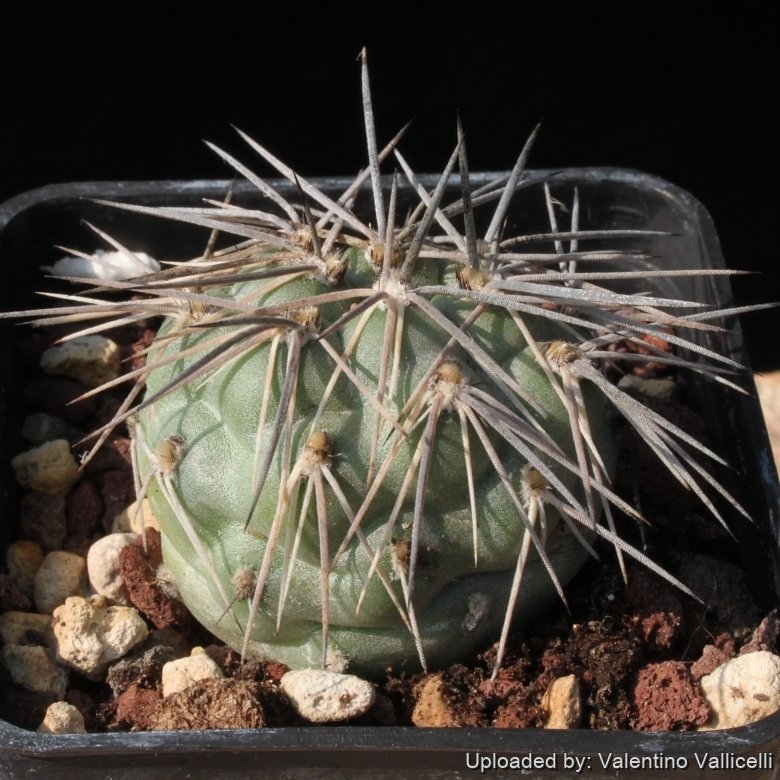
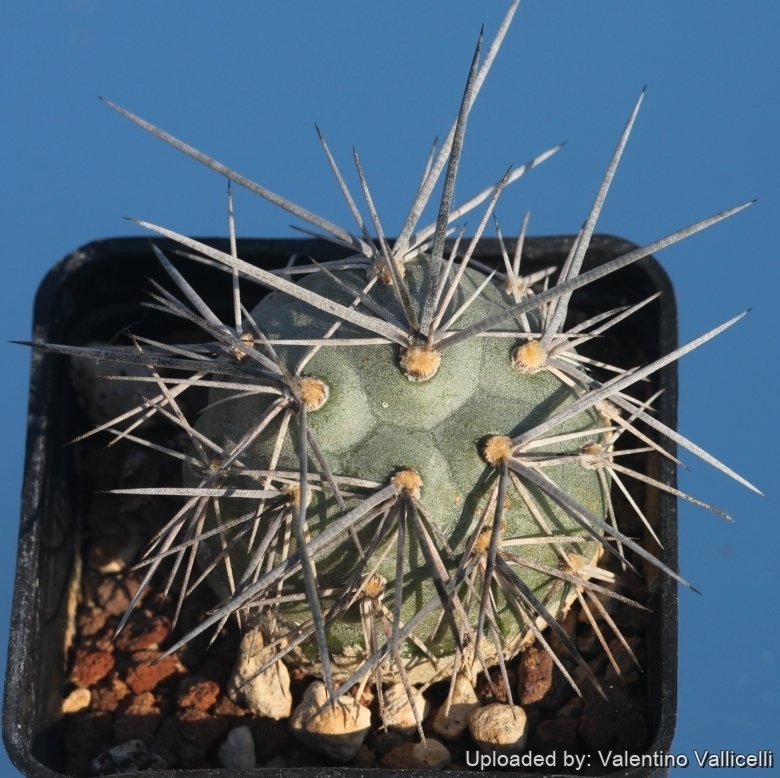
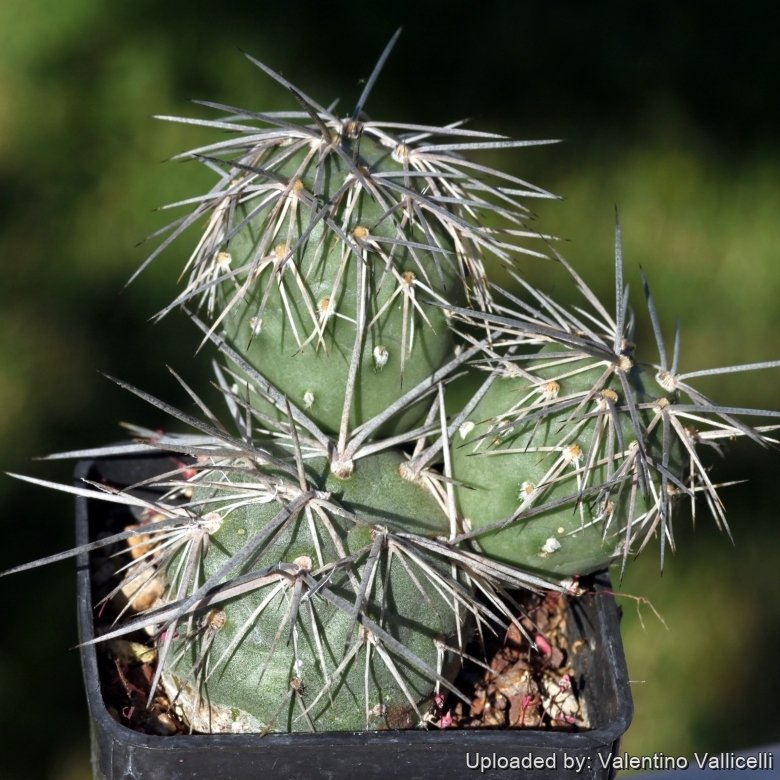
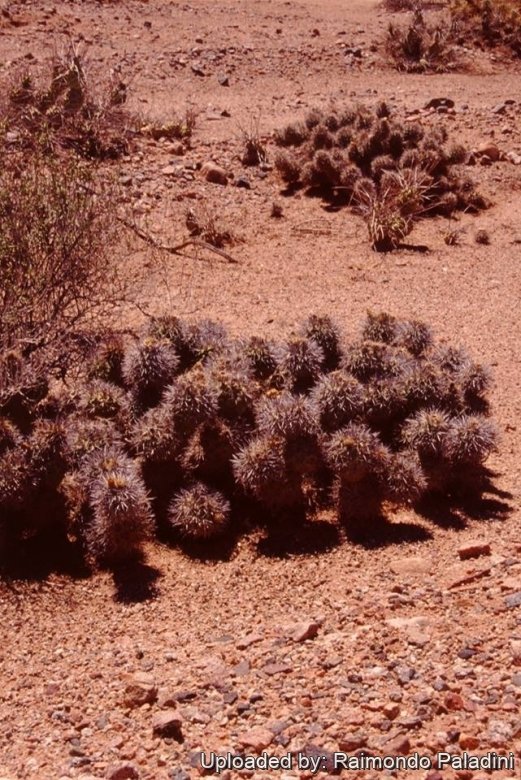
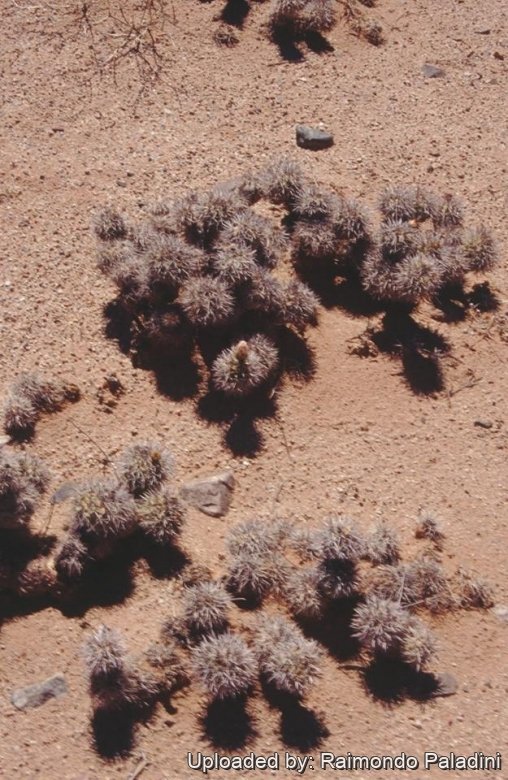
Tephrocactus alexanderi is a small low depressed or erect succulent plant with some spherical branches forming spiny cushions.
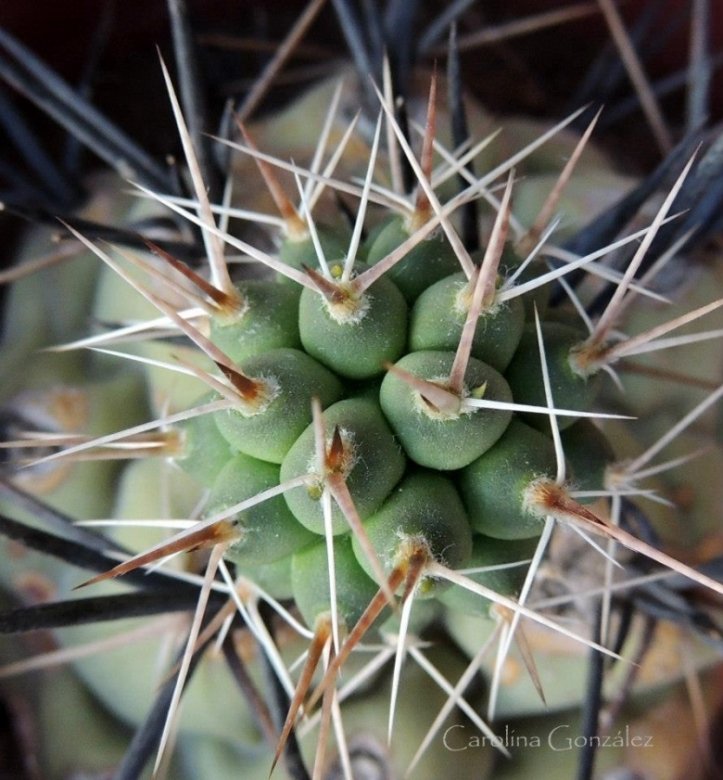
Stem (segments): 2,5-5 cm long, 2 to 3 cm thick, globose, egg-shaped or shortly cylindrical, greyish green tuberculate, covered with spines and readily detached.
Areoles: Small, round, closely set 30-60 or more per segment and extending to base, most with spines.
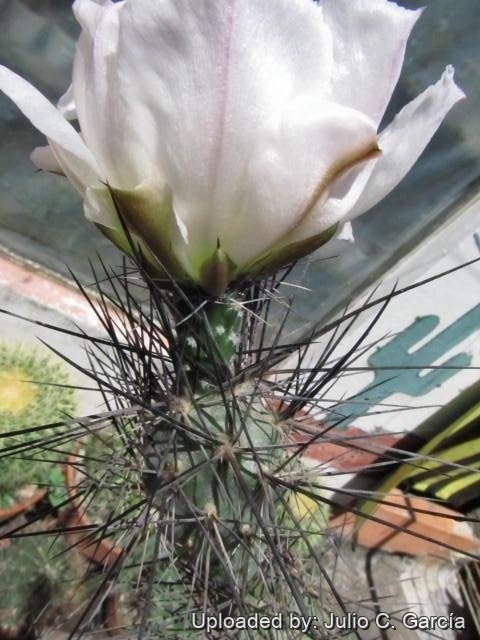
Spines: 4 to 15, up to 4 cm long, white below, dark above or with black tips, fading to dull grey as the stems age, scurfy-pubescent even in age, straight, erect or pointing downward, more or less flexible, spreading, interlocking mostly thin a few stout.
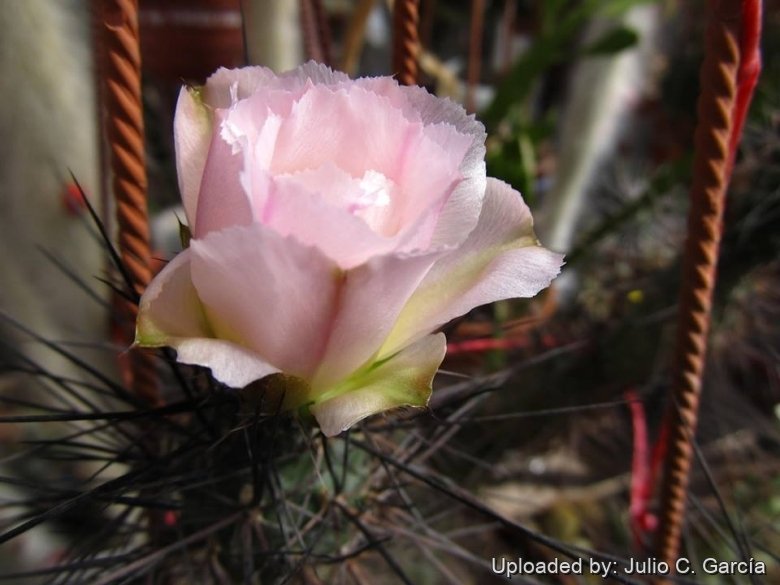
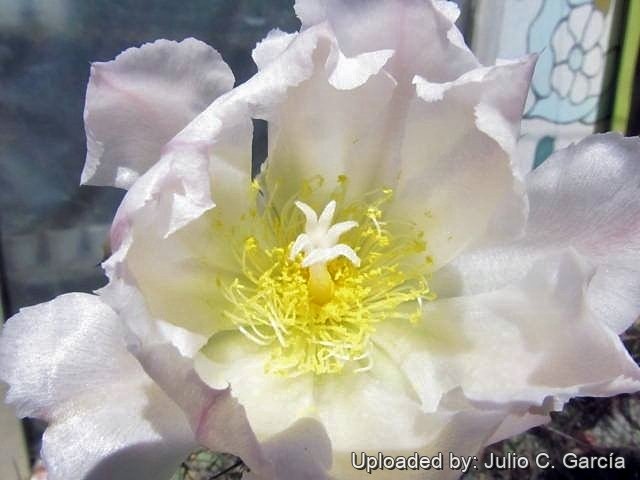
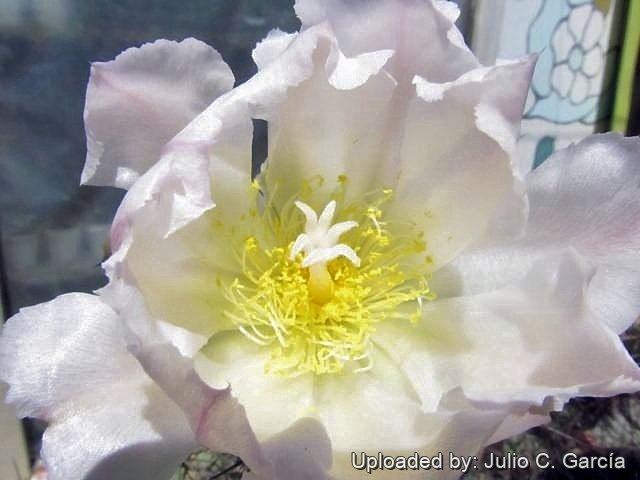
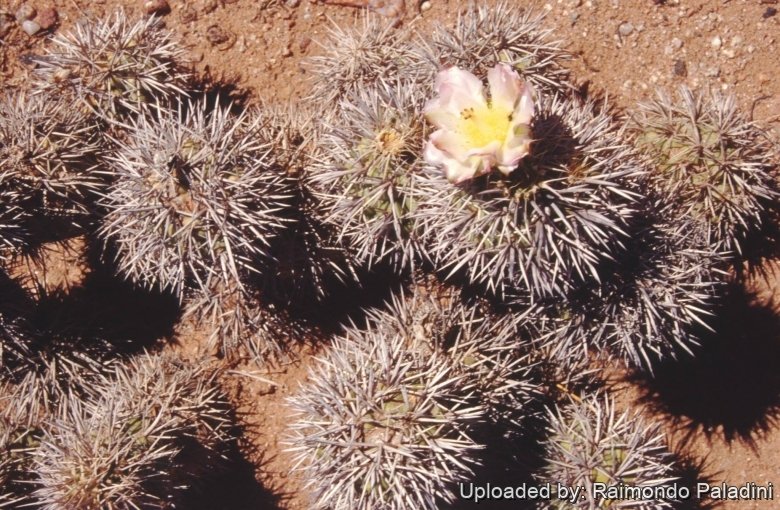
Flowers: Large pinkish-white. Pericarpels bristly above.
Fruit: Dry, thin walled, red, obovoid, 2 cm. long, not spiny, but upper areoles bearing 2 to 8 long, white, erect, fine bristles to 1 cm overtopping the fruit; umbilicus of fruit depressed.
Seed: White, 5 to 6 mm broad.
Origin and Habitat
It is found in the provinces of La Rioja and Salta, Argentina.
Habitat: This species grows and blooms in a very dry environment on rocky soil, where few other plants can survive.
Cultivation and Propagation
Tephrocactus alexanderi is susceptible to overwatering, but need enough water during the growing season. This mountain cactus - because of the elongated fat taproot - necessitate deep pots and a well drained mineral potting mix. It prefers a full sun exposure, but should be protected from excessive heat and sun in summer.
Frost Tolerance: They tolerate light frost -5 (-10) °C.
Remarks: Need to be kept in a cool place during winter rest this is important for the flowers as well as for their health. Without this cool winter period they normally wont get many buds. Keep dry in winter to avoid rot. Need a sufficient amount of air.
Propagation: Seeds are extremely difficult to germinate. Best reproduced from rooted cuttings. Grafting is often used to speed growth rate and to create a back-up for plants in collection.
Bibliography
Major references and further lectures
-
Edward Anderson “The Cactus family” Timber Press, Incorporated, 2001
-
James Cullen, Sabina G. Knees, H. Suzanne Cubey “The European Garden Flora Flowering Plants: A Manual for the Identification of Plants Cultivated in Europe, Both Out-of-Doors and Under Glass” Cambridge University Press, 11/Aug/2011
-
David R Hunt; Nigel P Taylor; Graham Charles; International Cactaceae Systematics Group. “The New Cactus Lexicon” dh books, 2006
-
Nathaniel Lord Britton, Joseph Nelson Rose “The Cactaceae: Descriptions and Illustrations of Plants of the Cactus Family” Volume 3, 1922
From llifle page Opuntia alexanderi var. bruchii
Description
Tephrocactus alexanderi var. bruchii is generally included within (as a synonym of) Tephrocactus alexanderi, suggesting that there is not really a fundamental difference between the two, and hard to name accurately without knowing where they come from, and there remains a considerable confusion surrounding the true identity of this this plant. Tephrocactus alexanderi var. bruchii has roundish joints the size of a tennis ball, dark spreading-spines and beautiful white flowers, sometimes a well-defined pink-blue tint. The seeds are quite characteristic about 5,9-8.5 x 5.6 to 7.1 mm yellowish-white, sponge-like, highly irregular in shape and gnarled. Seeds vary considerably in size. However the distinguishing characteristics of var. bruchii , appear to fall within the natural variation of Tephrocactus alexanderi. Most authors have dismissed Tephrocactus alexanderi var. bruchii as perhaps not worthy of even varietal status, but it still has a value for a collector because they identify plants with particular characters.
For more details see: Tephrocactus alexanderi.
Origin and Habitat
Argentina (San Juan and La Rioja)
Altitude range: 600-2250 metres above sea level.
Habitat and ecology: This species grows and blooms in a very dry environment on rocky soil, where few other plants can survive. Tephrocactus alexanderi var. bruchii and Trichocereus pasacana often grew nearby.
Cultivation and Propagation
Tephrocactus alexanderi var. bruchii is susceptible to overwatering, but need enough water during the growing season. This mountain cactus - because of the elongated fat taproot - necessitate deep pots and a well drained mineral potting mix. It prefers a full sun exposure, but should be protected from excessive heat and sun in summer.
Frost Tolerance: They tolerate light frost -5 (-10) °C.
Remarks: Need to be kept in a cool place during winter rest this is important for the flowers as well as for their health. Without this cool winter period they normally wont get many buds. Keep dry in winter to avoid rot. Need a sufficient amount of air.
Propagation: Seeds are extremely difficult to germinate. Best reproduced from rooted cuttings. Grafting is often used to speed growth rate and to create a back-up for plants in collection.
Source: Opuntia alexanderi var. bruchii, LLIFLE - Encyclopedia of living forms, CC-BY-SA, retrieved 2026-10-25.
From llifle page Opuntia halophila
Description
Tephrocactus halophilus, formerly Opuntia halophila, is a local or morphological form of Tephrocactus alexanderi with nore cylindrical joints, and white flowers. However the minimal differences of T. halophilus, appears to fall within the natural variation of Tephrocactus alexanderi and it should be fully synonymized with the latter.
Derivation of specific name: The specific name comes from the Greek “halos”, salt, and “philo”, loving. Salt-loving.
Origin and Habitat
San Juan, Argentina.
Altitude range: 1000 – 1500 metres above sea level.
Habitat and ecology: Tephrocactus halophilus grows, alongside the railroad from Serrezuela and on slopes with bromeliad cushions, in the saltpetre pans of the small valleys of the Sierra Pie de Palo. The bottom of the little valleys are typically occupied by unvegetated shallow salt lakes or saltpetre pans.
Cultivation and Propagation
Tephrocactus halophilus (Tephrocactus alexanderi) is susceptible to overwatering, but need enough water during the growing season. This mountain cactus - because of the elongated fat taproot - necessitate deep pots and a well drained mineral potting mix. It prefers a full sun exposure, but should be protected from excessive heat and sun in summer.
Frost Tolerance: They tolerate light frost -5 (-10) °C.
Remarks: Need to be kept in a cool place during winter rest this is important for the flowers as well as for their health. Without this cool winter period they normally wont get many buds. Keep dry in winter to avoid rot. Need a sufficient amount of air.
Propagation: Seeds are extremely difficult to germinate. Best reproduced from rooted cuttings. Grafting is often used to speed growth rate and to create a back-up for plants in collection.
Bibliography
Major references and further lectures
-
Catálogo de las Plantas Vasculares “Tephrocactus halophilus (Speg.) Backeb.” Instituto de Botánica Darwinion - IBODA 2014 web <http://www2.darwin.edu.ar\>
-
“Tephrocactus halophilus (Speg.) Backeb.” Bradleya, Volumi 14-20 page 245, The Society, 1996
Source: Opuntia halophila, LLIFLE - Encyclopedia of living forms, CC-BY-SA, retrieved 2026-10-25.
From llifle page Tephrocactus microsphaericus
Origin and Habitat
Jujuy (Argentina)
Source: Tephrocactus microsphaericus, LLIFLE - Encyclopedia of living forms, CC-BY-SA, retrieved 2026-10-25.
Cultivars and forms (1)
Varieties (1)
Gallery