Description
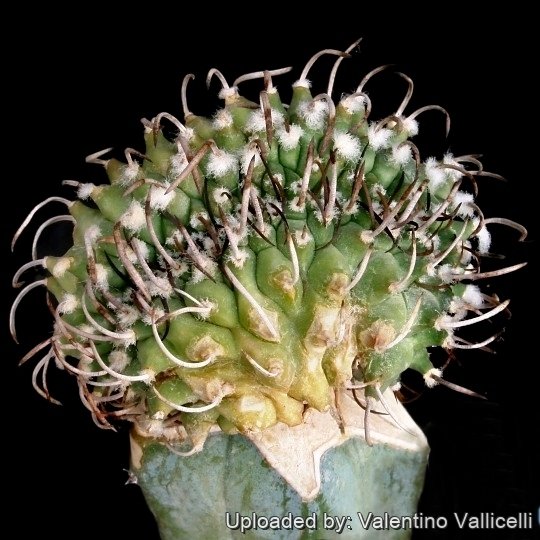
Turbinicarpus schmiedickeanus is a tiny cactus species whit corky spines that grows almost completely buried in the ground. The crested form Turbinicarpus schmiedickeanus f. cristatus is very rare and sought after by collectors, for its unique features.
Root: Has a large tap root below the surface of the compost.
Stem: Fan shaped, flattened on top, depressed centrally, green, apex with some white wool.
Ribs: completely divided into tubercles that are more or less well-rounded to square to almost short ,conical, 5 mm broad at the base, up to 7 mm long and pointing upwards, arranged in flat spirals.
Areoles: On the tip of the tubercle, with a little wool, soon becoming bare.
Spines: 3 (more rarely 4) the lower one longer, up to 2,5 cm, the 2 side spines approximately 1/3 as short and the upper, very often missing, still shorter, flattened below, curved towards the apex and often contorted, grey, corky, rather soft, with transverse fissures. The spines are persistent only on the upper body; below they fall off, and the body and tubercles are corky and bare.
Flowers: Apical funnel shaped, whitish to pinkish, outside with darker midribs 14-25 mm wide. This plant is capable of blooming when it is little larger than 1 cm Ø.
Origin and Habitat
Garden origin (Nursery produced cultivar)
Cultivation and Propagation
Although regarded as a choice and difficult plant is not too difficult in a greenhouse, although grows quite slowly. It is sometime seen as a grafted plant but grows very well on its own roots too.
Soil: Use mineral well permeable mineral soil with little organic matter (peat, humus).
Exposure: They need a good amount of light shade to full sun this help to keep the plants healthy, although slow growth.
Watering: Water sparingly from March till October (weekly during summertime, if the weather is sunny enough) , with a little fertilizer added. Less or no water during cold winter months to prevent root loss. It is sensitive to overwatering (rot prone).
Hardiness: Keep perfectly dry in winter at temperatures from 5 to 15 degrees centigrade. (but it is relatively cold resistant and hardy to -5° C for short periods) In the rest period no high atmospheric humidity!! (Temperature Zone: USDA 9-11)
Propagation: Grafting or cuttings. Plants are usually grafted onto column-shaped cacti but proved to be able to produce their own roots if degrafted.
Gallery