Publication: Cactaceae (Berlin) 1937(1): Blatt 27. [25 Mai 1937] et: Jahrb. Deutsch. Kakteen-Ges. 1937, 1st Teil, 27.
Description
Turbinicarpus schmiedickeanus (subsp. schmiedickeanus) is a tiny cactus species that grows almost completely buried in the ground.
Habit: It is solitary or slowly clumping, dichotomy also observed.
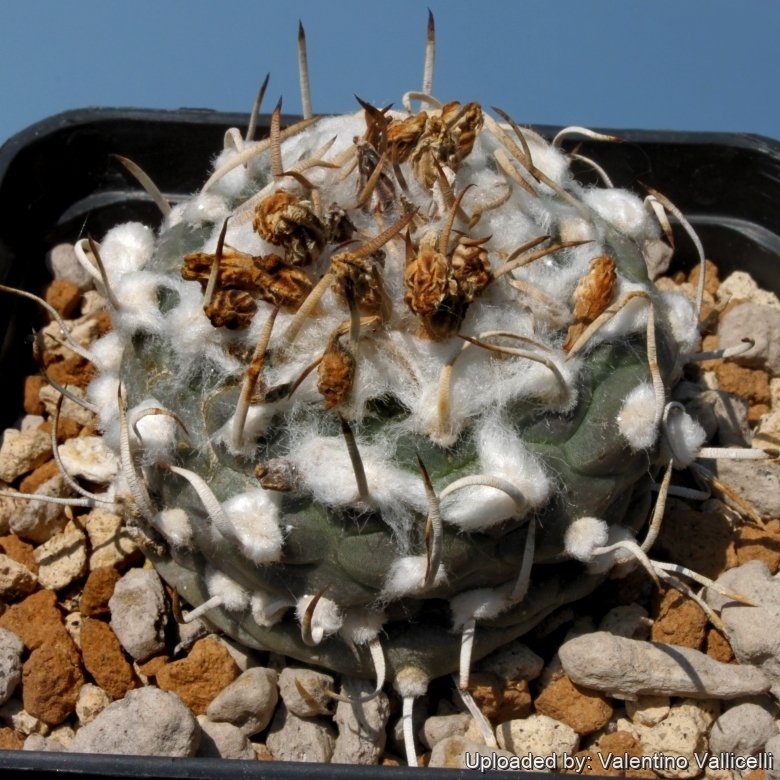
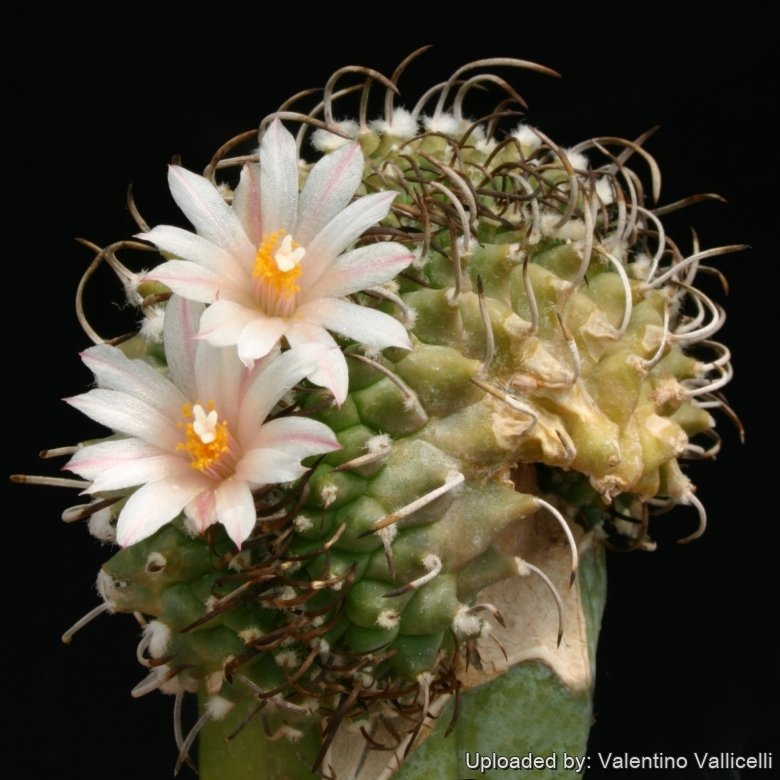
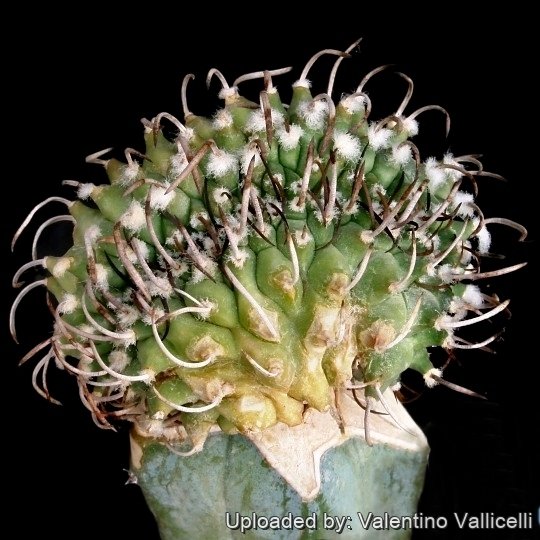
Stems: Globular more or less depressed, 30-50 mm high, 35-40 mm wide, green, apex with some white wool.
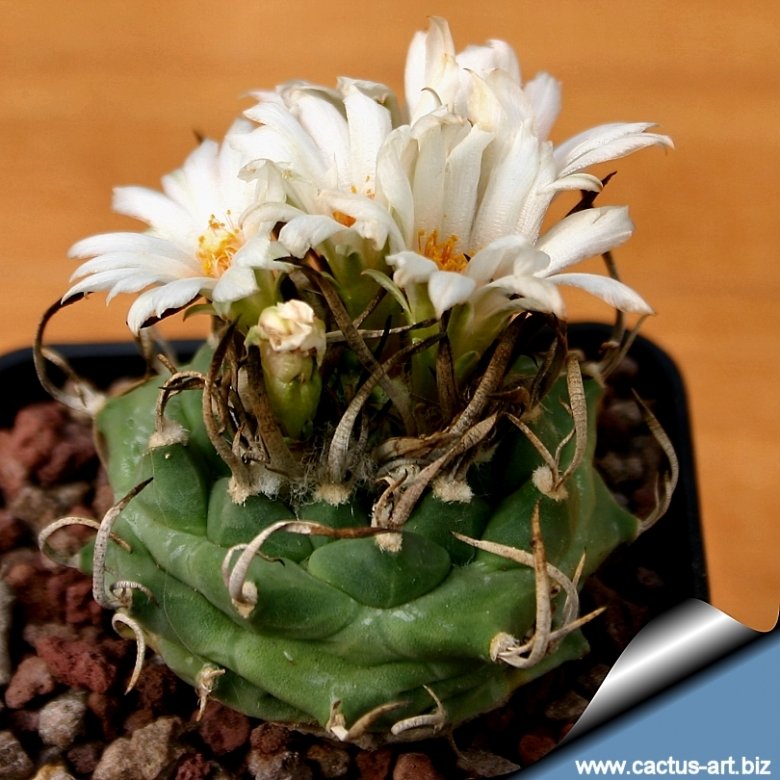
Ribs: completely divided into tubercles that are more or less well-rounded to square to almost short ,conical, 5 mm broad at the base, up to 7 mm long and pointing upwards, arranged in flat spirals.
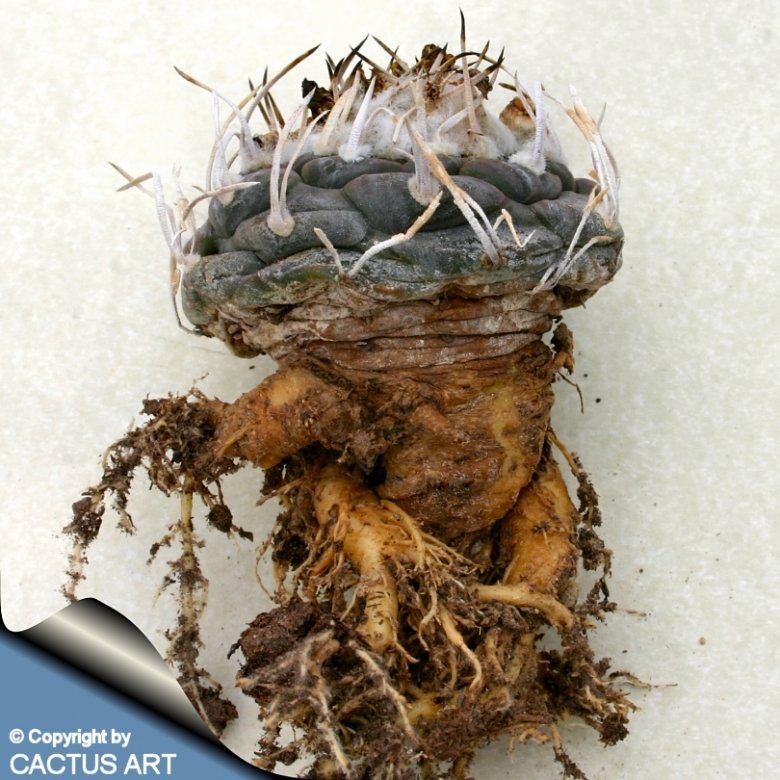
Root: Taproot.
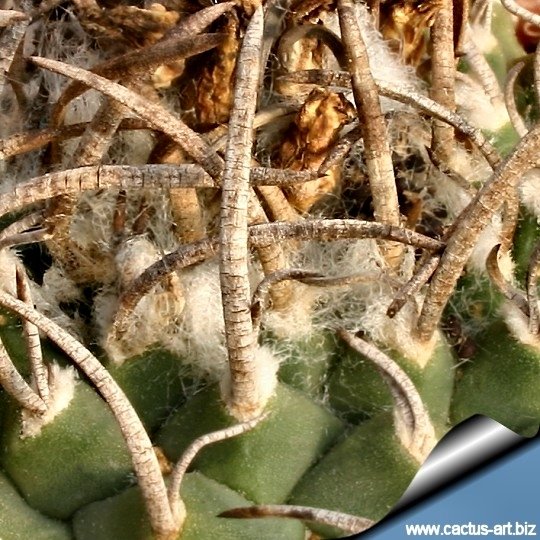
Areoles: On the tip of the tubercle, with a little wool, soon becoming bare.
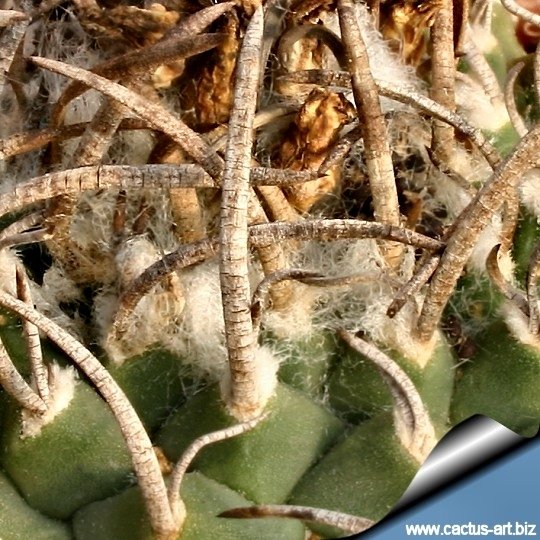
Spines: 3 (more rarely 4) the lower one longer, up to 2,5 cm, the 2 side spines approximately 1/3 as short and the upper, very often missing, still shorter, flattened below, curved towards the apex and often contorted, grey, corky, rather soft, with transverse fissures. The spines are persistent only on the upper body; below they fall off, and the body and tubercles are corky and bare.
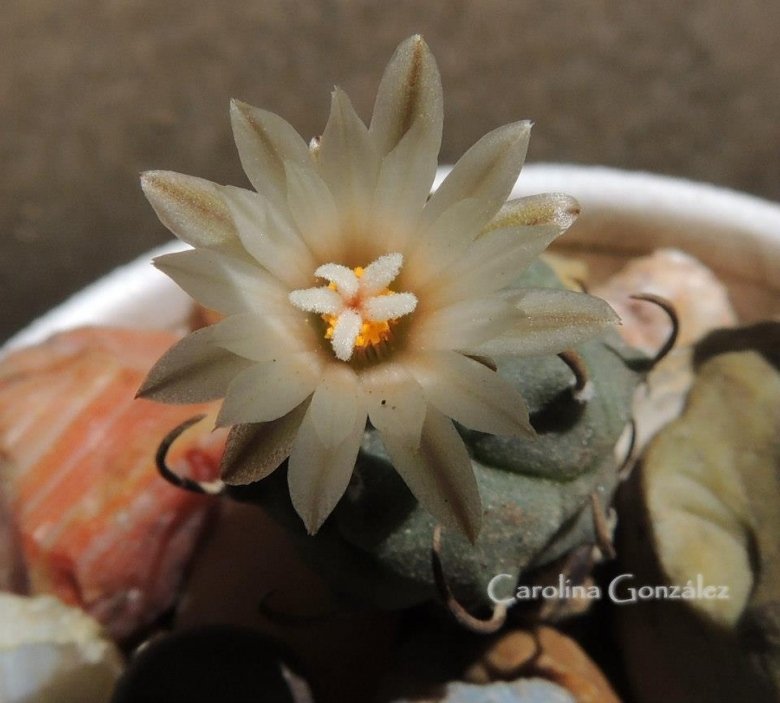
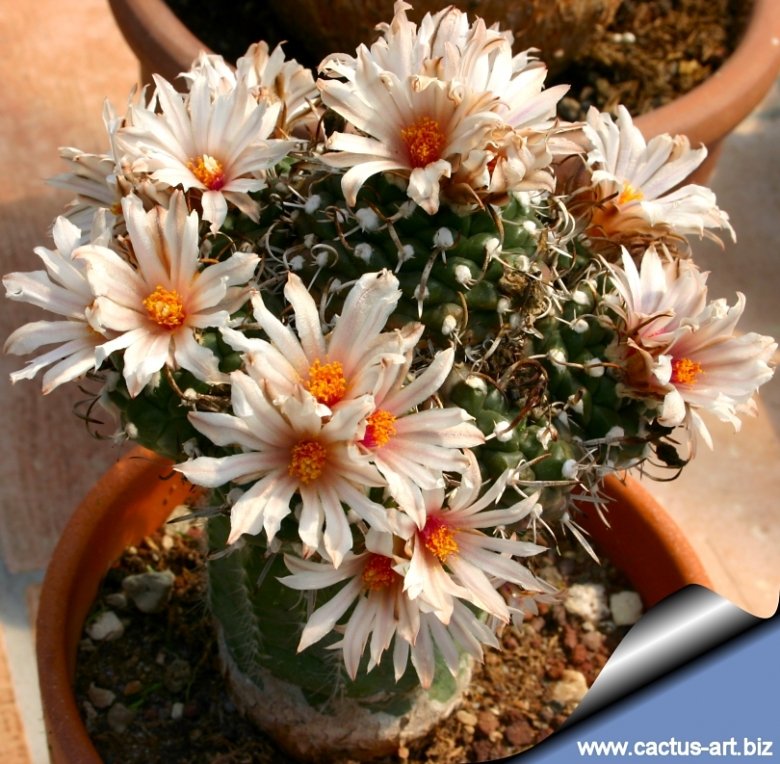
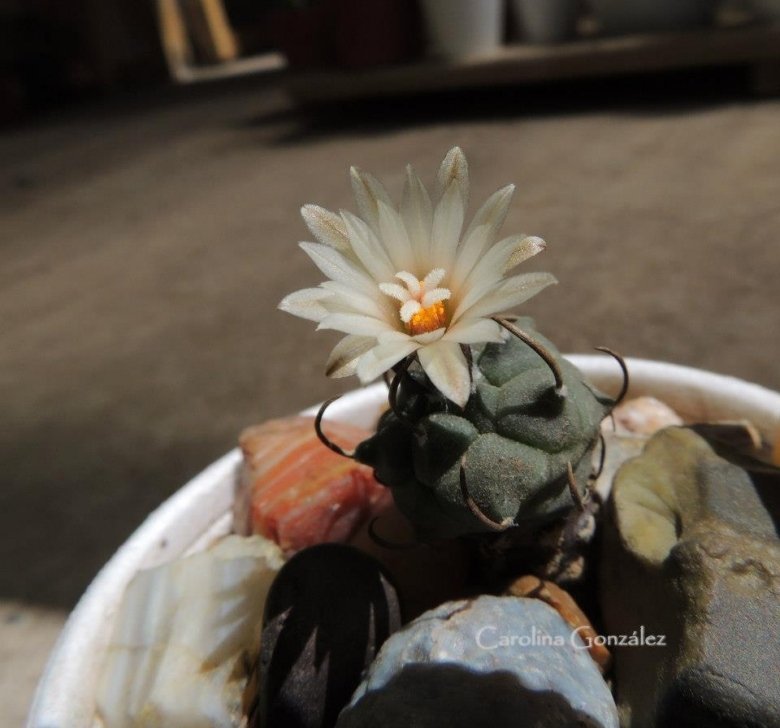
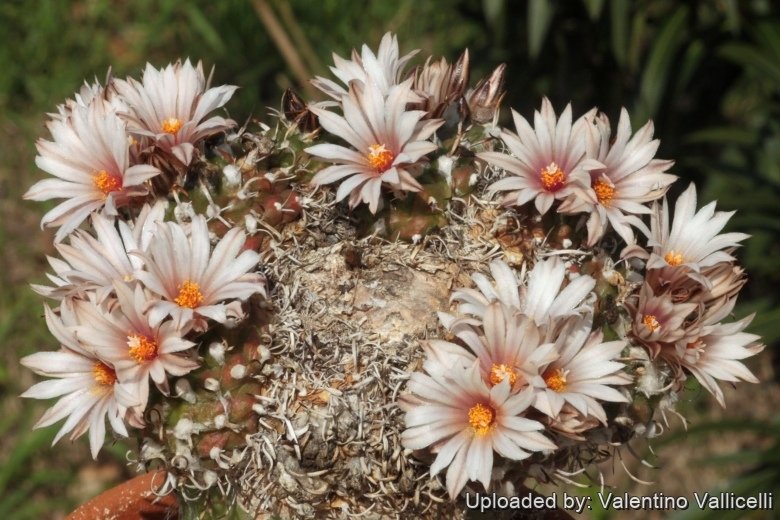
Flowers: Apical funnel shaped, whitish to pinkish, outside with darker midribs 14-25 mm wide. This plant is capable of blooming when it is little larger than 1 cm Ø.
Note: Twelve controversial subspecies are recognized: bonatzii (Gerhart Frank) Panar., dickisoniae (Glass & R.A.Foster) N.P.Taylor, flaviflorus (Gerhart Frank & A.B Lau) Glass, gracilis (Glass & R.A.Foster) Glass, jauernigii(Gerhart Frank) D.R.Hunt, klinkerianus (Backeb. & H.Jacobsen) N.P.Taylor, macrochele (Werderm.) N.P. Taylor, rioverdensis (Gerhart Frank) Lüthy, rubriflorus (Gerhart Frank) Panar., schmiedickeanus (Boed.) Rauh & Backeb. and schwarzii (Shurly) N.P.Taylor. But some hobbyists continue to place it in the genus Gymnocactus.
Origin and Habitat
Turbinicarpus schmiedickeanus (including the subspecies) is found over a wide area from many localities in the States of Nuevo León, San Luis Potosí and western Tamaulipas, Mexico. The subsp. schmiedickeanus is found in Tamaulipas, Nuevo Leon and San Luis Potosi, Mexico.
Altitude: 1500-1800 metres above sea level.
Habitat and Ecology: This cactus grows in xerophytic shrubland (Chihuahuan Desert) among calcareous rocks, often in rock cracks or in the shade of Hechtia spp. together with Leuchtenbergia principis and Pelecyphora strobiliformis. Illegal collecting is the major threat, and overgrazing and subsequent erosion poses a lesser threat.
Cultivation and Propagation
It’s a fairly easy and robust species to cultivate, but very slow growing. It needs a very well-drained soil, and requires strong sun to part sun to keep the plant compact and low and to develop a good spinal growth. Waterings should be rather infrequent to keep the plant compact, and avoid its becoming excessively elongated and unnatural in appearance. Furthermore it has a tap root, and watering it properly is often difficult, because it tends to crack open or rot if over-watered. Careful watering away from the body of the plant will allow the areoles to keep their wool. Keep dry in winter, or when night temperatures remain below 10° C. It is hardy to -4°C for a short period. Assure a good ventilation.
Reproduction: From seed, since the plant rarely produces plantlets, or grafted.
Bibliography
Major references and further lectures
-
Edward Anderson “The Cactus family” Timber Press, Incorporated, 2001
-
James Cullen, Sabina G. Knees, H. Suzanne Cubey “The European Garden Flora Flowering Plants: A Manual for the Identification of Plants Cultivated in Europe, Both Out-of-Doors and Under Glass” Cambridge University Press, 11/Aug/2011
-
David R Hunt; Nigel P Taylor; Graham Charles; International Cactaceae Systematics Group. “The New Cactus Lexicon” dh books, 2006
-
Davide Donati, Carlo Zanovello “Conoscere, capire, coltivare i Turbinicarpus-Rapicactus” Cactus Trentino Sudtirol, 2004
-
Fitz Maurice, B, Fitz Maurice, W.A., Sotomayor, M. & Smith, M. 2013. Turbinicarpus schmiedickeanus. In: IUCN 2013. “IUCN Red List of Threatened Species.” Version 2013.2. <www.iucnredlist.org>. Downloaded on 25 February 2014.
From llifle page Neolloydia schmiedickeana f. cristata
Description
Turbinicarpus schmiedickeanus is a tiny cactus species whit corky spines that grows almost completely buried in the ground. The crested form Turbinicarpus schmiedickeanus f. cristatus is very rare and sought after by collectors, for its unique features.
Root: Has a large tap root below the surface of the compost.
Stem: Fan shaped, flattened on top, depressed centrally, green, apex with some white wool.
Ribs: completely divided into tubercles that are more or less well-rounded to square to almost short ,conical, 5 mm broad at the base, up to 7 mm long and pointing upwards, arranged in flat spirals.
Areoles: On the tip of the tubercle, with a little wool, soon becoming bare.
Spines: 3 (more rarely 4) the lower one longer, up to 2,5 cm, the 2 side spines approximately 1/3 as short and the upper, very often missing, still shorter, flattened below, curved towards the apex and often contorted, grey, corky, rather soft, with transverse fissures. The spines are persistent only on the upper body; below they fall off, and the body and tubercles are corky and bare.
Flowers: Apical funnel shaped, whitish to pinkish, outside with darker midribs 14-25 mm wide. This plant is capable of blooming when it is little larger than 1 cm Ø.
Origin and Habitat
Garden origin (Nursery produced cultivar)
Cultivation and Propagation
Although regarded as a choice and difficult plant is not too difficult in a greenhouse, although grows quite slowly. It is sometime seen as a grafted plant but grows very well on its own roots too.
Soil: Use mineral well permeable mineral soil with little organic matter (peat, humus).
Exposure: They need a good amount of light shade to full sun this help to keep the plants healthy, although slow growth.
Watering: Water sparingly from March till October (weekly during summertime, if the weather is sunny enough) , with a little fertilizer added. Less or no water during cold winter months to prevent root loss. It is sensitive to overwatering (rot prone).
Hardiness: Keep perfectly dry in winter at temperatures from 5 to 15 degrees centigrade. (but it is relatively cold resistant and hardy to -5° C for short periods) In the rest period no high atmospheric humidity!! (Temperature Zone: USDA 9-11)
Propagation: Grafting or cuttings. Plants are usually grafted onto column-shaped cacti but proved to be able to produce their own roots if degrafted.
Source: Neolloydia schmiedickeana f. cristata, LLIFLE - Encyclopedia of living forms, CC-BY-SA, retrieved 2026-10-25.
From llifle page Turbinicarpus sp. Santa Rita
Description
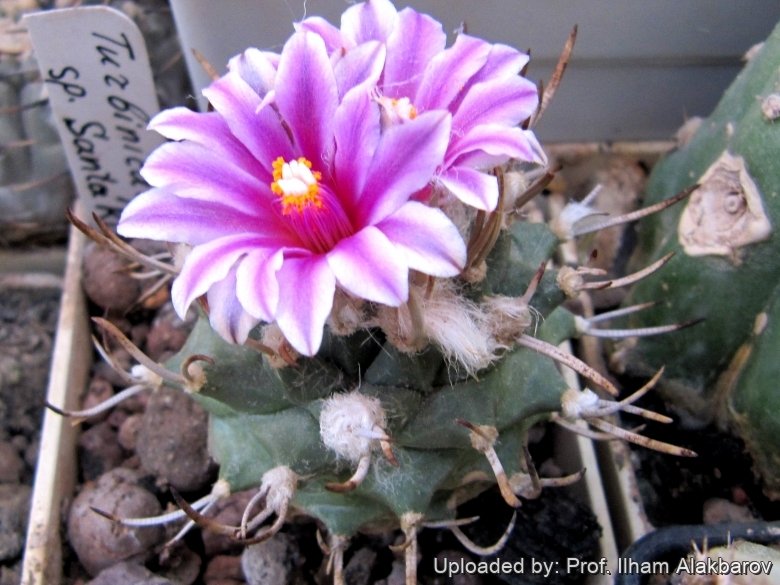
Turbinicarpus sp. Santa Rita, a.k.a. Turbinicarpus schmiedickeanus var. Santa Rita or Turbinicarpus santaritensis, is a tiny form with magnificent and unique flower colouring revealing the difference.
Stem: Solitary or slowly clumping semi-globose greysh-green to bluish-green globose, 3-5 cm in diameter (but often larger in cultivation).
Flowers: Apical short tubed, tepals lanceolate, central strip bright purple, wider downward, margins of tepals pinkish white. Filaments purple, anthers golden-yellow to orangish and style pink, stigma lobes whitish.
Origin and Habitat
Santa Rita, San Luis Potosí, Mexico
Cultivation and Propagation
It’s a fairly easy species to cultivate. It needs a very well drained soil, and requires strong sun to part sun to develop good spinal growth. Waterings should be rather infrequent, to keep the plant compact and avoid it becoming excessively elongated and unnatural in appearance. Keep dry in winter or when night temperatures remain below 10° C; it is hardy to -4°C for a short period. Assure a good ventilation.
Source: Turbinicarpus sp. Santa Rita, LLIFLE - Encyclopedia of living forms, CC-BY-SA, retrieved 2026-10-25.
Cultivars and forms (31)
Subspecies (10)
- Turbinicarpus schmiedickeanus subs. andersonii
- Turbinicarpus schmiedickeanus subs. bonatzii
- Turbinicarpus schmiedickeanus subs. dickisoniae
- Turbinicarpus schmiedickeanus subs. flaviflorus
- Turbinicarpus schmiedickeanus subs. gracilis
- Turbinicarpus schmiedickeanus subs. klinkerianus
- Turbinicarpus schmiedickeanus subs. macrochele
- Turbinicarpus schmiedickeanus subs. panarottoi
- Turbinicarpus schmiedickeanus subs. rubriflorus
- Turbinicarpus schmiedickeanus subs. schwarzii
Varieties (11)
- Turbinicarpus schmiedickeanus subs. klinkerianus var. lilnkeuiduus
- Turbinicarpus schmiedickeanus var. dickisoniae
- Turbinicarpus schmiedickeanus var. flaviflorus
- Turbinicarpus schmiedickeanus var. gracilis
- Turbinicarpus schmiedickeanus var. klinkerianus
- Turbinicarpus schmiedickeanus var. kupcakii
- Turbinicarpus schmiedickeanus var. macrochele
- Turbinicarpus schmiedickeanus var. panarottoi
- Turbinicarpus schmiedickeanus var. polaskii
- Turbinicarpus schmiedickeanus var. rubriflorus
- Turbinicarpus schmiedickeanus var. schwarzii
Forms (10)
- Turbinicarpus schmiedickeanus f. aurata
- Turbinicarpus schmiedickeanus f. cristatus
- Turbinicarpus schmiedickeanus f. schwarzii
- Turbinicarpus schmiedickeanus subs. flaviflorus f. brevispinus
- Turbinicarpus schmiedickeanus subs. gracilis f. cristatus
- Turbinicarpus schmiedickeanus subs. klinkerianus f. aurata
- Turbinicarpus schmiedickeanus subs. klinkerianus f. cristatus
- Turbinicarpus schmiedickeanus subs. klinkerianus f. pachystele
- Turbinicarpus schmiedickeanus subs. macrochele f. cristatus
- Turbinicarpus schmiedickeanus var. polaskii f. variegatus
Gallery