Description
Turbinicarpus schmiedickeanus subs. klinkerianus f. pachystele (Occasionally misspelled “pakistele”)
is a trade name Turbinicarpus schmiedickeanusSN’>12648] subs. klinkerianus. The differences with other “klinkerianus” are in reality very minimal (if none) and most botanist agree on the fact that “pachystele ” should be included in the “klinkerianus”, and the two plants are not readily distinguishable, if not for the label.
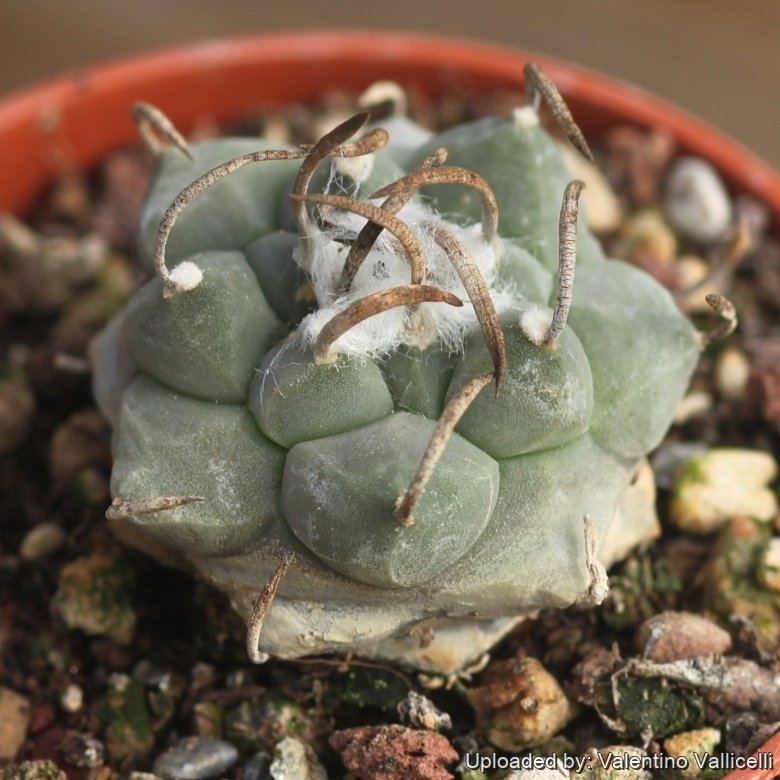
Habit: It is a small disk-shaped solitary or slowly clumping cactus, dichotomy also observed.
Stem: Globular depressed, 30-50 mm high, 35-40 mm wide, pale grey to greenish-brown, apex with some white wool.
Root: Taproot.
Tubercles: 1 cm broad and 6 mm high, pyramidal, angular and somewhat keeled, rhomboid at the base, arranged in flat spirals.
Areoles: on the tip of the tubercle, with a little wool, soon becoming bare.
Spines: 2-3, the lower one longer, up to 1 cm, the 2 upper ones only on young areoles, flattened below, curved towards the apex, grey-brown with dark tip, newly emerged centrals blackish brown, corky, rather soft, with transverse fissures. Juvenile radial spines are feathery and very characteristic.
Flowers: Apical, funnel shaped, inside ivory, outside with darker brown (or magenta) midribs 14-25mm wide. This plant is capable of blooming when it is little larger than 1 cm in diameter.
Blooming season: Summer (May-October) flowering.
Fruits: Green-brown with a woolly top.
Origin and Habitat
Unknown.
Cultivation and Propagation
Turbinicarpus schmiedickeanus subs. klinkerianus f. pachystele is a fairly easy and robust species to cultivate, but very slow growing. It needs a very well-drained soil, and requires strong sun to part sun to keep the plant compact and low and to develop a good spinal growth. Waterings should be rather infrequent to keep the plant compact, and avoid its becoming excessively elongated and unnatural in appearance. Furthermore it has a tap root, and watering it properly is often difficult, because it tends to crack open or rot if over-watered. Careful watering away from the body of the plant will allow the areoles to keep their wool. Keep dry in winter, or when night temperatures remain below 10° C. It is hardy to -4°C for a short period. Assure a good ventilation.
Reproduction: From seed, since the plant rarely produces plantlets, or grafted.
Gallery