Publication: Cactaceae Consensus Init. 5: 14. 1998 - Remarks: Panarotto (in Piante Grasse, 18(3): 120. 1998 (1999)) also published this comb. nov. (isonym)
Description
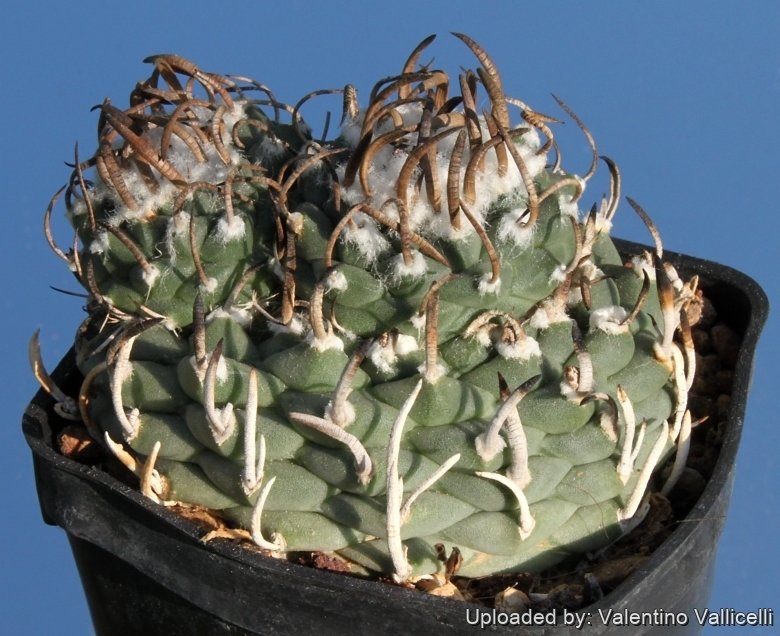
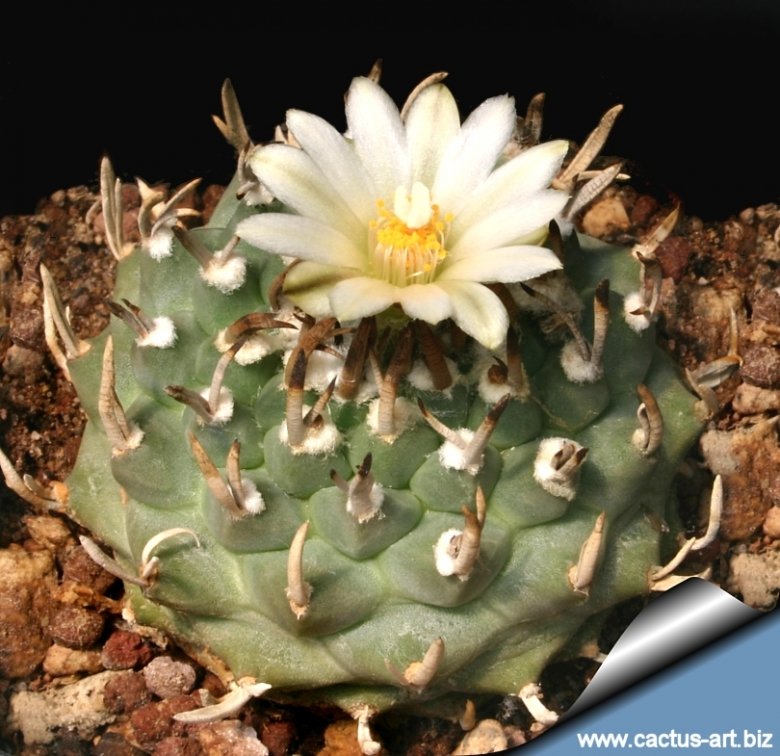
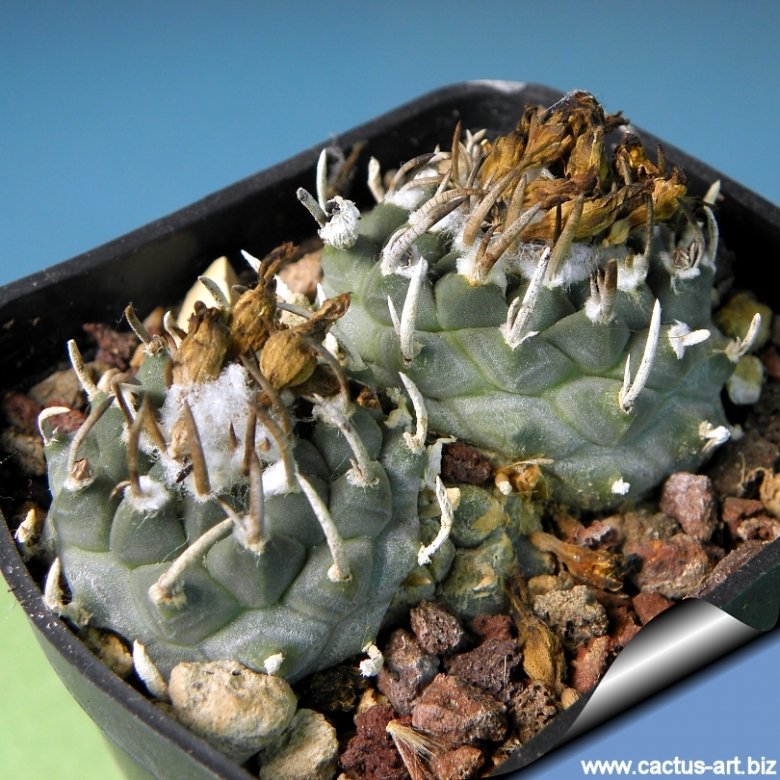
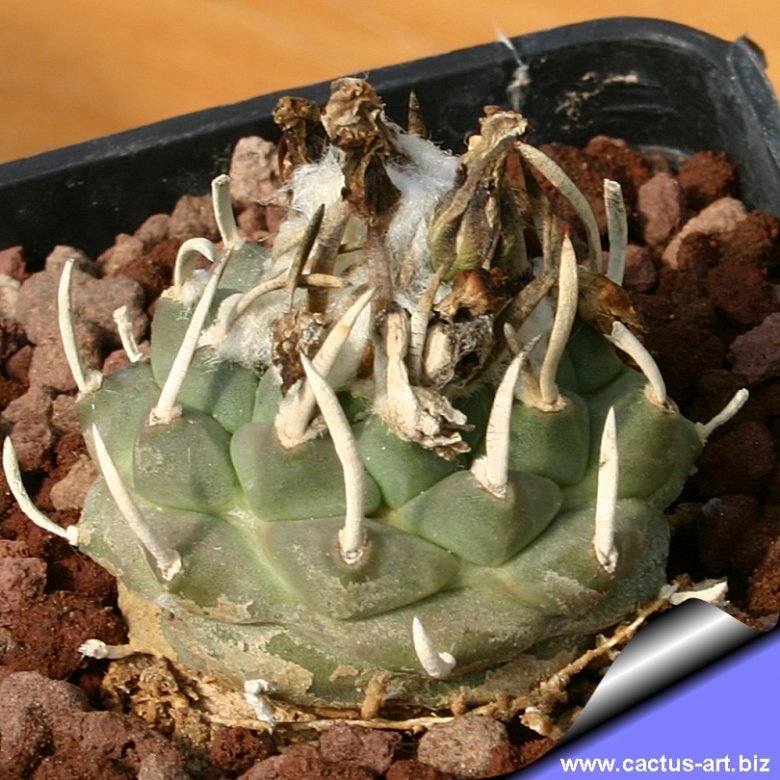
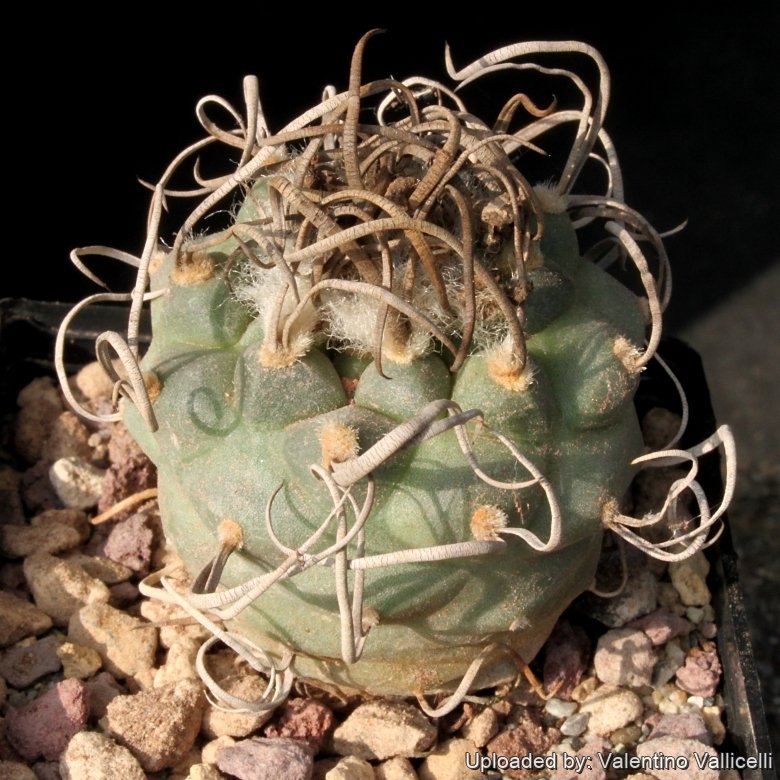
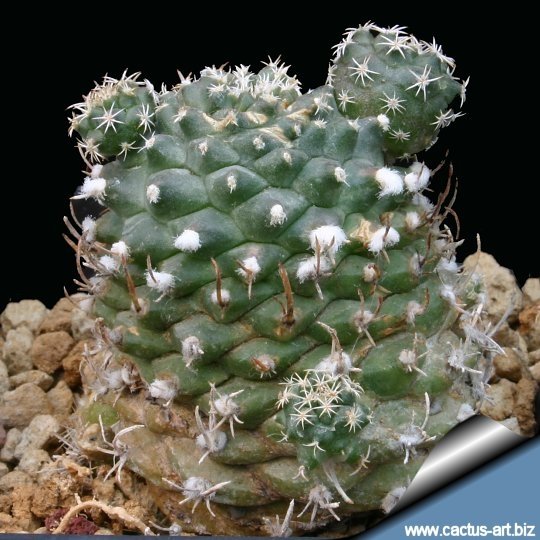
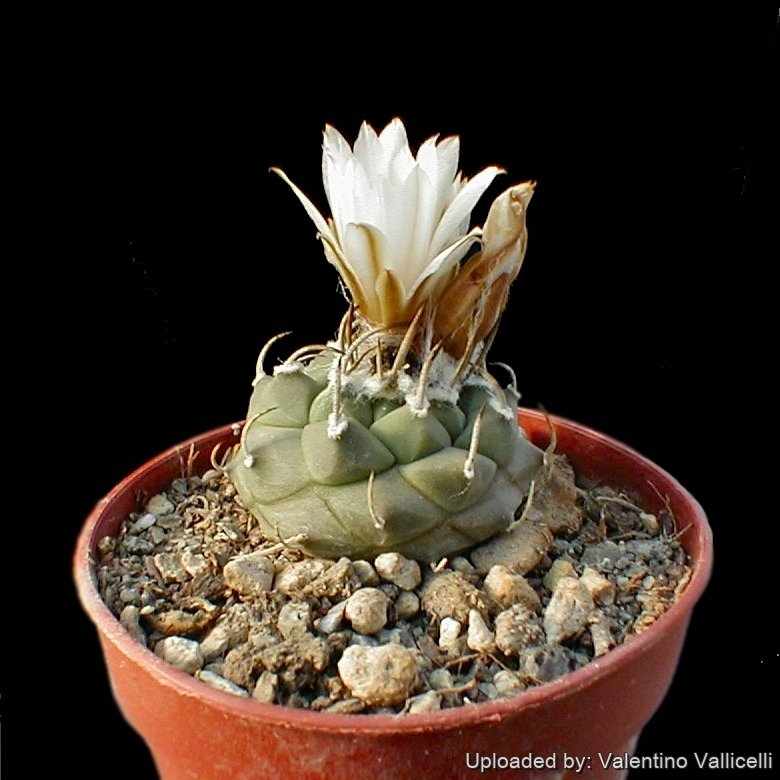
Turbinicarpus schmiedickeanus subs. klinkerianus best known as: Turbinicarpus klinkerianus is a one of the several local form of the very variable Turbinicarpus schmiedickeanus distinguished for having pyramidal tubercles and only 3 corky spines per areole, with only one persisting, and ivory white flowers with magenta midribs. This subspecies exhibits wide diversity in form.
Habit: It is a small disk-shaped solitary or slowly clumping cactus, dichotomy also observed.
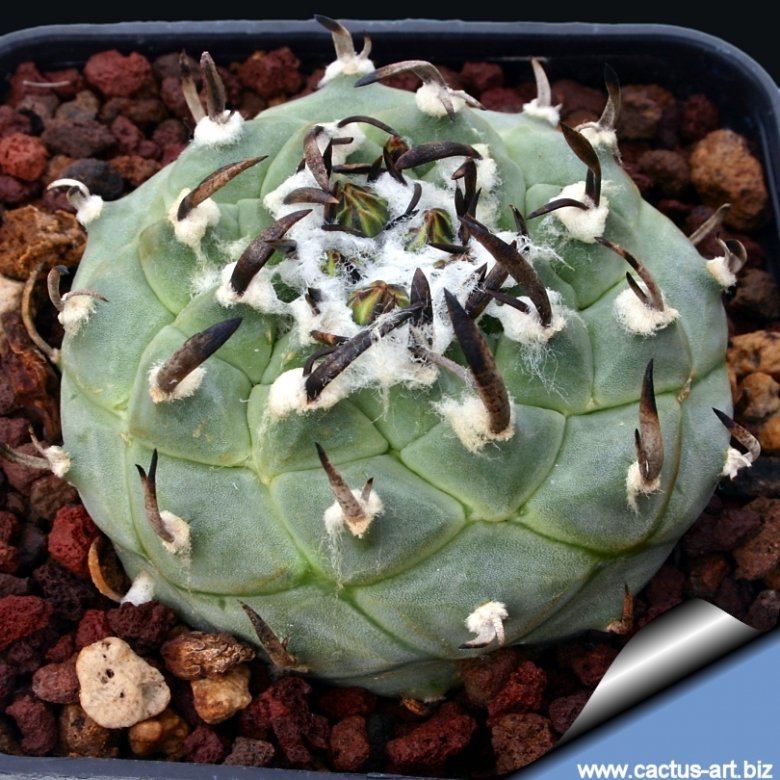
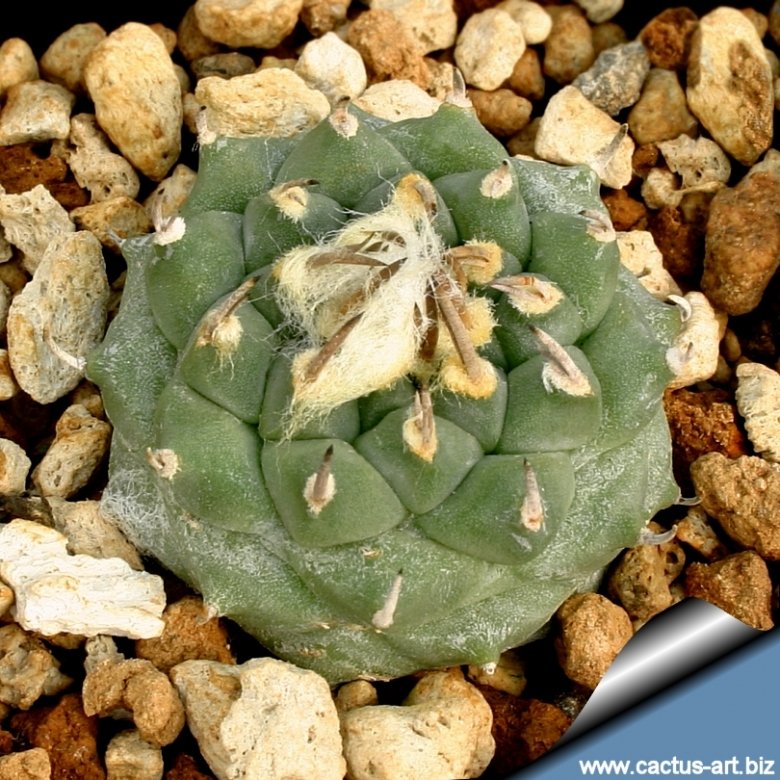
Stem: Globular depressed, 30-50 mm high, 35-40 mm wide, pale grey to greenish-brown, apex with some white wool.
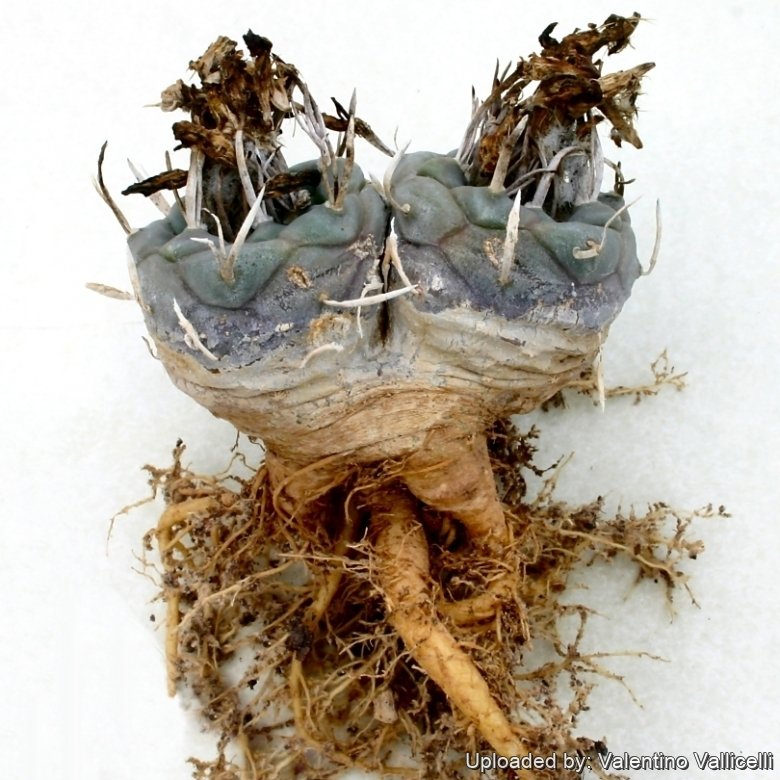
Root: Taproot.
Tubercles: 1 cm broad and 6 mm high, pyramidal, rhomboid at the base, arranged in flat spirals.
Areoles: on the tip of the tubercle, with a little wool, soon becoming bare.
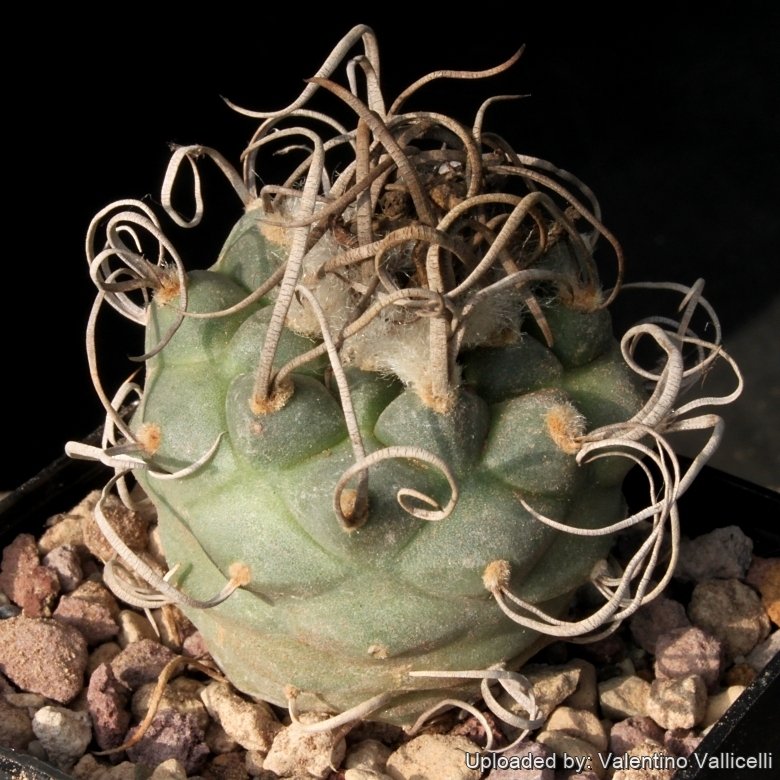
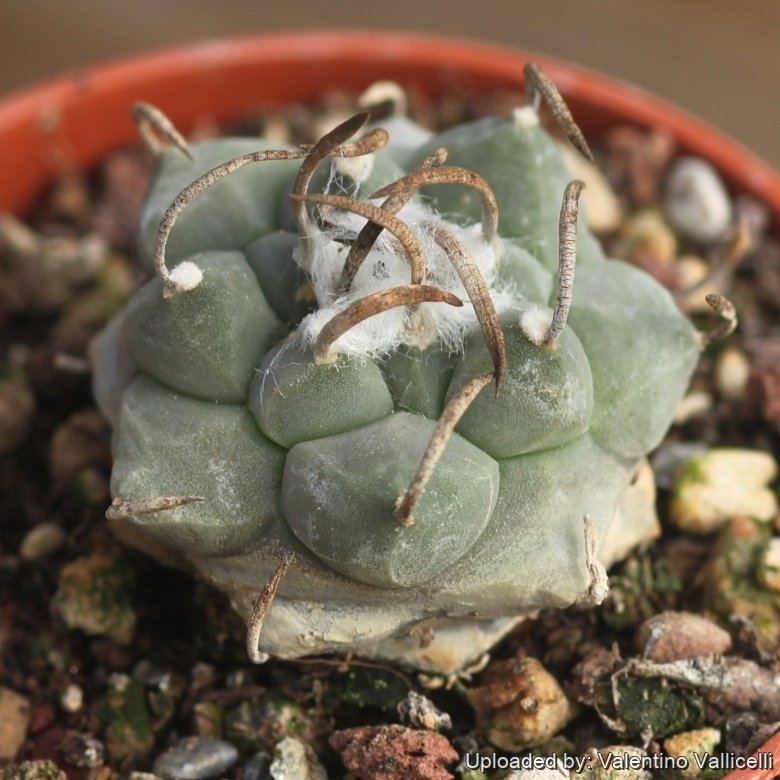
Spines: 2-3, the lower one longer, up to 1 cm, the 2 upper ones only on young areoles, flattened below, curved towards the apex, grey-brown with dark tip, newly emerged centrals blackish brown, corky, rather soft, with transverse fissures. Juvenile radial spines are feathery and very characteristic.
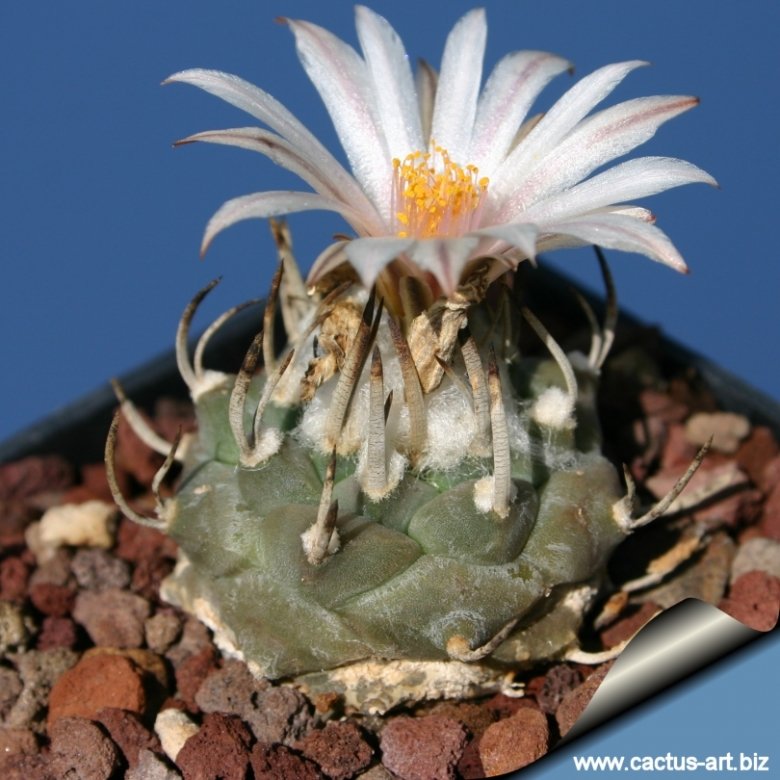
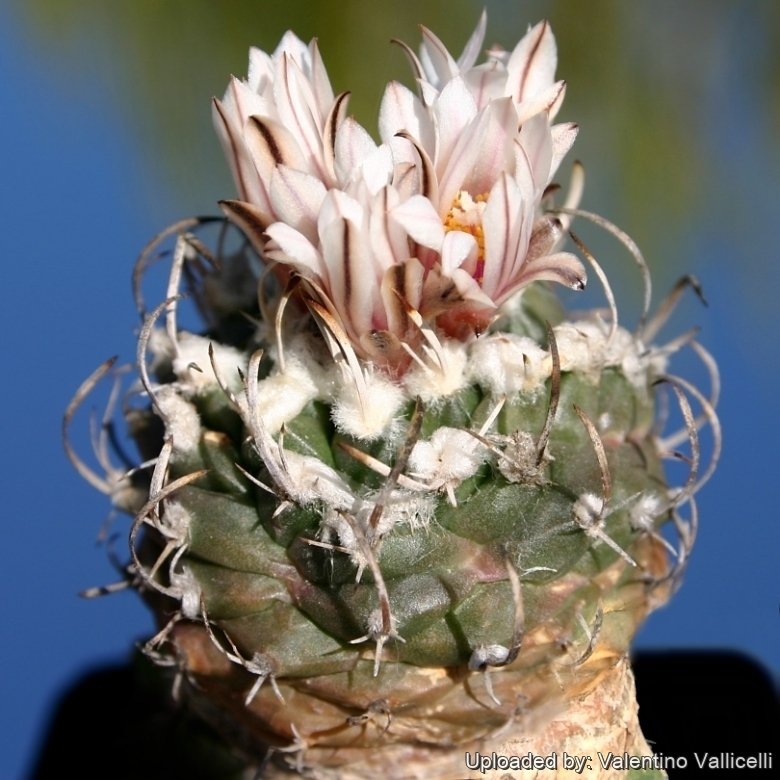
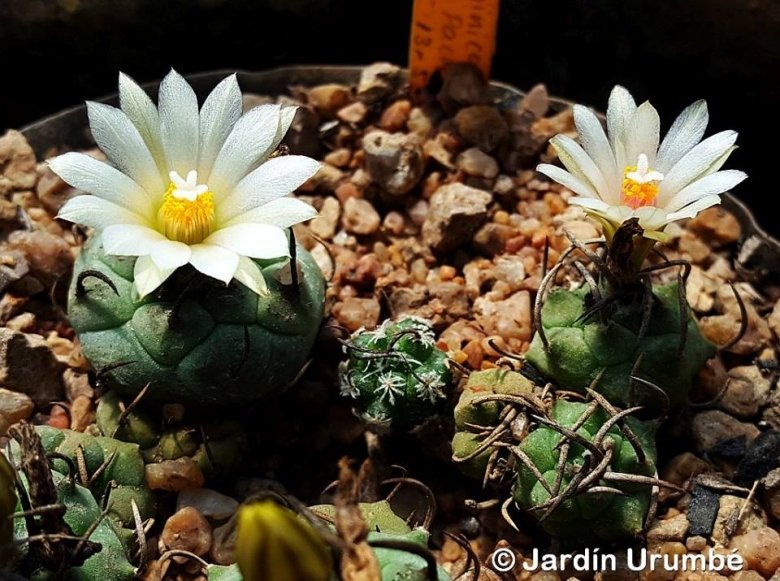
Flowers: Apical, funnel shaped, inside ivory, outside with darker brown (or magenta) midribs 14-25mm wide. This plant is capable of blooming when it is little larger than 1 cm in diameter.
Blooming season: Summer (May-October) flowering.
Fruits: Green-brown with a woolly top.
Origin and Habitat
Guadalcazar in the state of San Luis Potosi (Mexico)
Habitat: Grows in scattered colonies, mostly in mossy crevices on rooky slopes at altitudes around 1150-2250m.
Cultivation and Propagation
It’s a fairly easy species to cultivate. It needs a very well-drained soil, and requires strong sun to part sun to develop good spinal growth. Waterings should be rather infrequent to keep the plant compact and avoid it becoming excessively elongated and unnatural in appearance. Keep dry in winter, or when night temperatures remain below 10° C. It is hardy to -4°C for a short period. Assure a good ventilation.
Reproduction: From seed, since the plant rarely produces plantlets, or grafted.
Bibliography
Major references and further lectures
-
Edward Anderson “The Cactus family” Timber Press, Incorporated, 2001
-
James Cullen, Sabina G. Knees, H. Suzanne Cubey “The European Garden Flora Flowering Plants: A Manual for the Identification of Plants Cultivated in Europe, Both Out-of-Doors and Under Glass” Cambridge University Press, 11/Aug/2011
-
David R Hunt; Nigel P Taylor; Graham Charles; International Cactaceae Systematics Group. “The New Cactus Lexicon” dh books, 2006
-
Davide Donati, Carlo Zanovello “Conoscere, capire, coltivare i Turbinicarpus-Rapicactus” Cactus Trentino Sudtirol, 2004
From llifle page Turbinicarpus klinkerianus subs. hiemalis
Description
It flowers in winter, hence the scientific name “Hiemalis” (Belonging to winter)
Origin and Habitat
This is a form of klinkerianus from San Luis Potosi.
Cultivation and Propagation
Turbinicarpus klinkerianus subs. hiemalis is a summer-growing species fairly easy and robust to cultivate, but very slow growing. This plant is xerophytic, adapted to dry soils and is quite susceptible to over-watering if kept in a non ventilated place.
Growth rate: Slow-growing.
Soil: Grow it in an open mineral, sandy-gritty cactus compost and provide a very good drainage.
Exposure: It is suited for sunny-brightly exposure, but can tolerate light shade. However it will do its best only with lots of sun and become stressed with inadequate light which could result in poor growth and unnatural shape. Direct sun is also beneficial in order to get a good spine growth. It has a good heat tolerance.
Watering: Waterings should be rather infrequent to keep the plant compact, and avoid its becoming excessively elongated and unnatural in appearance. Furthermore it has a tap root, and watering it properly is often difficult, because it tends to crack open or rot if over-watered. Keep dry in winter or when night temperatures remain below 10° C. Mature individuals easily rot and die especially after transplanting so be extremely cautious with watering. Water it less than average if in bigger pots.
Fertilization: Feed them once during the growing season with a fertilizer specifically formulated for cactus and succulents (high potash fertilizer with a dilute low nitrogen), including all micro nutrients and trace elements diluted to ½ the strength recommended on the label. They thrive in poor soils and need a limited supplies of fertilizer to avoid the plants developing excess vegetation, which is easily attacked by fungal diseases.
Special need: It is suited for airy exposures. Provide very good ventilation. Nearly all problems occur as a result of overwatering and poor ventilation, especially when weather conditions are dull and cool or very humid. They must have very dry atmosphere.
Hardiness: It likes warmth (recommended minimum winter temperature 5° C) But plants kept perfectly dry can easily survive a light frost.
Pests & diseases: These cacti may be attractive to a variety of insects, but plants in good condition should be nearly pest-free, particularly if they are grown in a mineral potting-mix, with good exposure and ventilation. Nonetheless, there are several pests to watch for:
- Red spiders: Red spiders may be effectively rubbed up by misting the plants from above.
- Mealy bugs: Mealy bugs occasionally develop aerial into the new leaves and flowers with disfiguring results, but the worst types develop underground on the roots and are invisible except by their effects.
- Rot: Rot is only a minor problem if the plants are watered and “aired” correctly. If they are not, fungicides won’t help all that much.
Reproduction: From seed, since the plant rarely produces plantlets, or grafted. The seeds can be sown in pots of fine, well-drained sandy soil, any time during the spring when temperatures are warm. Cover the seeds with a fine layer of grit and water from below with a fungicide to prevent damping off. For the 1-2 weeks cover the pots with a sheet of glass/clear perspex to keep the humidity levels high. Remove the glass and replace it with light shade-cloth and mist once or twice a day for the next two weeks after which most seeds should have germinated. From then on mistings can be reduced to every second and then every third day as the little plants grow. The seedlings should not be disturbed until they are well rooted after which they can be planted separately in small pots. Sometimes it is grafted to avoid root rot problems as plants grafted on an hardy stock are easy to grow and no special skill is required.
Bibliography
Major references and further lectures
-
Edward Anderson “The Cactus family” Timber Press, Incorporated, 2001
-
James Cullen, Sabina G. Knees, H. Suzanne Cubey “The European Garden Flora Flowering Plants: A Manual for the Identification of Plants Cultivated in Europe, Both Out-of-Doors and Under Glass” Cambridge University Press, 11/Aug/2011
-
David R Hunt; Nigel P Taylor; Graham Charles; International Cactaceae Systematics Group. “The New Cactus Lexicon” dh books, 2006
-
Davide Donati, Carlo Zanovello “Conoscere, capire, coltivare i Turbinicarpus-Rapicactus” Cactus Trentino Sudtirol, 2004
-
Halda and Panarotto, Acta. Mus. Richnov. Sect. natur. 5:162, 1998
Source: Turbinicarpus klinkerianus subs. hiemalis, LLIFLE - Encyclopedia of living forms, CC-BY-SA, retrieved 2026-10-25.
From llifle page Turbinicarpus lilinkioides
Description
Turbinicarpus schmiedickeanus subs. klinkerianus var. lilnkeuiduus (a.k.a. “lilinkeuidus” or “lilinkioides”) is a trade name used to indicate a plant of unknown origin. Plants so-named are known in cultivation in the USA and material has found its way to Europe. It is nothing else than a form of Turbinicarpus schmiedickeanus subs. klinkerianus. The differences with other “klinkerianus” are in reality very minimal (if none) and most botanist agree on the fact that “lilnkeuiduus” should be included in the “klinkerianus”, and the two plants are not readily distinguishable, if not for the label.
Habit: It is a small disk-shaped solitary or slowly clumping cactus, dichotomy also observed.
Stem: Globular depressed, 30-50 mm high, 35-40 mm wide, pale grey to greenish-brown, apex with some white wool.
Root: Taproot.
Tubercles: 1 cm broad and 6 mm high, pyramidal, angular and somewhat keeled, rhomboid at the base, arranged in flat spirals.
Areoles: on the tip of the tubercle, with a little wool, soon becoming bare.
Spines: 2-3, the lower one longer, up to 1 cm, the 2 upper ones only on young areoles, flattened below, curved towards the apex, grey-brown with dark tip, newly emerged centrals blackish brown, corky, rather soft, with transverse fissures. Juvenile radial spines are feathery and very characteristic.
Flowers: Apical, funnel shaped, inside ivory, outside with darker brown (or magenta) midribs 14-25mm wide. This plant is capable of blooming when it is little larger than 1 cm in diameter.
Blooming season: Summer (May-October) flowering.
Fruits: Green-brown with a woolly top.
Origin and Habitat
Unknown origin (more likely, Guadalcazar in the state of San Luis Potosi, Mexico). Plants so-named are known in cultivation in the USA and material has found its way to Europe.
Cultivation and Propagation
It’s a fairly easy and robust species to cultivate, but very slow growing. It needs a very well-drained soil, and requires strong sun to part sun to keep the plant compact and low and to develop a good spinal growth. Waterings should be rather infrequent to keep the plant compact, and avoid its becoming excessively elongated and unnatural in appearance. Furthermore it has a tap root, and watering it properly is often difficult, because it tends to crack open or rot if over-watered. Careful watering away from the body of the plant will allow the areoles to keep their wool. Keep dry in winter, or when night temperatures remain below 10° C. It is hardy to -4°C for a short period. Assure a good ventilation.
Reproduction: From seed, since the plant rarely produces plantlets, or grafted.
Source: Turbinicarpus lilinkioides, LLIFLE - Encyclopedia of living forms, CC-BY-SA, retrieved 2026-10-25.
From llifle page Turbinicarpus sp. Negrita
Description
Turbinicarpus sp. Negrita is a trade name used to indicate a local form of Turbinicarpus schmiedickeanus subs. klinkerianus. The differences with other “klinkerianus” are in reality very minimal (if none) and most botanist agree on the fact that Turbinicarpus sp. Negrita should be included in the “klinkerianus”, and the two plants are not readily distinguishable, if not for the label.
Habit: It is a small disk-shaped solitary or slowly clumping cactus, dichotomy also observed.
Stem: Globular depressed, 30-50 mm high, 35-40 mm wide, pale grey to greenish-brown, apex with some white wool.
Root: Taproot.
Tubercles: 1 cm broad and 6 mm high, pyramidal, angular and somewhat keeled, rhomboid at the base, arranged in flat spirals.
Areoles: on the tip of the tubercle, with a little wool, soon becoming bare.
Spines: 2-3, the lower one longer, up to 1 cm, the 2 upper ones only on young areoles, flattened below, curved towards the apex, grey-brown with dark tip, newly emerged centrals blackish brown, corky, rather soft, with transverse fissures. Juvenile radial spines are feathery and very characteristic.
Flowers: Apical, funnel shaped, inside ivory, outside with darker brown (or magenta) midribs 14-25mm wide. This plant is capable of blooming when it is little larger than 1 cm in diameter.
Blooming season: Summer (May-October) flowering.
Fruits: Green-brown with a woolly top.
Origin and Habitat
La Negrita, San Luis Potosi, Mexico.
Cultivation and Propagation
This species is relatively easy to cultivate. Requires full sun and careful watering to keep plant compact and low. It has a tap root, and watering it properly is often difficult and tends to crack open or rot if over-watered. Requires full sun and careful watering to keep plant compact. Hardy to -4°C for a short period.
Source: Turbinicarpus sp. Negrita, LLIFLE - Encyclopedia of living forms, CC-BY-SA, retrieved 2026-10-25.
From llifle page Turbinicarpus klinkerianus f. pachystele
Description
Turbinicarpus schmiedickeanus subs. klinkerianus f. pachystele (Occasionally misspelled “pakistele”)
is a trade name Turbinicarpus schmiedickeanusSN’>12648] subs. klinkerianus. The differences with other “klinkerianus” are in reality very minimal (if none) and most botanist agree on the fact that “pachystele ” should be included in the “klinkerianus”, and the two plants are not readily distinguishable, if not for the label.
Habit: It is a small disk-shaped solitary or slowly clumping cactus, dichotomy also observed.
Stem: Globular depressed, 30-50 mm high, 35-40 mm wide, pale grey to greenish-brown, apex with some white wool.
Root: Taproot.
Tubercles: 1 cm broad and 6 mm high, pyramidal, angular and somewhat keeled, rhomboid at the base, arranged in flat spirals.
Areoles: on the tip of the tubercle, with a little wool, soon becoming bare.
Spines: 2-3, the lower one longer, up to 1 cm, the 2 upper ones only on young areoles, flattened below, curved towards the apex, grey-brown with dark tip, newly emerged centrals blackish brown, corky, rather soft, with transverse fissures. Juvenile radial spines are feathery and very characteristic.
Flowers: Apical, funnel shaped, inside ivory, outside with darker brown (or magenta) midribs 14-25mm wide. This plant is capable of blooming when it is little larger than 1 cm in diameter.
Blooming season: Summer (May-October) flowering.
Fruits: Green-brown with a woolly top.
Origin and Habitat
Unknown.
Cultivation and Propagation
Turbinicarpus schmiedickeanus subs. klinkerianus f. pachystele is a fairly easy and robust species to cultivate, but very slow growing. It needs a very well-drained soil, and requires strong sun to part sun to keep the plant compact and low and to develop a good spinal growth. Waterings should be rather infrequent to keep the plant compact, and avoid its becoming excessively elongated and unnatural in appearance. Furthermore it has a tap root, and watering it properly is often difficult, because it tends to crack open or rot if over-watered. Careful watering away from the body of the plant will allow the areoles to keep their wool. Keep dry in winter, or when night temperatures remain below 10° C. It is hardy to -4°C for a short period. Assure a good ventilation.
Reproduction: From seed, since the plant rarely produces plantlets, or grafted.
Source: Turbinicarpus klinkerianus f. pachystele, LLIFLE - Encyclopedia of living forms, CC-BY-SA, retrieved 2026-10-25.
From llifle page Turbinicarpus klinkerianus f. aurata
Description
Turbinicarpus schmiedickeanus subs. klinkerianus best known as: Turbinicarpus klinkerianus is a one of the several local form of the very variable Turbinicarpus schmiedickeanus distinguished for having pyramidal tubercles and only 3 corky spines per areole, with only one persisting, and ivory white flowers with magenta midribs. This subspecies exhibits wide diversity in form.
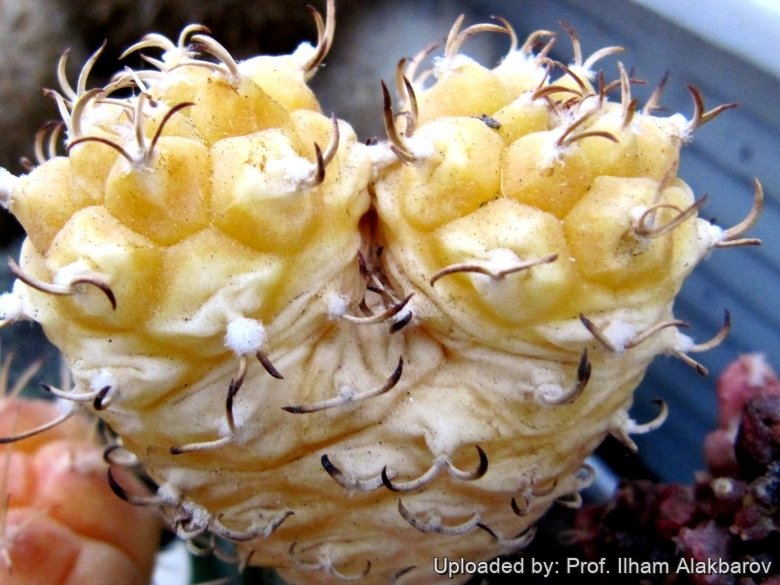
Forma aurea or aurata (yellow form): The schizochromic form (Turbinicarpus klinkerianus f. aurata) has pale yellow stems due to the absence (or reduced production) of chlorophyll pigments: every other pigment is present at normal levels, the dominant green colouration is lost, but will still more than likely have normal other pigments that give the yellow overall appearance of the stem. This form with yellow stems is very attractive and highly prized. This schizochromic form is almost always seen grafted on stronger columnar species, and cannot can be grown on its own roots. However some clones have enough chlorophyll in their tissues and can be grown on they own roots too, but very slow growing.
Habit: It is a small disk-shaped solitary or slowly clumping cactus, dichotomy also observed.
Stem: Globular depressed, 30-50 mm high, 35-40 mm wide, yellow, apex with some white wool.
Tubercles: 1 cm broad and 6 mm high, pyramidal, rhomboid at the base, arranged in flat spirals.
Areoles: On the tip of the tubercle, with a little wool, soon becoming bare.
Spines: 2-3, the lower one longer, up to 1 cm, the 2 upper ones only on young areoles, flattened below, curved towards the apex, grey-brown with dark tip, newly emerged centrals blackish brown, corky, rather soft, with transverse fissures. Juvenile radial spines are feathery and very characteristic.
Flowers: Apical, funnel shaped, inside ivory, outside with darker brown (or magenta) midribs 14-25mm wide. This plant is capable of blooming when it is little larger than 1 cm in diameter.
Blooming season: Summer (May-October) flowering.
Origin and Habitat
Garden origin (Nursery produced cultivar)
Cultivation and Propagation
Variegated and albinous cacti are regarded as choice and difficult in cultivation, but despite that many of them are relatively easy to grow. But be aware that they cannot tolerate prolonged exposure to direct sun light (especially during the hottest summer days), so grow them in half-shade or under filtered sun. They are sometime seen as grafted plants, but many grow well on their own roots, too.
On the contrary, the albinos can survive only if grafted on a strong green base.
Use mineral well-permeable substratum with little organic matter (peat, humus). Water sparingly from March till October and keep perfectly dry in winter at temperatures from 5 to 15 degrees centigrade. (In general these plants are more tender and cannot endure freezing temperatures ) In the rest period no high atmospheric humidity!!
Propagation: Usually by seed. Plants are often grafted onto column-shaped cacti.
Source: Turbinicarpus klinkerianus f. aurata, LLIFLE - Encyclopedia of living forms, CC-BY-SA, retrieved 2026-10-25.
Gallery