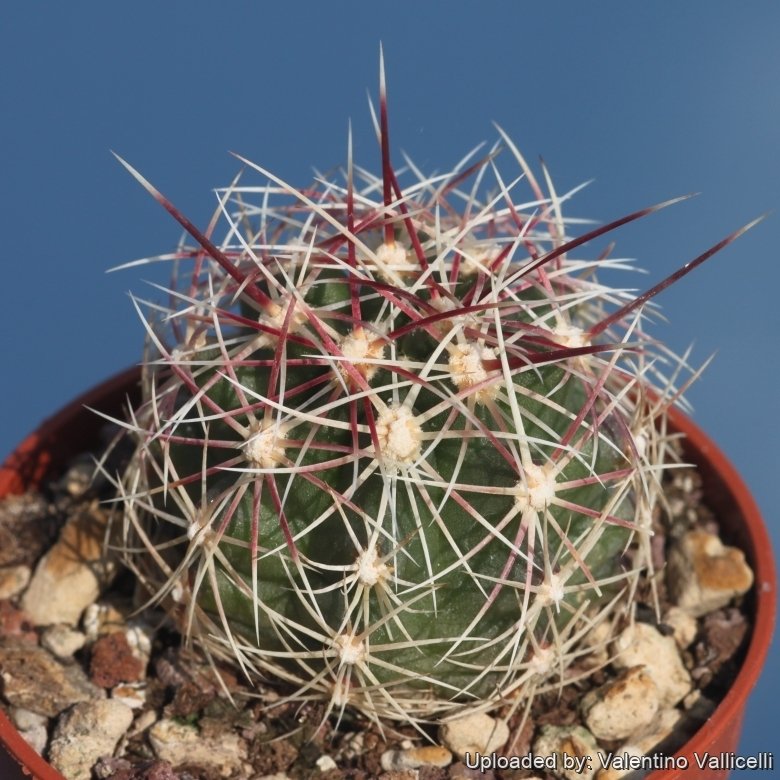
Publication: Bull. Torrey Bot. Club 49: 251. 1922
Description
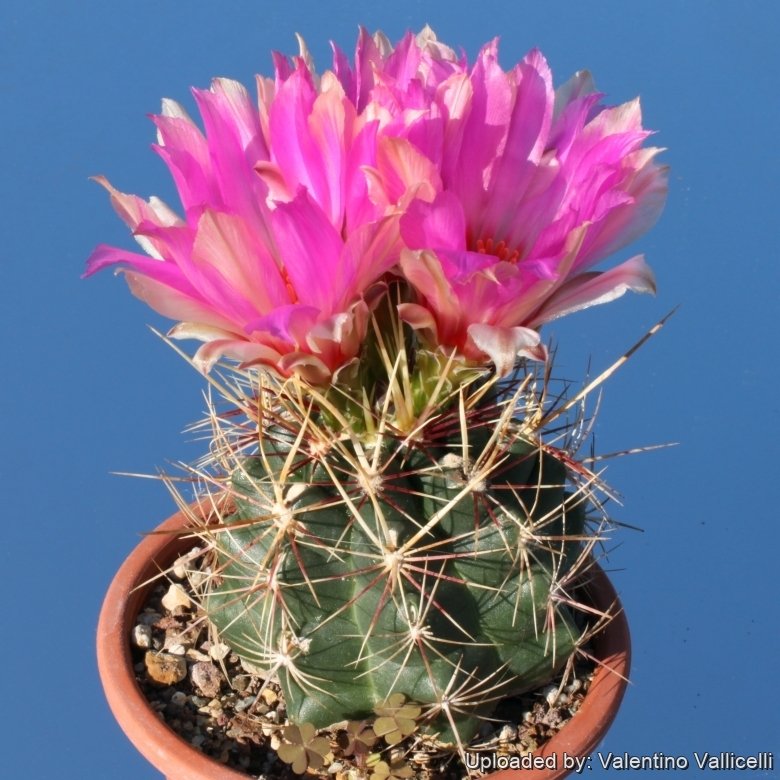
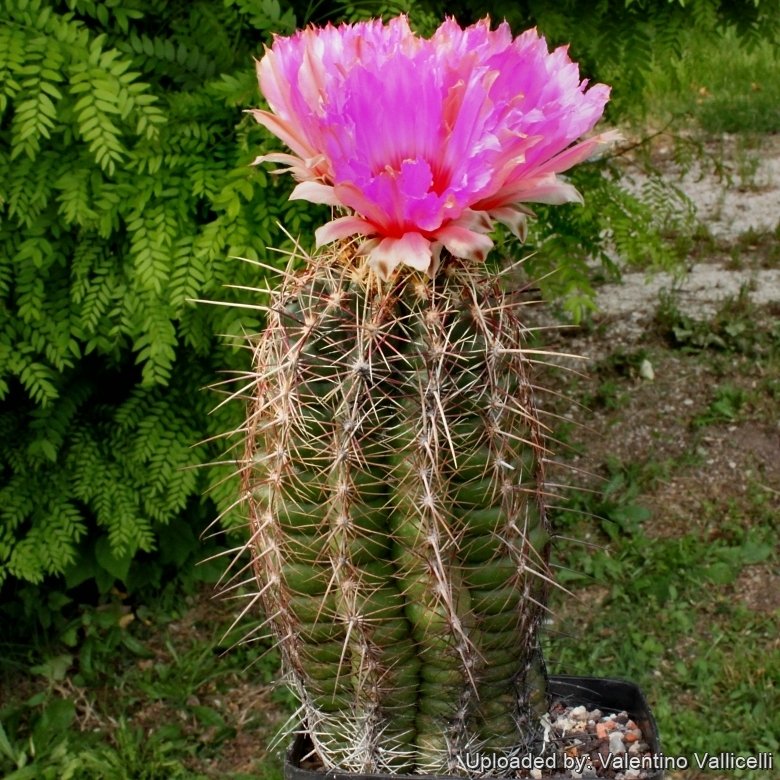
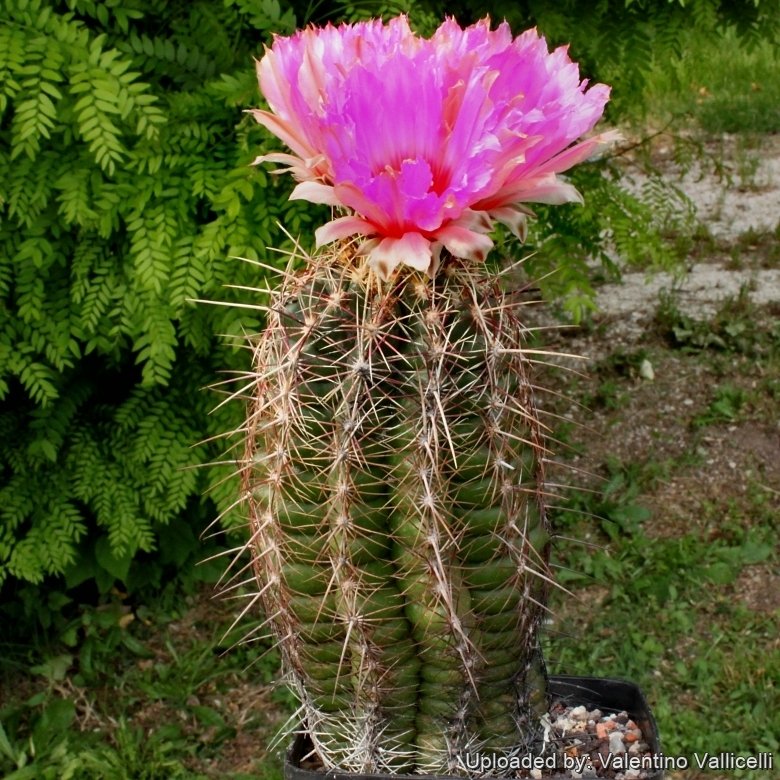
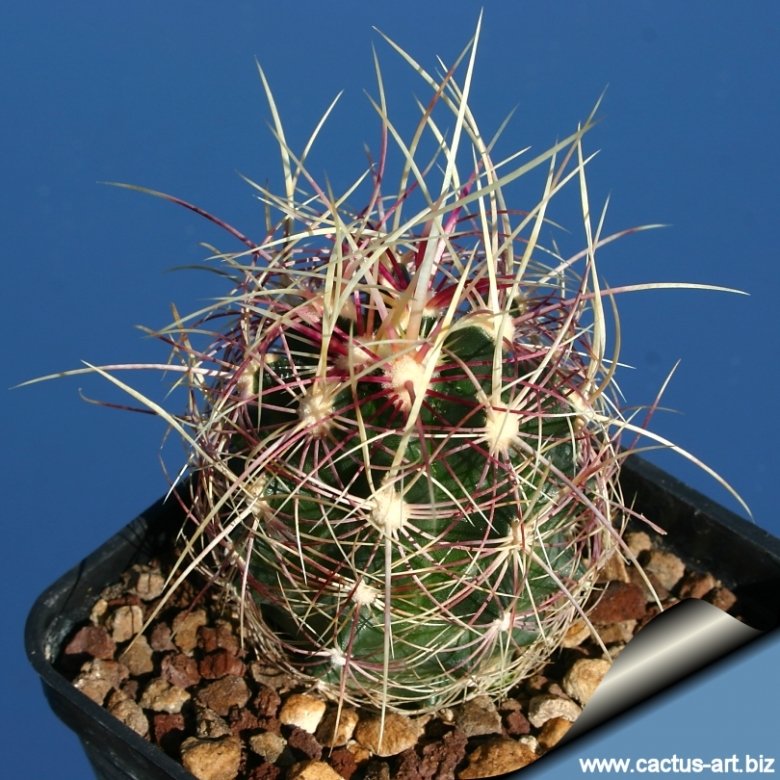
Globular usually solitary cacti up to 10 cm in diameter.
Stem: Ovoidal, 8-20 cm tall, 5-12 cm wide.
Ribs: 8, distinct.
Tubercles: Rounded.
Areoles: With glands.
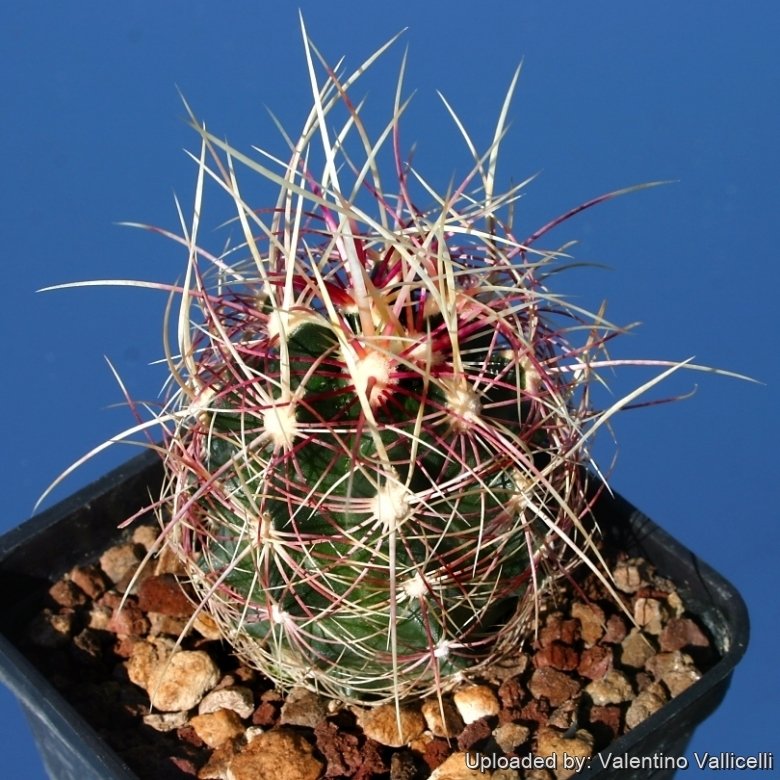
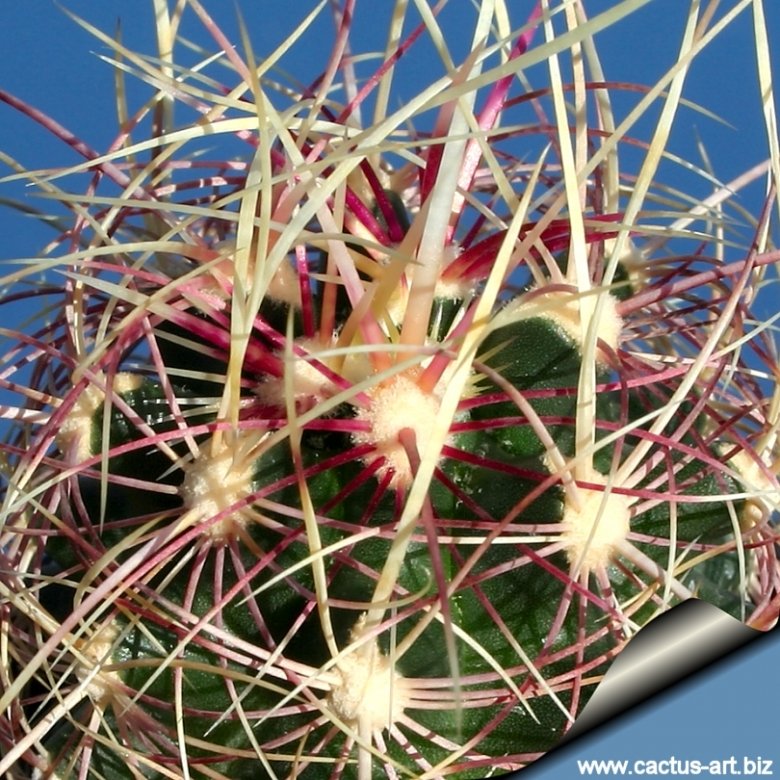
Central spines: 3-4, 15-75 mm long, ochre to reddish, straight, acicular or slightly bent inwards.
Radial spines: 8-18, 10-30 mm long, ochre to reddish, straight, acicular.
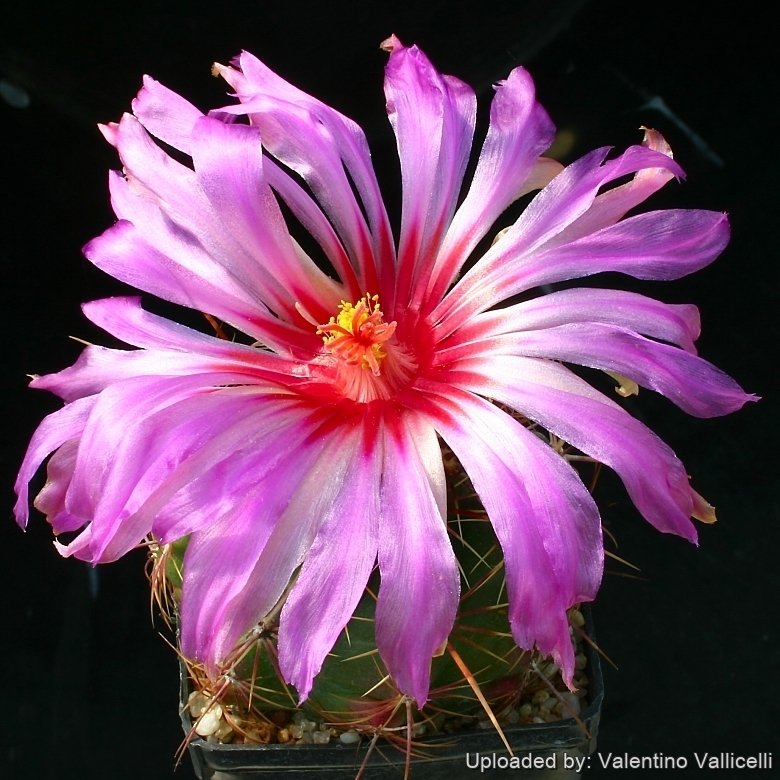
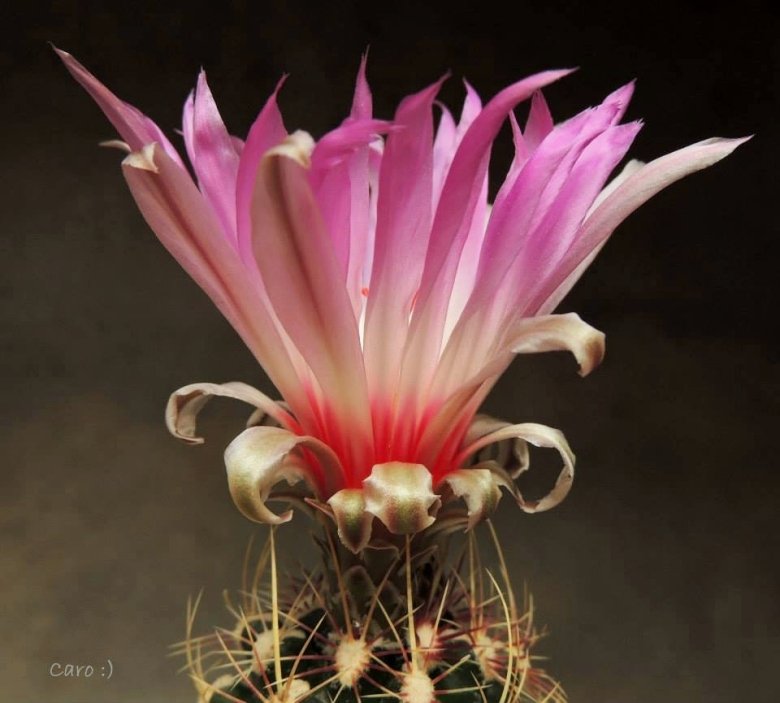
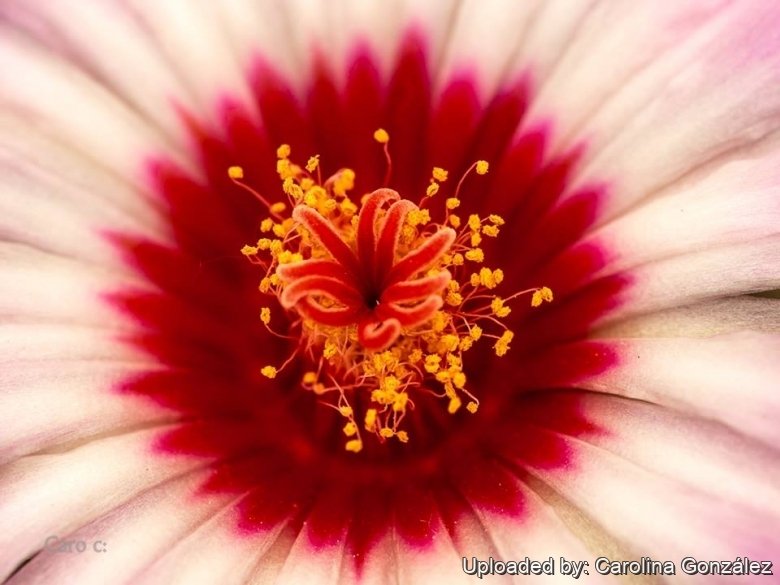
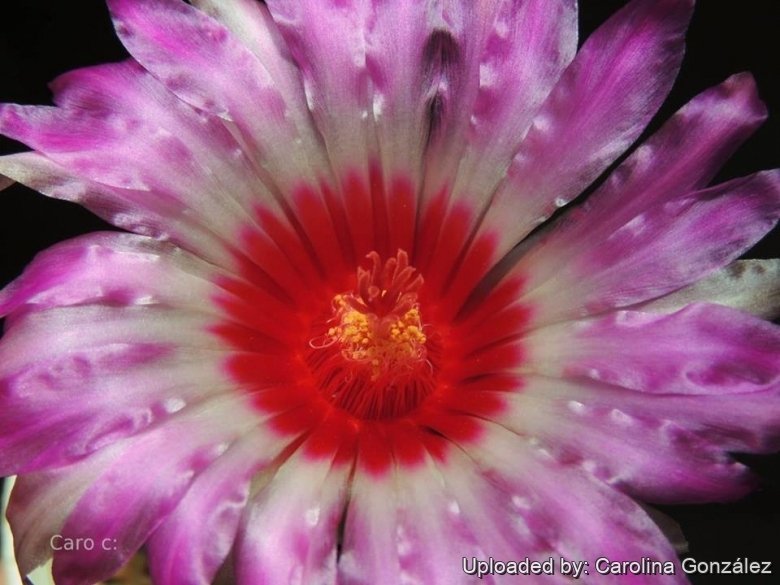
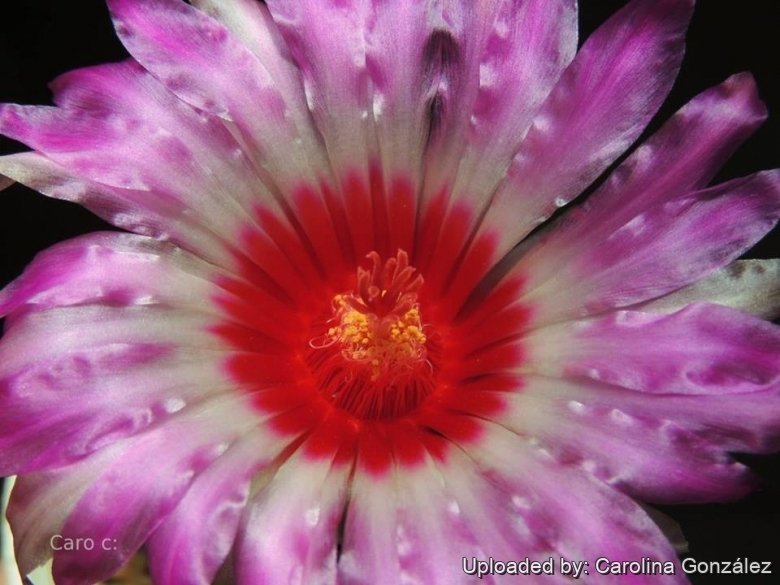
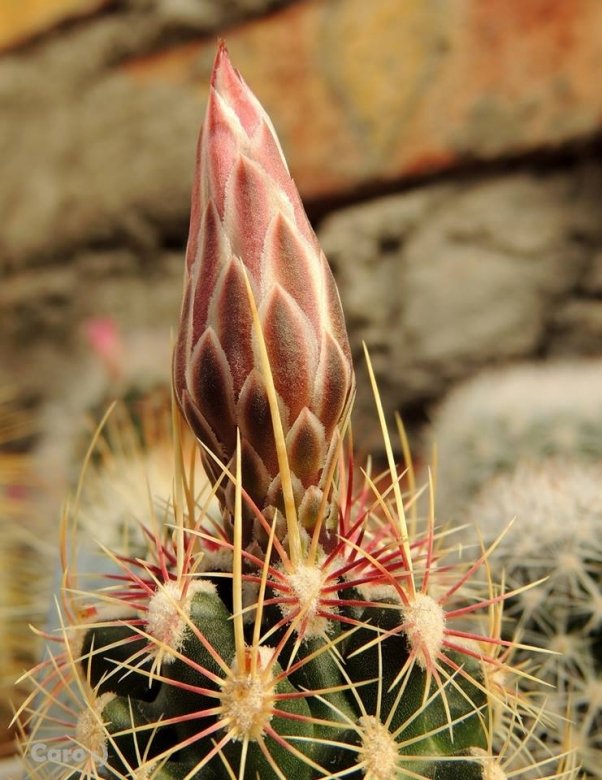
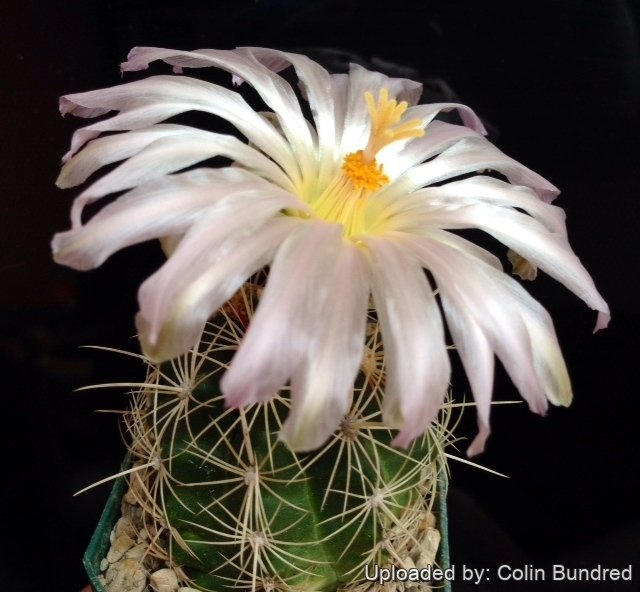
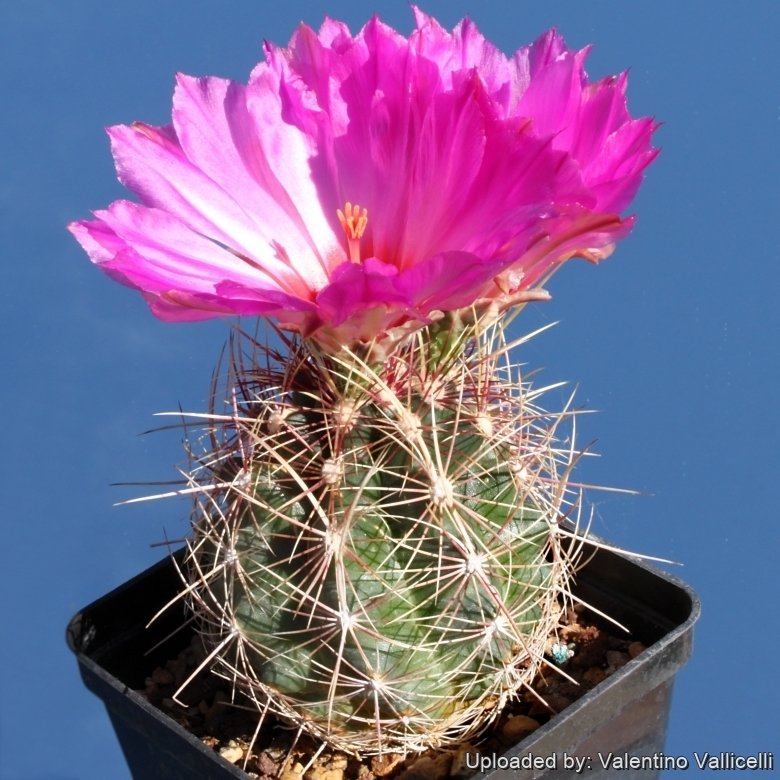
Flowers: 55-110 mm wide, magenta with a red throat from early spring to autumn.
Remarks: This Taxon has lots of synonyms ( like many other cacti) whit several controversial varieties and subspecies and comprises a multitude of different forms, but where each form is linked to others by populations of plants with intermediate characteristics. Five subspecies are recognized, the nominate form, subsp. bolaensis (Runge) Doweld, subsp.,flavidispinus (Backeb.) N.P.Taylor, subsp. heterochromus (F.A.C.Weber) Mosco & Zanov. and subsp. schwarzii (Backeb.) N.P.Taylor.
Origin and Habitat
Thelocactus bicolor has a very large range in the northern Chihuahuan desert in USA (Texas) and Mexico(Chihuahua, Coahuila, Durango, Nuevo León, San Luis Potosí, Tamaulipas, Zacatecas).
Altitude: 800-2200 metres above sea level.
Habitat: Occurring in mattoral xerofilo together with Larrea tridentata, Fouquieria splendens, Jatropha spathulata, Agave lechuguilla and Yucca thompsoniana on flat gravelly soils, limestone or sandstone slopes of hills or outcrops and alluvial fans in desert or grassland. (The extensive distribution range of this species has led to the formation of many local forms which in the years have been formally named. Most of these names are not accepted by many botanists that treat them as synonyms, but they still have a value for a collector because they identify plants with particular characters). It is abundant, and there are no major threats to this species. In the same area it is possible to find several cactus species like: Echinocactus horizonthalonius, Homalocephala texensis, Coryphantha echinus, Coryphantha runyonii, Coryphantha valida, Coryphantha scherii, Mammillaria pottsii, Mammillaria formosa, Mammillaria grusonii, Mammillaria chica, Echinocereus pectinatus, Echinocereus stramineus, Echinocereus conglomeratus, Echinocereus merkeri, Thelocactus conothelos v. argenteus, Gladulicactus uncinatus, Grusonia bradtiana, Opuntia imbricata, Epithelantha micromeris v. gregii, Gymnocactus beguinii, Echinomastus unguispinus, Lophophora williamsii, Escobaria duncanii, Leuchtenbergia principis, Astrophytum senile, Hamatocactus hamatacanthus and Neolloydia conoidea.
Cultivation and Propagation
Thelocactus bicolor is a summer grower species easy to cultivate, more cold tolerant than most and less fussy regarding soil conditions.
Growth rate: It is a relatively rapidly growing and easily flowering species that will make clumps given the best conditions.
Soils: It likes very porous standard cactus mix soil, but can become too elongated if compost is too rich.
Repotting: Use pot with good drainage.
Watering: Water regularly from Spring to Autumn, but do not overwater(Rot prone), keep dry in winter.
Fertilization: Feed with a high potassium fertilizer in summer.
Hardiness: Reputedly somewhat resistant to frost if kept on the dry side prior to, and during, cold weather (hardy to -7 C ° C, or less for short periods).
Exposition: Requires full sun or light shade and careful watering to keep plant compact with strong coloured spines. Tends to bronze in strong light, which encourages flowering and heavy spine production.
Uses: It is an excellent plant for container growing. It always looks good and stays small. It look fine in a cold greenhouse and frame or outdoor in a rockery.
Pests & diseases: It may be attractive to a variety of insects, but plants in good condition should be nearly pest-free, particularly if they are grown in a mineral potting-mix, with good exposure and ventilation. Nonetheless, there are several pests to watch for:
- Red spiders: Red spiders may be effectively rubbed up by watering the infested plants from above.
- Mealy bugs: Mealy bugs occasionally develop aerial into the new growth among the wool with disfiguring results, but the worst types develop underground on the roots and are invisible except by their effects.
- Sciara Flies: Sciara flies are one of the major problems for seedlings. It is a good practice to mulch your seedlings with a layer of grit, which will strongly discourage the flies.
- Scales: Scales are rarely a problem.
It is wise to treat your whole collection with a systemic insecticide twice a year in spring and autumn.
- Rot: Rot is only a minor problem with cacti if the plants are watered and “aired” correctly. If they are not, fungicides won’t help all that much.
Propagation: From seed, since the plant rarely produces plantlets.. Seeds germinate in 7-14 days at 21-27° C in spring, remove gradually the glass cover as soon the plants will be well rooted (ca 1-2 weeks) and keep ventilated, no full sun for young plants!
Bibliography
Major references and further lectures
-
Edward Anderson “The Cactus family” Timber Press, Incorporated, 2001
-
Goettsch, B.K., Heil, K., Terry, M. & Corral-Díaz, R. 2013. Thelocactus bicolor. In: IUCN 2013. “IUCN Red List of Threatened Species.” Version 2013.2. <www.iucnredlist.org>. Downloaded on 11 January 2014.
-
James Cullen, Sabina G. Knees, H. Suzanne Cubey “The European Garden Flora Flowering Plants: A Manual for the Identification of Plants Cultivated in Europe, Both Out-of-Doors and Under Glass” Cambridge University Press, 11/Aug/2011
-
David R Hunt; Nigel P Taylor; Graham Charles; International Cactaceae Systematics Group. “The New Cactus Lexicon” dh books, 2006
-
Nathaniel Lord Britton, Joseph Nelson Rose “Cactaceae: Descriptions and Illustrations of Plants of the Cactus Family” Courier Dover Publications, 1963
-
Del Weniger “Cacti of the Southwest: Texas, New Mexico, Oklahoma, Arkansas, and Louisiana” University of Texas Press, 1969
From llifle page Echinocactus bicolor var. schottii
Description
Thelocactus bicolor var. schottii distinguishes from the standard Thelocactus bicolor for its very long, papery upper spine, all the other characteristics namely size of stems, flowers, fruits, roots etc. clearly show that they are conspecific.
Habit: it is a globular usually solitary cactus.
Stem: Globose, ovoidal or slightly pyramidal, 8-20 cm tall, 5-12 cm wide.
Ribs: 8, distinct.
Tubercles: Rounded.
Areoles: With glands.
Central spines: 3-4, 15-75 mm long, ochre to reddish, straight, acicular, the upper one very long, somewhat flattened and papery.
Radial spines: 8-18, 10-30 mm long, ochre to reddish, straight or slightly bent inwards, acicular.
Flowers: 55-110 mm wide, magenta with a red throat.
Blooming season: Early spring to autumn.
Origin and Habitat
Big Bend area, Texas, USA
Cultivation and Propagation
Thelocactus bicolor is a summer grower species easy to cultivate, more cold tolerant than most and less fussy regarding soil conditions.
Growth rate: It is a relatively rapidly growing and easily flowering species that will make clumps given the best conditions.
Soils: It likes very porous standard cactus mix soil, but can become too elongated if compost is too rich.
Repotting: Use pot with good drainage.
Watering: Water regularly from Spring to Autumn, but do not overwater(Rot prone), keep dry in winter.
Fertilization: Feed with a high potassium fertilizer in summer.
Hardiness: Reputedly somewhat resistant to frost if kept on the dry side prior to, and during, cold weather (hardy to -7 C ° C, or less for short periods).
Exposition: Requires full sun or light shade and careful watering to keep plant compact with strong coloured spines. Tends to bronze in strong light, which encourages flowering and heavy spine production.
Uses: It is an excellent plant for container growing. It always looks good and stays small. It look fine in a cold greenhouse and frame or outdoor in a rockery.
Pests & diseases: It may be attractive to a variety of insects, but plants in good condition should be nearly pest-free, particularly if they are grown in a mineral potting-mix, with good exposure and ventilation. Nonetheless, there are several pests to watch for:
- Red spiders: Red sopiders may be effectively rubbed up by watering the infested plants from above.
- Mealy bugs: Mealy bugs occasionally develop aerial into the new growth among the wool with disfiguring results, but the worst types develop underground on the roots and are invisible except by their effects.
- Sciara Flies: Sciara flies are one of the major problems for seedlings. It is a good practice to mulch your seedlings with a layer of grit, which will strongly discourage the flies.
- Scales: Scales are rarely a problem.
It is wise to treat your whole collection with a systemic insecticide twice a year in spring and autumn.
- Rot: Rot is only a minor problem with cacti if the plants are watered and “aired” correctly. If they are not, fungicides won’t help all that much.
Propagation: From seed, since the plant rarely produces plantlets. Seeds germinate in 7-14 days at 21-27° C in spring, remove gradually the glass cover as soon the plants will be well rooted (ca 1-2 weeks) and keep ventilated, no full sun for young plants!
Bibliography
Major references and further lectures
-
Edward F. Anderson “The Cactus Family” Timber Press, 2001
-
Curt Backeberg “Cactus Lexicon” Sterling Publishing Company, Incorporated, 1978
-
David Hunt, Nigel Taylor “The New Cactus Lexicon” DH Books, 2006 ISBN 0953813444, 9780953813445
-
James Cullen, Sabina G. Knees, H. Suzanne Cubey “The European Garden Flora Flowering Plants: A Manual for the Identification of Plants Cultivated in Europe, Both Out-of-Doors and Under Glass” Cambridge University Press, 11/Aug./2011
Source: Echinocactus bicolor var. schottii, LLIFLE - Encyclopedia of living forms, CC-BY-SA, retrieved 2026-10-25.
From llifle page Echinocactus bicolor var. tricolor
Description
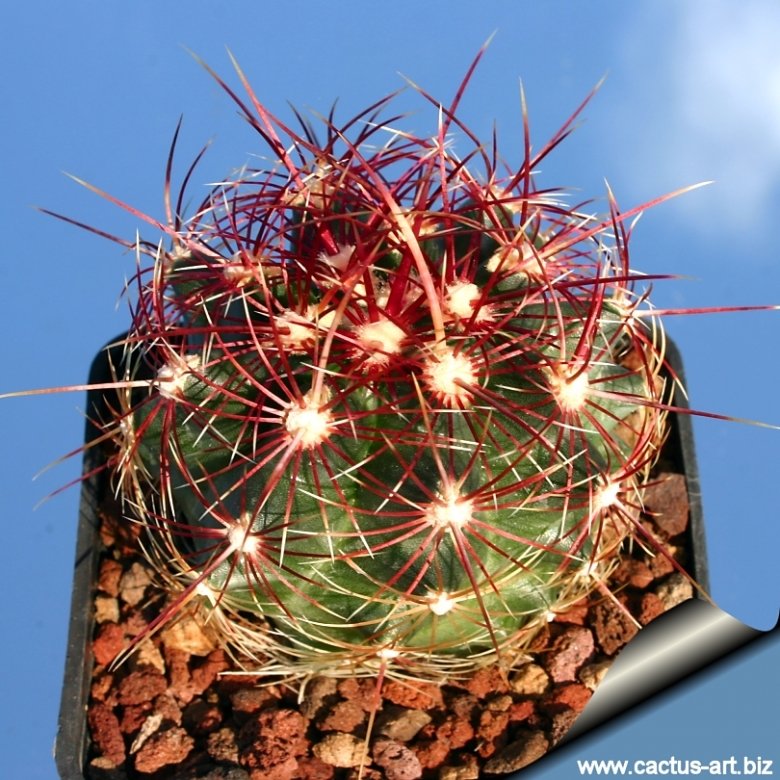
Thelocactus bicolor are globular usually solitary cacti up to 10 cm in diameter. The var. tricolor is a densely spiny form with bright red and white spines.
Stem: Ovoidal, 8-20 cm tall, 5-12 cm wide.
Ribs: 8, distinct. Tubercles rounded. Areoles with glands.
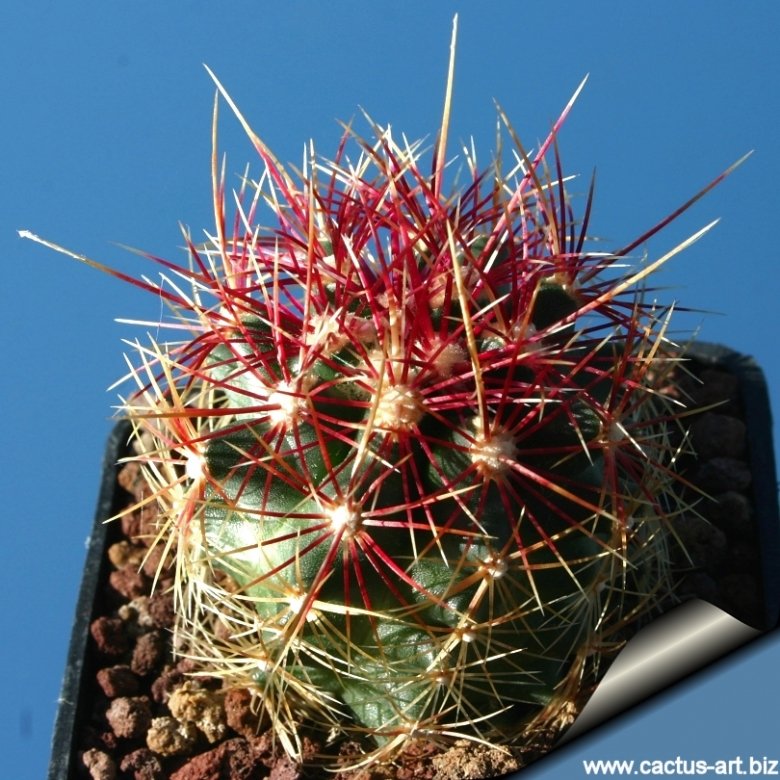
Spines: Centrals 3-4, 15-75 mm long, reddish to bright purple, straight, acicular. Radials 8-18, 10-30 mm long, white to reddish, straight, acicular.
Flowers: 55-110 mm wide, magenta with a red throat from early spring to autumn.
Remarks: Thelocactus bicolor has lots of synonyms (like many other cacti) whit several controversial varieties and subspecies and comprises a multitude of different forms and ecotypes, but where each form is linked to others by populations of plants with intermediate characteristics
Origin and Habitat
Saltillo, Coahuila (Mexico).
Cultivation and Propagation
Thelocactus bicolor is a summer grower species easy to cultivate, more cold tolerant than most and less fussy regarding soil conditions.
Growth rate: It is a relatively rapidly growing and easily flowering species that will make clumps given the best conditions.
Soils: It likes very porous standard cactus mix soil, but can become too elongated if compost is too rich.
Repotting: Use pot with good drainage.
Watering: Water regularly from Spring to Autumn, but do not overwater(Rot prone), keep dry in winter.
Fertilization: Feed with a high potassium fertilizer in summer.
Hardiness: Reputedly somewhat resistant to frost if kept on the dry side prior to, and during, cold weather (hardy to -7 C ° C, or less for short periods).
Exposition: Requires full sun or light shade and careful watering to keep plant compact with strong coloured spines. Tends to bronze in strong light, which encourages flowering and heavy spine production.
Uses: It is an excellent plant for container growing. It always looks good and stays small. It look fine in a cold greenhouse and frame or outdoor in a rockery.
Pests & diseases: It may be attractive to a variety of insects, but plants in good condition should be nearly pest-free, particularly if they are grown in a mineral potting-mix, with good exposure and ventilation. Nonetheless, there are several pests to watch for:
- Red spiders: Red sopiders may be effectively rubbed up by watering the infested plants from above.
- Mealy bugs: Mealy bugs occasionally develop aerial into the new growth among the wool with disfiguring results, but the worst types develop underground on the roots and are invisible except by their effects.
- Sciara Flies: Sciara flies are one of the major problems for seedlings. It is a good practice to mulch your seedlings with a layer of grit, which will strongly discourage the flies.
- Scales: Scales are rarely a problem.
- Rot: Rot is only a minor problem with cacti if the plants are watered and “aired” correctly. If they are not, fungicides won’t help all that much.
Propagation: From seed, since the plant rarely produces plantlets. Seeds germinate in 7-14 days at 21-27° C in spring, remove gradually the glass cover as soon the plants will be well rooted (ca 1-2 weeks) and keep ventilated, no full sun for young plants!
Bibliography
Major references and further lectures
-
David Hunt, Nigel Taylor “The New Cactus Lexicon” DH Books, 2006
-
Edward F. Anderson “The Cactus Family” Timber Press, 2001
-
Nathaniel Lord Britton, Joseph Nelson Rose “Cactaceae: Descriptions and Illustrations of Plants of the Cactus Family” Courier Dover Publications, 1963
Source: Echinocactus bicolor var. tricolor, LLIFLE - Encyclopedia of living forms, CC-BY-SA, retrieved 2026-10-25.
Cultivars and forms (18)
Subspecies (6)
Varieties (10)
- Thelocactus bicolor var. bolaensis
- Thelocactus bicolor var. bolansis
- Thelocactus bicolor var. commodus
- Thelocactus bicolor var. flavidispinus
- Thelocactus bicolor var. pottsii
- Thelocactus bicolor var. schottii
- Thelocactus bicolor var. schwarzii
- Thelocactus bicolor var. texensis
- Thelocactus bicolor var. tricolor
- Thelocactus bicolor var. wagnerianus
Gallery